

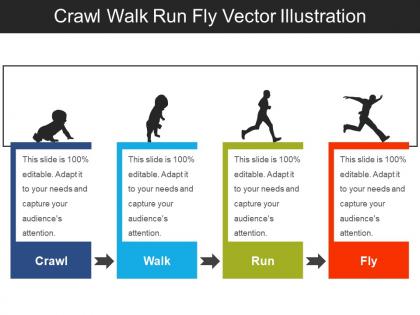
Crawl walk run fly vector illustration




Try Before you Buy Download Free Sample Product
 Impress Your
 Audience
 100%
100% Editable
 Save Hours
 of Time


Caution folks about avoiding dangerous actions with our Crawl Walk Run Fly Vector Illustration. Identify those that can injure them.
People who downloaded this PowerPoint presentation also viewed the following :
Crawl walk run fly vector illustration with all 5 slides:
Identify insidious diseases with our Crawl Walk Run Fly Vector Illustration. Inform folks on how to detect them.

FAQs for Crawl walk run
So basically you've got four main stages: self-awareness, skill building, application, and reflection. First step is honestly figuring out what you actually want to improve - and trust me, this trips up way more people than you'd think because we're terrible at self-assessment. Then you learn new skills or knowledge. After that comes the fun part (sarcasm intended) - trying to apply everything in real situations where nothing goes according to plan. Finally, you reflect on what worked and what was a disaster. But here's the thing: it's not linear at all. You'll cycle through these stages over and over. Pick one specific area and be brutally honest about where you're starting from.
So basically, "progress" means the same thing everywhere - just moving forward bit by bit. But how you actually measure it? Totally different depending on what you're doing. Education tracks test scores and skill development. Business people are obsessed with revenue and quarterly growth (which honestly gets exhausting). Health is all about fitness goals or recovery milestones. The tricky part is figuring out what "moving forward" actually looks like in YOUR situation first. Otherwise you're just measuring random stuff that doesn't matter.
Dude, progress bars are a game changer! Seriously, I've been in so many presentations where I'm just sitting there like "are we done yet??" Your audience needs to know where they stand. Try putting a simple "slide 3 of 7" counter somewhere - it's weirdly satisfying. Timeline graphics work awesome for chronological stuff. You could also do numbered sections or those little breadcrumb things at the top. Oh, and section dividers help break up heavy content so people don't zone out. Trust me, when folks can see the roadmap ahead, they'll actually pay attention instead of mentally checking out halfway through.
Honestly, feedback is what makes teams actually get better instead of just spinning their wheels. People need to know what they're crushing and what's falling flat. The hard part? Making everyone feel safe enough to speak up - nobody wants to be the constant complainer, you know? I've found that once you get into a rhythm with regular check-ins (could be formal one-on-ones or just grabbing coffee), people start fixing things way faster. They also build off each other's wins more. My advice: start super simple. Just ask your team "what worked this week and what didn't?" You'd be surprised how much comes up.
Look, milestone tracking shows you what's actually moving the needle versus what's just busywork. People get pumped seeing their progress mapped out - it's like having a fitness tracker but for career growth. You'll catch problems before someone hits a wall and gets discouraged. Honestly, I've seen too many teams wing it and wonder why people stagnate. The data helps you tweak your approach as you go. Don't overthink it though - start with maybe 3-5 milestones that actually matter for your team's development. Track those consistently first, then you can get fancy later if needed.
Honestly, the worst thing you can do is cherry-pick the good stuff and ignore everything else. Don't just throw out random percentages like "we improved 15%" without explaining what you started with or why anyone should care. Real progress is messy - it's not this perfect upward line, so don't pretend it is. Also make sure you're actually comparing similar things, not mixing random metrics from different time periods (I've seen people do this and it's painful). Be upfront about the rough patches. And always answer the "so what?" question - like, why does this progress actually matter?
Oh man, this stuff gets messy fast. Some cultures are all about lifting the whole team up together - mentorship, group wins, that kind of thing. Others? Pure individual hustle and self-promotion. Then you've got totally different timelines too. Like, some people expect to see progress every quarter, while others are thinking years ahead. Communication styles throw another wrench in it - I swear, hierarchy expectations alone can make your head spin. Best bet is just talking to each person directly about what they actually want instead of guessing everyone's on the same page.
Gantt charts are your best bet for project timelines - Asana and Monday work well, or just use Excel if you're keeping it simple. Progress bars are weirdly motivating for skill tracking, trust me on this one. Burndown charts are underrated too. Tableau's great if you need fancy dashboards, but honestly? Start with whatever you already have before dropping money on new tools. Oh, and milestone maps are clutch for learning paths - they make everything feel more achievable when you can see the steps laid out.
Make it a journey with clear before/after moments - that's what hooks people. Sarah went from barely finishing one module to crushing entire courses sounds way better than "completion rates up 40%." Nobody cares about charts tbh. Show the struggle first, then the turning point, then boom - the transformation. Real names help tons when you can use them. I mean, we're wired for stories, not spreadsheets. Focus on the human stuff behind your numbers. What obstacles did they actually face? That's where the good content lives.
Tech stuff actually makes projects way smoother. Real-time dashboards show you where things get stuck, and automated workflows keep everything moving without you having to babysit every handoff. Gantt charts are clutch for spotting delays early - honestly saved my butt so many times. AI scheduling can predict when you'll have resource conflicts too, which is pretty wild. Just don't pick tools that'll mess up your current setup. I learned that the hard way with this overly complicated system my old boss insisted on.
Pick 3-5 metrics that actually connect to what you're trying to achieve. Milestone completion and timeline stuff are obvious ones. Budget variance matters most though - leadership cares way more about money than anything else, honestly. I like mixing leading indicators (training hours) with lagging ones (actual revenue). Make your KPIs specific and time-bound - "boost customer retention 15% by June" beats some vague "improve satisfaction" nonsense. Oh, and don't build some elaborate dashboard nobody will use. Keep it simple so your team actually checks it weekly. Resource utilization's worth tracking too if you're managing a bigger team.
Honestly, growth mindset is a game-changer for learning stuff. Instead of thinking "I suck at math" or whatever, you tell yourself "I don't get this yet." Sounds cheesy but it works. People with fixed mindsets hit roadblocks and just quit - they assume they're not wired for it. But when you believe skills can improve with practice, you actually stick with hard things longer. Each mistake becomes useful info instead of proof you're hopeless. My sister used to hate coding until she started doing this. Try switching your self-talk from "I can't" to "I can't yet" and see what happens.
People basically need three things: autonomy, mastery, and purpose. They want to choose their path, get better at meaningful stuff, and work toward goals that actually matter. Progress visibility is everything though - without clear milestones, even real progress feels invisible and super demotivating. I'm totally guilty of this next part: don't overwhelm people with too many goals at once. Small wins build momentum way better. Celebrate those moments! Also make sure your team can actually connect their daily grind to the bigger picture. That connection is honestly what separates engaged teams from burned-out ones.
Honestly, case studies are so much better than those generic "10 steps to success" articles. You get to see actual paths people took - like that software engineer who went from junior dev to CTO, or the nurse who ended up running a whole hospital. The patterns are pretty clear once you look: successful people grab stretch projects, network outside their immediate circle, and yeah, they're not scared to jump companies when it makes sense. I'd find some in your field specifically and just map out what moves they made. Way more realistic than abstract advice, if you ask me.
Look, you can't really have one without the other. Creative thinking is what pushes you past those annoying roadblocks at work. The more you grow, the braver you get about trying weird ideas that might actually work. It's this whole cycle thing - progress makes you confident enough to experiment, then those experiments speed up your growth even more. Honestly, some of my best career moves came from random creative solutions I never would've tried when I first started. Maybe track one new idea you try each month? You'll be surprised how much it moves the needle forward.
-
Amazing product with appealing content and design.
-
It saves your time and decrease your efforts in half.