

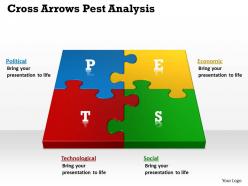
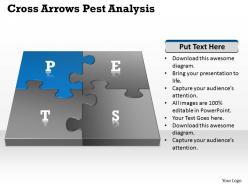
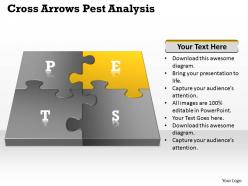
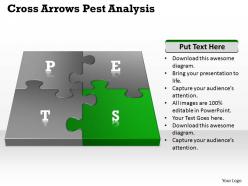
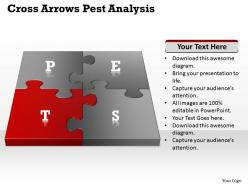
Cross arrows pest analysis





Try Before you Buy Download Free Sample Product
 Impress Your
 Audience
 100%
100% Editable
 Save Hours
 of Time


Raise the hopes of your team with our Cross Arrows Pest Analysis. They will get closer to believing in your ideas.
People who downloaded this PowerPoint presentation also viewed the following :
Cross arrows pest analysis with all 10 slides:
Be early off the blocks with our Cross Arrows Pest Analysis. Get in the lead from the word go.

FAQs for Cross
Cross Arrows PEST Analysis originated as an enhanced strategic planning framework that combines traditional PEST factors (Political, Economic, Social, Technological) with directional arrows showing interconnections and impacts between these elements. This visual approach enables organizations to better understand how external factors influence each other, ultimately delivering more comprehensive strategic insights and helping businesses anticipate cascading effects across multiple environmental dimensions.
Cross Arrows PEST Analysis enhances traditional PEST by incorporating dynamic interconnections between Political, Economic, Social, and Technological factors through visual arrows showing cause-and-effect relationships. While traditional PEST examines factors in isolation, this approach reveals how economic shifts influence political decisions, or how technological advances drive social changes, ultimately delivering deeper strategic insights and more comprehensive risk assessment for organizations navigating complex market environments.
Cross Arrows PEST Analysis proves particularly beneficial when businesses face complex market transitions, regulatory changes, or expansion decisions across multiple regions. This enhanced framework enables organizations to identify interconnected factors between political, economic, social, and technological elements, with companies in healthcare, financial services, and manufacturing finding that these cross-connections reveal strategic opportunities and competitive advantages.
Cross Arrows PEST Analysis incorporates political, economic, social, technological factors with interconnected relationship mapping, stakeholder impact assessment, dynamic trend analysis, and strategic implications evaluation. This framework enables organizations to examine how external factors influence each other and business operations simultaneously, with many strategic planners finding that cross-referencing elements delivers deeper insights and more comprehensive competitive positioning strategies.
Organizations effectively visualize Cross Arrows PEST Analysis findings through comprehensive matrix diagrams, interactive dashboards, color-coded impact mapping, stakeholder presentation formats, and strategic timeline visualizations. These visualization methods streamline complex political, economic, social, and technological interconnections, enabling leadership teams across industries like healthcare, financial services, and manufacturing to identify strategic opportunities, ultimately delivering enhanced decision-making capabilities and competitive advantage.
Cross-functional collaboration ensures comprehensive Cross Arrows Pest Analysis by integrating diverse departmental perspectives, expertise, and insights across political, economic, social, and technological factors. Teams from marketing, finance, operations, and strategy contribute specialized knowledge, identifying interconnected risks and opportunities that single departments might overlook, ultimately delivering more accurate strategic assessments and robust business planning.
Digital tools enhance Cross Arrows Pest Analysis effectiveness by automating data collection, enabling real-time updates, and facilitating collaborative analysis across teams. These platforms streamline environmental scanning through AI-powered trend identification, interactive visualization dashboards, and integrated scenario modeling, with many strategic planning teams finding that digital frameworks accelerate insights while improving accuracy and stakeholder engagement.
Industries with complex regulatory environments and dynamic market conditions see the most success with Cross Arrows PEST Analysis, including financial services, healthcare, telecommunications, energy, and pharmaceuticals. These sectors benefit from the framework's ability to map interconnected political, economic, social, and technological factors, with many organizations finding that cross-factor analysis delivers enhanced strategic planning and improved risk management in increasingly volatile business landscapes.
Cross Arrows Pest Analysis helps anticipate market trends by systematically examining Political, Economic, Social, and Technological factors while identifying their interconnections and directional impacts on business environments. This strategic framework enables organizations to recognize emerging patterns, assess regulatory shifts, and evaluate consumer behavior changes, ultimately delivering enhanced forecasting accuracy and competitive positioning in increasingly dynamic markets.
Common pitfalls include oversimplifying complex interconnections between factors, focusing only on obvious relationships while missing subtle dependencies, and failing to quantify the strength of cross-impacts. Organizations often struggle with data quality issues, insufficient stakeholder input, and static analysis that doesn't account for changing dynamics, with many finding that regular updates and diverse perspectives ultimately deliver more accurate strategic insights.
Cross Arrows PEST Analysis informs strategic decision-making by revealing interconnections between political, economic, social, and technological factors, enabling leaders to identify emerging opportunities, anticipate regulatory shifts, and assess market vulnerabilities. These comprehensive insights help organizations develop adaptive strategies, allocate resources more effectively, and build competitive advantages by understanding how external forces collectively impact business environments.
When designing a Cross Arrows PEST Analysis presentation, consider visual clarity through directional arrows connecting political, economic, social, and technological factors, comprehensive data integration, stakeholder-specific insights, and interactive elements for audience engagement. These design elements enhance strategic communication by streamlining complex interconnections, facilitating collaborative discussions, and ultimately delivering actionable business intelligence that enables organizations to navigate market complexities with greater strategic precision.
Cross Arrows PEST Analysis supports risk management by identifying interconnected external threats across political, economic, social, and technological factors while mapping their relationships and potential cascading effects. This comprehensive approach enables organizations to develop proactive mitigation strategies, anticipate market disruptions, and create contingency plans, with many financial services and manufacturing companies finding enhanced preparedness and strategic resilience.
Cross Arrows PEST Analysis findings translate into actionable initiatives through strategic prioritization, resource allocation, and targeted response planning across identified political, economic, social, and technological factors. Organizations leverage these insights to develop specific mitigation strategies, capitalize on emerging opportunities, and align operational decisions with external environment shifts, ultimately enabling proactive adaptation, competitive positioning, and sustainable growth in an increasingly dynamic business landscape.
Cultural context significantly influences Cross Arrows Pest Analysis outcomes by shaping how political regulations, economic conditions, social behaviors, and technological adoption interact within specific markets. Organizations operating across different regions find that cultural values affect consumer preferences, regulatory compliance expectations, and business relationship dynamics, ultimately requiring localized strategic approaches that account for cultural nuances to deliver competitive advantage.
-
Use of different colors is good. It's simple and attractive.
-
Professional and unique presentations.