


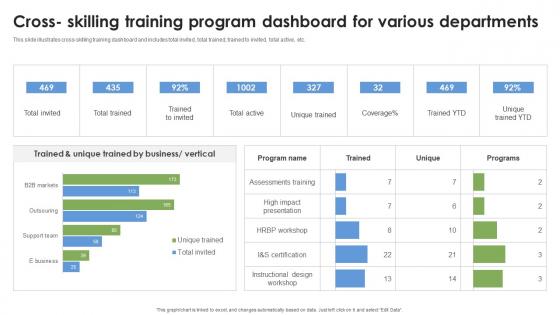
Cross Skilling Training Program Dashboard For Various Departments




Try Before you Buy Download Free Sample Product
 Impress Your
 Audience
 100%
100% Editable
 Save Hours
 of Time


This slide illustrates cross-skilling training dashboard and includes total invited, total trained, trained to invited, total active, etc.
People who downloaded this PowerPoint presentation also viewed the following :
Cross Skilling Training Program Dashboard For Various Departments with all 10 slides:
Use our Cross Skilling Training Program Dashboard For Various Departments to effectively help you save your valuable time. They are readymade to fit into any presentation structure.










FAQs for Cross Skilling Training Program Dashboard
Cross skilling training programs aim to develop versatile employees, reduce skill gaps, enhance operational flexibility, improve team collaboration, and increase organizational resilience. These strategic initiatives enable companies to streamline workforce deployment, minimize dependency on specialized roles, and deliver faster project completion, with many organizations finding that cross-trained teams significantly enhance productivity and competitive advantage.
Organizations effectively identify skills gaps through comprehensive skills assessments, performance reviews, employee surveys, competency mapping, and future role analysis against current capabilities. These evaluation methods enable HR teams to pinpoint specific technical and soft skill deficiencies across departments, with many companies finding that systematic gap analysis streamlines cross-skilling program design and ultimately delivers more targeted training investments and enhanced workforce adaptability.
Success metrics for cross-skilling training initiatives include skill assessment scores, employee engagement rates, internal mobility percentages, project completion times, and knowledge retention levels. Organizations typically measure training ROI through reduced hiring costs, faster project delivery, improved team collaboration, and enhanced operational flexibility, with many companies finding that cross-skilled employees demonstrate higher job satisfaction and career advancement rates.
Cross skilling contributes to employee engagement and retention by providing career development opportunities, preventing workplace monotony, and demonstrating organizational investment in individual growth. Through diverse skill acquisition, employees experience increased job satisfaction, enhanced career mobility, and greater organizational value, with many companies finding that cross-trained workforce shows significantly higher retention rates and stronger workplace commitment.
Technology serves as the backbone of modern cross-skilling programs through learning management systems, AI-powered skill assessments, virtual reality simulations, mobile learning platforms, and analytics dashboards. These digital tools streamline training delivery, personalize learning paths, and track progress across departments, with organizations in healthcare, finance, and manufacturing finding significantly faster skill development and improved workforce adaptability.
Industries that benefit most from cross skilling programs include technology, healthcare, manufacturing, financial services, and retail. These sectors leverage cross skilling by enhancing operational flexibility, reducing skill gaps, and accelerating digital transformation, with many organizations finding that diversified employee capabilities deliver improved customer experiences, reduced downtime, and stronger competitive positioning.
Cross skilling training programs can be tailored through multiple delivery methods including visual presentations, hands-on workshops, interactive simulations, peer mentoring, and self-paced digital modules. These diverse approaches enable organizations to accommodate different learning preferences while ensuring comprehensive skill transfer, with many companies finding that blended learning models significantly enhance employee engagement, knowledge retention, and ultimately accelerate cross-functional capabilities across departments.
Best practices for integrating cross skilling include conducting skills gap assessments, aligning programs with strategic objectives, creating structured learning pathways, establishing mentorship networks, and implementing progress tracking systems. These approaches streamline workforce development by leveraging existing training infrastructure, enhancing employee versatility, and building organizational resilience, with many companies finding that strategic cross skilling ultimately delivers improved operational flexibility and competitive advantage.
Mentoring and coaching enhance cross skilling effectiveness by providing personalized guidance, accelerating skill transfer, and creating structured feedback loops that address individual learning gaps. Through one-on-one support, employees in manufacturing, healthcare, and financial services develop competencies faster, retain knowledge better, and apply new skills confidently, ultimately delivering improved performance and seamless role transitions.
Organizations face challenges including resistance to change from employees comfortable in specialized roles, resource allocation for comprehensive training programs, identifying optimal skill combinations across departments, and measuring training effectiveness. While initial implementation requires significant time investment and careful curriculum design, many companies find that structured cross-skilling ultimately delivers enhanced workforce flexibility, improved collaboration, and stronger operational resilience during market transitions.
Cross skilling improves collaboration by breaking down departmental silos, fostering mutual understanding of roles and responsibilities, enhancing communication through shared knowledge bases, and creating empathy for different team challenges. When employees understand workflows across marketing, operations, finance, and customer service, they collaborate more effectively on projects, resolve conflicts faster, and ultimately deliver seamless customer experiences while driving organizational efficiency.
Employers can ensure motivation by offering clear career advancement pathways, financial incentives, flexible scheduling options, and recognition programs that celebrate skill acquisition achievements. Through strategic communication about growth opportunities and market relevance, organizations enhance employee engagement while building versatile talent pools, with many companies finding that voluntary participation rates increase significantly when cross-skilling directly connects to promotional opportunities and competitive salary adjustments.
Continuous feedback in cross skilling training ensures learners stay aligned with objectives, identify skill gaps early, and accelerate competency development across multiple domains. Through regular assessments and coaching sessions, organizations can adjust training paths dynamically, measure progress effectively, and ultimately deliver faster skill acquisition and improved employee adaptability in an increasingly versatile workforce landscape.
Organizations assess long-term cross skilling impact through comprehensive metrics including employee mobility rates, project assignment flexibility, knowledge transfer efficiency, and succession planning readiness. Through performance analytics and skills mapping, companies track reduced hiring costs, faster project delivery, and enhanced operational resilience, with many finding that cross-skilled teams deliver significantly improved adaptability and competitive advantage.
Organizations can foster continuous learning and cross-skilling through mentorship programs, collaborative project assignments, skills-based job rotations, internal knowledge-sharing sessions, and incentivized learning pathways. These strategies enhance employee engagement while building organizational resilience, with many companies finding that cross-functional teams ultimately deliver improved innovation, operational flexibility, and competitive advantage in increasingly dynamic markets.
-
“The presentation template I got from you was a very useful one.My presentation went very well and the comments were positive.Thank you for the support. Kudos to the team!”
-
SlideTeam just saved my project! Thank you so much. The variety of templates helped me showcase multiple perspectives easily.