


Culture Change Frameworks Communicate Vision And Strategy Information





Try Before you Buy Download Free Sample Product
 Impress Your
 Audience
 100%
100% Editable
 Save Hours
 of Time


Our Culture Change Frameworks Communicate Vision And Strategy Information can be extremely enchanting. Customers gazes get automatically fixed.
People who downloaded this PowerPoint presentation also viewed the following :
Content of this Powerpoint Presentation
Slide 1: This slide introduces Culture Change FRAMEWORKS. State Your Company Name and begin.
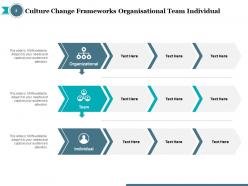
Slide 2: This slide shows Culture Change Frameworks as Organisational, Team, Individual.
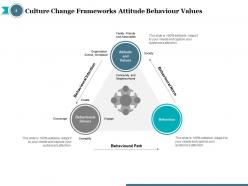
Slide 3: This slide presents Culture Change Frameworks as Attitude, Behaviour, Values.
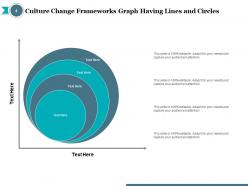
Slide 4: This slide displays Culture Change Frameworks Graph Having Lines and Circles
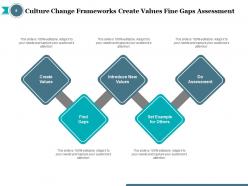
Slide 5: This slide represents Culture Change Frameworks describing- Create Values, Find Gaps, Introduce New Values, Do Assessment, Set Example for Others.
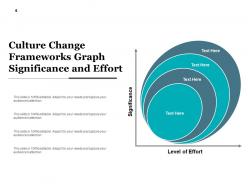
Slide 6: This slide showcases Culture Change Frameworks Graph Significance and Effort.
Slide 7: This slide shows Culture Change Framework Icon PowerPoint Slide with additional text boxes.
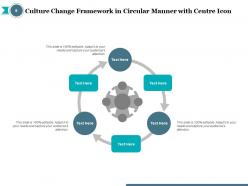
Slide 8: This slide presents Culture Change Framework in Circular Manner with Centre Icon.
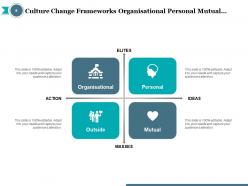
Slide 9: This slide displays Culture Change Frameworks describing- Personal, Organisational, Mutual, Outside.
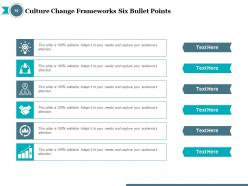
Slide 10: This slide represents Culture Change Frameworks Six Bullet Points with related icons.
Slide 11: This slide showcases Culture Change Frameworks Using Four Direction Lines.
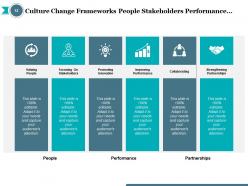
Slide 12: This slide shows Culture Change Frameworks describing- Improving Performance, Promoting Innovation, Valuing People, Focusing On Stakeholders, Strengthening Partnerships, Collaborating.
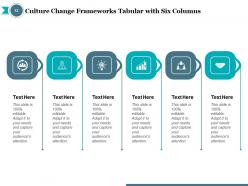
Slide 13: This slide presents Culture Change Frameworks Tabular with Six Columns and related icons.
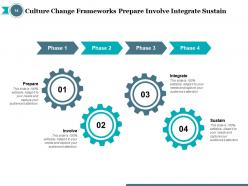
Slide 14: This slide displays Culture Change Frameworks describing- Prepare, Involve, Integrate, Sustain.
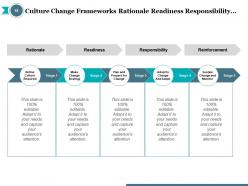
Slide 15: This slide represents Culture Change Frameworks describing- Rationale, Readiness, Responsibility, Reinforcement.
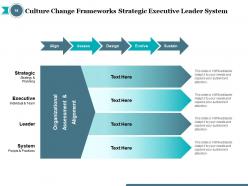
Slide 16: This slide showcases Culture Change Frameworks describing- Strategic, Executive, Leader, System.
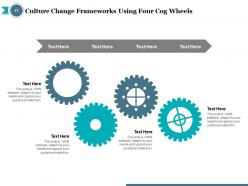
Slide 17: This slide shows Culture Change Frameworks Using Four Cog Wheels.
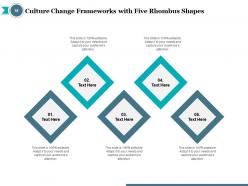
Slide 18: This slide presents Culture Change Frameworks with Five Rhombus Shapes.
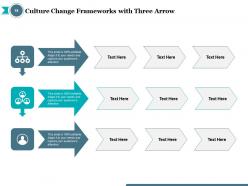
Slide 19: This slide displays Culture Change Frameworks with Three Arrow and related icons.
Slide 20: This slide represents Culture Change Frameworks Using Location Bubbles and Arrow.
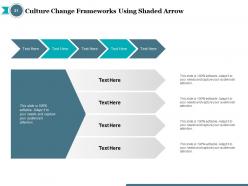
Slide 21: This slide showcases Culture Change Frameworks Using Shaded Arrow with additional text boxes.
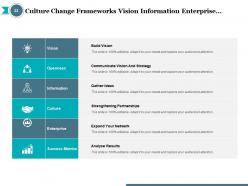
Slide 22: This slide shows Culture Change Frameworks describing- Vision, Openness, Information, Culture, Enterprise and success metrics.
Slide 23: This is a Thank you slide with address, contact numbers and email address.
Culture Change Frameworks Communicate Vision And Strategy Information with all 23 slides:
Advise folks against being boastful with our Culture Change Frameworks Communicate Vision And Strategy Information. Elaborate on the benefits of humility.



FAQs for Culture Change Frameworks Communicate Vision
Effective culture change assessment frameworks include the Organizational Culture Inventory (OCI), Denison Organizational Culture Survey, Competing Values Framework, Culture Transformation Tools, and employee engagement assessments. These frameworks streamline evaluation by measuring behavioral shifts, leadership alignment, and employee sentiment across departments, with many organizations finding that combining quantitative metrics with qualitative feedback ultimately delivers comprehensive insights and sustainable transformation outcomes.
Success in culture change initiatives is measured through employee engagement surveys, retention rates, productivity metrics, behavioral assessments, and 360-degree feedback systems. These measurement frameworks enable organizations to track shifts in workplace dynamics, communication patterns, and performance outcomes, with many companies finding that combining quantitative data with qualitative insights delivers the most comprehensive view of cultural transformation progress.
Leadership serves as the primary catalyst for culture change implementation, driving vision alignment, resource allocation, strategic communication, and behavioral modeling throughout organizations. Through consistent messaging, active participation, and transparent decision-making, leaders in sectors like healthcare and financial services enable sustainable transformation, overcome resistance, and ultimately deliver enhanced employee engagement and organizational performance.
Key stakeholders in culture change include senior leadership, middle management, HR teams, employee resource groups, and frontline staff representatives. These groups collaborate by providing strategic direction, facilitating communication, identifying cultural barriers, and championing new behaviors, with many organizations finding that cross-functional stakeholder engagement significantly accelerates transformation timelines and sustainable adoption.
Existing company values serve as foundational anchors when selecting culture change frameworks, helping identify which methodologies align with organizational DNA, leadership philosophies, and employee expectations. Companies with innovation-focused values often gravitate toward agile transformation models, while those emphasizing stability may prefer structured approaches like Kotter's framework, ultimately ensuring cultural evolution feels authentic rather than imposed.
Common challenges include resistance from employees, lack of leadership commitment, insufficient communication, unclear expectations, and competing priorities during implementation. Organizations often find that overcoming these obstacles requires consistent messaging, dedicated resources, and strategic alignment across departments, with many companies discovering that sustained executive sponsorship and transparent progress tracking ultimately deliver greater employee buy-in and successful cultural transformation.
Aligning culture change with organizational goals requires establishing clear connections between desired cultural behaviors and strategic outcomes, integrating cultural metrics into performance systems, and ensuring leadership consistently models values that support business objectives. Through strategic communication and reinforcement mechanisms, organizations streamline this alignment by embedding cultural expectations into hiring practices, performance reviews, and decision-making processes, ultimately delivering sustained behavioral change that drives competitive advantage.
Strategies include establishing quick wins, maintaining consistent leadership communication, creating feedback loops, recognizing early adopters, and embedding changes into daily processes and systems. Through regular pulse surveys and milestone celebrations, organizations can sustain engagement while addressing resistance, with many companies finding that visible leadership commitment and peer champion networks ultimately deliver lasting transformation and improved employee buy-in.
Technology facilitates culture change frameworks through digital collaboration platforms, real-time feedback systems, data analytics for measuring cultural metrics, virtual training modules, and communication tools that enhance transparency. These solutions streamline change management by enabling continuous employee engagement, tracking behavioral shifts, and delivering personalized development experiences, with many organizations finding that integrated technology accelerates cultural transformation while improving adoption rates.
**INPUT**: What case studies exemplify successful culture change using specific frameworks? **OUTPUT**: Microsoft's cultural transformation under Satya Nadella exemplifies successful framework application, shifting from competitive to collaborative mindsets through growth mindset principles, while General Electric's WorkOut methodology streamlined decision-making across divisions. These frameworks delivered measurable outcomes including improved employee engagement, faster innovation cycles, and enhanced cross-functional collaboration, with many organizations finding that structured approaches accelerate sustainable cultural evolution. **Word count: 60 words**
Organizational size significantly influences culture change model selection, with smaller companies often favoring agile, informal approaches like Appreciative Inquiry, while larger enterprises typically require structured frameworks such as Kotter's 8-Step Process or McKinsey's 7-S Model. Medium-sized organizations increasingly blend approaches, with many finding that hybrid models combining flexibility and systematic implementation deliver faster adoption and sustainable transformation across diverse teams.
Employee feedback can be integrated through regular pulse surveys, focus groups, anonymous suggestion systems, town halls, and cross-functional committees that directly inform culture initiatives. Through digital platforms and structured listening sessions, organizations streamline feedback collection, enhance transparency in decision-making, and accelerate buy-in, with many companies finding that continuous employee input ultimately delivers more sustainable culture transformations.
Critical phases in culture change frameworks include assessment and diagnosis, vision development, stakeholder engagement, implementation planning, and monitoring progress. These phases work systematically by establishing baseline culture metrics, aligning leadership around transformation goals, and cascading changes through organizational layers, with many companies finding that sustained communication and reinforcement ultimately delivers lasting behavioral shifts and competitive advantage.
Customizing culture change frameworks requires assessing organizational maturity, industry context, workforce demographics, and specific cultural challenges through comprehensive diagnostics and stakeholder feedback. Organizations typically adapt core methodologies by integrating existing values, modifying communication strategies, and aligning timelines with business cycles, with many companies finding that hybrid approaches combining multiple frameworks deliver more sustainable transformation and higher employee engagement rates.
Communication serves as the foundational element of successful culture change initiatives, enabling transparency, alignment, and employee engagement throughout the transformation process. Through strategic messaging, regular feedback loops, and multi-channel approaches, organizations streamline adoption rates, minimize resistance, and enhance overall buy-in, with many companies finding that consistent, authentic communication ultimately delivers faster cultural shifts and sustained behavioral changes.
No Reviews