


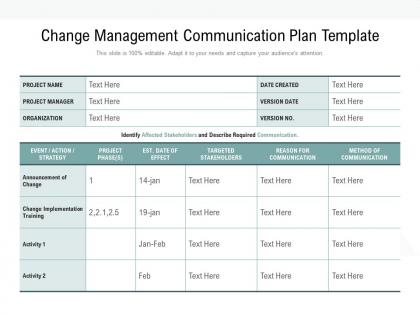
Change management communication plan template




Try Before you Buy Download Free Sample Product
 Impress Your
 Audience
 100%
100% Editable
 Save Hours
 of Time


Consent is guaranteed with our Change Management Communication Plan Template. Folks find your arguments highly convincing.
People who downloaded this PowerPoint presentation also viewed the following :
Change management communication plan template with all 2 slides:
Folks find your arguments highly convincing due to our Change Management Communication Plan Template. Getting their consent is guaranteed.
FAQs for Change management
So there's basically four main steps: prep work, talking to people, actually doing it, and making it stick. First you figure out what exactly needs changing and get the bosses on board. Communication is huge - and honestly where most companies totally blow it. People need to understand WHY this is happening or they'll just resist everything. When you're rolling things out, give tons of support and training. The last part though? That's where the real work is. You gotta keep celebrating the small wins and call out people who try sliding back to the old ways. Otherwise you're just wasting everyone's time.
Start with employee surveys and performance data - that's your foundation. Exit interviews are honestly underrated for finding real problems. Look for complaint patterns too, they're usually telling you something specific. Productivity drops or engagement scores tanking? Red flags right there. But here's the thing - numbers only tell half the story. Those random conversations with your team? Sometimes more valuable than any formal survey. Don't just ask leadership either, they're often out of touch. Your frontline people see the mess first, so check in with them regularly. Mix hard data with actual human input.
Your stakeholders can totally make or break this thing, so you've got to get them on board early. Map out who has influence and who'll be impacted most. Some will be easy wins - give those people talking points to help sell it. Others? Yeah, they're gonna need way more hand-holding. Honestly, the skeptics are sometimes your best source of intel about what could go wrong. Schedule face-to-face time with your top players this week - like 5-10 max. Don't try to boil the ocean here. Get them involved in planning and let them help communicate the why to their teams.
Honestly, it's all about meeting people where they're at. Figure out your main groups first - some folks want all the technical details, others just need the basic timeline. Frontline staff usually ask "how does this mess with my day?" while managers want the nitty-gritty implementation stuff. Don't just blast everyone with the same email either. Face-to-face sessions are clutch for dealing with pushback and worried people. Oh, and stay consistent with your main message but totally switch up how you deliver it depending on who you're talking to. Different audiences need different approaches.
Honestly, the worst part is always dealing with people who feel totally blindsided by changes. Leadership thinks they communicated but really just sent one vague email. Change fatigue is brutal too - like when your team's already drowning and then you pile more stuff on them. Oh, and unrealistic deadlines are the absolute worst. People won't get behind anything if they don't understand the "why" behind it all. Start by actually talking to your key people early on, not after you've already decided everything. Makes such a difference when they feel heard from the beginning.
Honestly, you've gotta tackle the pushback directly. Explain the "why" early - people hate being left in the dark about changes that affect them. Get them involved in planning if you can. Some of their complaints might actually be legit and save you from bigger problems later. Training helps build confidence with new stuff. But here's what really works - find those employees who are naturally influential and get them on board first. They'll do half the convincing for you. Don't try to win everyone over at once. Start with your champions and let it spread from there.
Track the obvious stuff first - adoption rates, how you're doing on timeline and budget, productivity before/during/after. But honestly? The soft metrics matter way more. Employee engagement, how much pushback you're getting, general vibe from feedback. Also retention rates and training completion. Set your baselines early or you'll have nothing to compare against later. Oh and don't go crazy with data - pick like 5-7 key things for a simple dashboard. I've seen people drown in metrics and miss what's actually happening.
Start by being the example - if you're not changing and adapting, why would they? Always explain WHY something's happening, not just what needs to happen. People hate being left in the dark about decisions that affect them. Make sure they can actually speak up about concerns without getting their heads bitten off. Oh, and don't forget to celebrate the small stuff during transitions - it keeps morale up. The biggest thing though? Get them involved in HOW changes roll out instead of just dropping announcements on them. When they help shape the process, they'll fight for it instead of against it.
Communication is everything - be super clear about what's changing and why. Don't dump all the training on them at once, that's brutal. Break it into small chunks based on their actual roles. People get weird about change anyway, so generic sessions just stress them out more. Set up practice time in small groups or pair people up for mentoring. Timing matters too - not so early they forget everything, but not last minute when everyone's freaking out. Oh and definitely keep asking how it's going. If something isn't clicking, switch it up. Your team will tell you what works if you actually listen.
Look, your org structure is basically what controls how fast change actually happens. Flat companies? They move quick because there's less bureaucracy to wade through. Hierarchical ones though - ugh, everything has to bounce up and down the ladder, which honestly takes forever. I've seen changes die in committee hell. Figure out who actually needs to sign off on stuff and find the people with real influence at each level. Once you know the flow, you can work with it instead of fighting upstream constantly.
Tech is honestly a lifesaver for change management - it keeps everyone on the same page and tracks how things are actually going. I'd start with collaboration tools to break down those annoying departmental silos, then add project management software to see who's adapting and who's dragging their feet. Analytics help you spot the troublemakers too (kidding, but resistance patterns are real). Don't go crazy picking fancy new platforms though. Your team's already stressed about changes - use what they know and maybe add one new thing at a time.
Don't just wait until the end to ask for feedback - that's a rookie mistake. Build it in throughout the whole thing. Quick pulse surveys work great during rollout, plus set up casual stuff like drop-in sessions or anonymous boxes. Here's what kills me though - people collect all this feedback then do nothing with it! That actually makes things worse than not asking at all. Show them what you heard and what you're changing. Get input from everyone, not just the bosses. Oh, and leave room to actually pivot when you learn something new. Start with small wins so people see you're listening.
Honestly, communication is everything here. Keep everyone in the loop about what's happening and why, even when you're still figuring stuff out (which let's be real, happens more than we'd like to admit). Get people involved - feedback sessions, focus groups, whatever works. Training's a no-brainer too. Small wins matter way more than you think, so celebrate those. Change sucks for most people, so acknowledge that upfront. Regular check-ins are clutch for catching problems early before they blow up into bigger headaches.
Honestly, the key is connecting every change back to what your company's actually trying to accomplish. Map each project to your strategic goals - if you can't draw that line clearly, maybe don't do it? I've watched so many changes crash because people couldn't see the bigger picture. Keep explaining the "why" over and over. Show your team how their daily stuff connects to company wins. Also, stay in touch with leadership since priorities shift constantly (which is annoying but reality). Really though, think of change management as strategy, not just checking boxes.
Honestly, the biggest thing I've noticed? Leadership has to actually show up, not just send an email saying they support it. People can smell fake commitment from a mile away. Communication is huge too - explain WHY you're doing this, don't just dump changes on people. I've seen companies mess this up by rolling things out before anyone was properly trained. Bad move. Oh, and resistance is totally normal! Don't pretend everyone's gonna love it. Find your enthusiastic people first and let them help convince the skeptics. Timing really does matter more than most people think.
No Reviews