


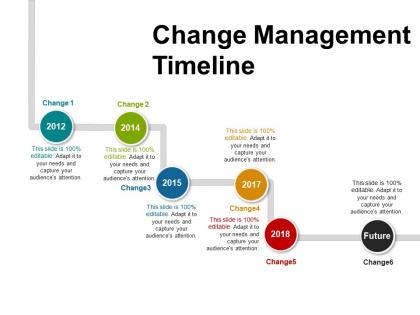
Change management timeline




Try Before you Buy Download Free Sample Product
 Impress Your
 Audience
 100%
100% Editable
 Save Hours
 of Time


Get a finer assessment of cost factors with our Change Management Timeline. It helps hone down the estimates.
People who downloaded this PowerPoint presentation also viewed the following :
Change management timeline with all 5 slides:
Handle cut-throat competition with our Change Management Timeline. Be able to effectively counter their efforts.


FAQs for
So basically you've got four main stages. First, figure out what actually needs fixing and why - the assessment part. Getting everyone to buy in comes next, and honestly this always drags on forever. People resist change, what can I say? Then you do the actual rollout of whatever you planned. After that it's tracking how things are going and tweaking stuff that isn't working. Oh, and these phases usually bleed into each other rather than happening one at a time. Pro tip: pad your timeline for the buy-in stage because that's where everything goes sideways.
Look, you gotta track different stuff depending on where you are. Planning phase? Survey your stakeholders, see if they're actually bought in. Implementation gets messy fast - watch adoption rates and how many people finish training. Resistance indicators are huge here. After launch, focus on performance gains and whether people are happier. Oh, and check if you hit your original goals (crazy concept, right?). Set baselines before you start or you'll have nothing to compare against later. Weekly check-ins during busy periods, then quarterly reviews once things settle down. Mix hard numbers with real feedback from your teams.
Look, I can't stress this enough - communication will make or break your whole timeline. People need to know what's changing, when it's happening, and why they should actually care. I've watched so many projects completely implode because managers thought everyone would just figure it out on their own (spoiler: they won't). Hit multiple channels since everyone processes info differently. Oh, and repeat your key points - like, a lot. Here's what actually works: bake communication checkpoints right into your timeline instead of treating it like an afterthought.
Honestly, the biggest pain points are usually pushback from your team, crappy communication, and timeline issues. People hate change - like, really hate it - so you're gonna get resistance no matter what. Plus leadership always thinks stuff will happen faster than it actually does. Oh and communication gets super messy when messages have to flow through different departments. Things get lost in translation, you know? My advice? Build in way more time than you think you need for each step. Also set up regular check-ins so nobody goes off track. Trust me on the extra time thing - you'll need it.
Don't just check in at the big milestones - you'll lose people. Figure out early how each stakeholder likes to communicate. Some want those long detailed emails, others just need a quick "hey, we're on track" text. Honestly, half the projects I've seen fail because someone felt ignored around week 3. Build in actual feedback moments where people can change things, not just nod along. Those little pulse surveys are clutch for this. Oh, and make sure they feel like their input matters - nobody wants another pointless meeting.
Honestly, Gantt charts are your best bet here - Microsoft Project or Asana make it super easy to track everything. Excel works too if you're feeling scrappy. Kotter's 8-step thing is decent for structure, but man, it can be pretty inflexible when real life hits. ADKAR's solid if you want to focus more on how people actually handle change (which, let's be real, is usually the hard part). Oh, and roadmaps in Miro or Lucidchart look way cleaner for presentations. Stakeholders eat that visual stuff up. Just go with whatever won't make your team want to throw their laptops out the window.
Honestly, training's gonna happen in waves - not all at once like most people think. Start with your leaders first, maybe 2-3 months early so they can actually back you up when things get weird. Hit everyone else around 4-6 weeks before launch. No matter how much time you give yourself, it'll still feel crazy rushed (learned that the hard way). The real trick though? Plan those follow-up sessions now for like 30-60 days after launch. People's brains just dump everything when they're stressed about change. Trust me, you'll definitely need those refresher sessions later.
Look, feedback loops are your safety net for catching problems early. You don't want to be three months in and suddenly realize everyone's confused or pushing back. I like to think of it as taking your project's temperature regularly - quick pulse surveys work great, or just grab coffee with people and see how they're really feeling about changes. Skip-level meetings help too. The trick is doing these check-ins consistently, not waiting for big milestones when it might be too late to pivot. Without that constant pulse, you're basically hoping everything works out. And honestly? It rarely does.
Oh man, culture stuff will absolutely mess with your timeline. Risk-averse places? People need forever to feel okay with changes. Then you've got those super hierarchical orgs where everything needs like five approvals - I swear some companies exist just to create paperwork. But here's the thing: innovative cultures with good psychological safety actually speed things up because folks adapt quicker. Honestly, do a culture check before you even start planning. That way you won't be scrambling when everything takes twice as long as expected.
Focus on those tiny wins when things get sluggish - even the stupid small stuff counts. People honestly forget how much those little victories actually boost morale. Blast those achievements to everyone on your team, don't keep them quiet. Regular check-ins help you catch pushback before it gets ugly. Also, keep talking to people even when there's literally nothing new happening (I know, feels weird but trust me). Quick wins remind everyone why they signed up for this mess in the first place. Stay visible instead of disappearing until the next major milestone hits.
Oh man, external stuff will mess with your timeline constantly. Market changes, new regulations, economic weirdness - it all forces you to stop, switch directions, or suddenly speed everything up. Sometimes all at once, which is fun. I've watched projects cruise along perfectly until a competitor drops something similar and suddenly management wants everything done yesterday. You'll probably need to shift resources around or put things on pause while everyone freaks out about whatever crisis just hit. Honestly? Build in extra time from day one and have backup plans ready. That way you can roll with it without completely losing your mind.
Okay so first thing - map out your big milestones and what depends on what. That's honestly the most important part. Don't be overly optimistic with timing (I always mess this up lol). Document who owns each piece and what resources you actually need. Gantt charts are ugly but stakeholders eat them up for some reason. Build in extra time because literally everything takes longer than you think. Oh and assign someone to each phase - can't stress this enough. Keep updating it and sharing with your team so nobody gets lost. Potential roadblocks should go in there too.
Dude, always pad your timeline upfront because stuff WILL break. When it does, look at what's actually critical vs what can wait or get combined. Smart project managers put buffer time at major checkpoints, not just the very end - learned that the hard way on my last big project. Communication is huge here. Tell everyone what's happening fast, don't sugarcoat it. You'll probably need to cut features, throw more people at it, or push deadlines. Making quick calls beats crossing your fingers hoping things fix themselves. Trust me on that one.
Honestly? Your leaders are make-or-break for this whole thing. They're the ones who'll push decisions through when stuff gets stuck and actually tell people why hitting these dates matters. When teams start slacking (and they will), someone has to be willing to crack the whip. Plus if your timeline goes sideways - which let's be real, it probably will at some point - leadership can shift resources around or change scope. Without them really owning it, your timeline just becomes this nice document everyone ignores the second something "urgent" comes up. Make sure they're genuinely committed to holding people's feet to the fire.
Skip the vague "success" stuff and get specific with your metrics. Planning phase? Track stakeholder buy-in percentages and how much of your resources you've actually locked down. Implementation gets tricky - honestly, this is where everything falls apart if you're not careful. Watch adoption rates, training completion, resistance levels. Later in the sustaining phase, focus on actual performance improvements and whether people stick with the changes long-term. Set your targets before you start so you're not scrambling later trying to prove it worked. Keep it simple with a dashboard - maybe 2-3 metrics per phase tops.
-
Easily Understandable slides.
-
Out of the box and creative design.