


Change management budget control powerpoint presentation slides




Try Before you Buy Download Free Sample Product
 Impress Your
 Audience
 100%
100% Editable
 Save Hours
 of Time


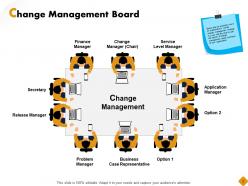
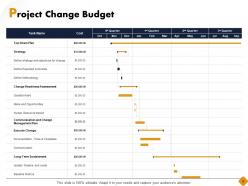
Manage change budgets & forecasts in an effective manner by employing Change Management Budget Control Powerpoint Presentation Slides. Showcase the role of the change management board like secretory, application manager, etc which plays an essential role in the organization’s overall change management strategy. Mention the responsibilities of key team members such as project leaders, release management, performance management involved in the change management process with the use of organizational transformation process cost management PPT slideshow. Determine the cost incurred in executing various steps of the transition process by taking the assistance of change cost control PowerPoint layouts. Highlight the process to ensure changes are properly managed in the project using project change costing management PPT graphics. Employ the budgeting in the change process presentation template and monitor the business activities appropriately. Thus download our high-quality change project cost management PPT Presentation to support the process of business transformation. Get instant access to our budget presentation templates now.
People who downloaded this PowerPoint presentation also viewed the following :
Change management budget control powerpoint presentation slides with all 16 slides:
Use our Change Management Budget Control Powerpoint Presentation Slides to effectively help you save your valuable time. They are readymade to fit into any presentation structure.









FAQs for Change management budget control
Key components of a change management budget include training and development costs, communication expenses, technology infrastructure, consultant fees, and employee support resources. These elements work together by ensuring adequate resource allocation for stakeholder engagement, skill development, and system implementation, with many organizations finding that comprehensive budgeting ultimately delivers smoother transitions and sustained adoption rates.
Organizations can effectively allocate resources for change initiatives by conducting thorough impact assessments, establishing clear success metrics, prioritizing high-value transformations, and creating dedicated budget reserves for unexpected challenges. Through strategic resource planning, companies streamline implementation timelines, enhance stakeholder buy-in, and minimize operational disruptions, with many finding that phased allocation approaches deliver measurable ROI while maintaining financial flexibility.
Key metrics for change management budgeting success include budget variance analysis, ROI measurement, milestone completion rates, stakeholder adoption percentages, and cost-per-change ratios. These indicators enable organizations to track financial efficiency, measure actual outcomes against projected benefits, and identify areas requiring resource reallocation, with many companies finding that comprehensive metric tracking reduces change costs by 15-25%.
Unforeseen changes significantly impact initial change management budgets by requiring additional resources, extended timelines, and expanded training programs. These disruptions often increase costs by 20-40%, with organizations finding that building contingency reserves, implementing phased rollouts, and maintaining flexible resource allocation ultimately delivers better financial control and project success rates.
Stakeholder engagement ensures budget transparency, secures necessary approvals, and identifies potential cost impacts early in the change process. Through regular communication and involvement, stakeholders provide valuable insights on resource allocation, help prioritize initiatives, and support budget adjustments, with many organizations finding that engaged stakeholders ultimately reduce project costs and accelerate successful implementation.
Technology assists in monitoring change management costs through automated budget tracking systems, real-time expense monitoring tools, predictive analytics platforms, and integrated project management software. These solutions enable organizations to track resource allocation, identify cost overruns early, and optimize spending patterns across change initiatives, with many companies finding that automated monitoring reduces budget variances by up to 30% while enhancing financial transparency.
Common pitfalls in change management budget planning include underestimating training costs, overlooking stakeholder resistance expenses, inadequate contingency reserves, ignoring technology integration costs, and failing to account for productivity dips during transitions. These challenges can be avoided by conducting thorough stakeholder assessments, building 15-20% contingency buffers, and implementing phased rollouts, with many organizations finding that detailed change impact analysis ultimately delivers more accurate forecasting and successful transformations.
Organizations ensure alignment between change initiatives and budget constraints by establishing clear ROI metrics, implementing phased rollout approaches, conducting regular cost-benefit assessments, and maintaining transparent stakeholder communication throughout project lifecycles. Through strategic prioritization frameworks, companies like manufacturing firms and financial services streamline resource allocation, minimize budget overruns, and maximize change effectiveness, ultimately delivering sustainable transformations while maintaining fiscal responsibility.
**INPUT**: What techniques can be employed to prioritize change management activities within a limited budget? **OUTPUT**: Budget-constrained change management prioritization techniques include impact-effort matrix analysis, stakeholder influence mapping, risk assessment scoring, phased implementation planning, and resource allocation modeling. These strategic approaches enable organizations to maximize transformation outcomes by focusing on high-impact, low-cost initiatives first, while many companies finding that targeted communication and training investments deliver disproportionate returns on limited change budgets.
Change management budgets should be reviewed monthly during active initiatives and quarterly during stable periods, with immediate adjustments triggered by scope changes, resource shifts, or milestone deviations. This strategic approach enables organizations to maintain financial control while adapting to evolving requirements, with many finding that regular reviews reduce cost overruns by 30% and enhance project success rates.
Effective strategies include demonstrating ROI through quantifiable metrics, presenting risk mitigation scenarios, benchmarking against industry standards, showcasing pilot program successes, and connecting initiatives to strategic business objectives. These approaches work by translating change management investments into measurable outcomes like reduced implementation timelines, higher adoption rates, and minimized productivity losses, with many organizations finding that comprehensive justification frameworks ultimately secure stronger executive buy-in and sustainable funding.
External economic factors significantly influence change management budgets through market volatility, inflation rates, interest costs, regulatory changes, and competitive pressures. During economic uncertainty, organizations typically adopt more conservative approaches, prioritizing essential transformations while deferring non-critical initiatives, with many companies finding that strategic timing and phased implementations help maintain momentum while managing financial risk effectively.
**INPUT**: What approaches can be taken to forecast future costs associated with change management? **OUTPUT**: Change management cost forecasting includes historical analysis, stakeholder impact assessment, training requirements evaluation, resource allocation modeling, and risk contingency planning. These approaches enable organizations to anticipate expenses through benchmarking similar projects, calculating communication costs, and estimating productivity impacts, with many finding that comprehensive forecasting reduces budget overruns while ensuring adequate resources for successful transformation initiatives.
A contingency fund enhances change management budget resilience by providing financial flexibility for unexpected challenges, resource adjustments, and timeline extensions that commonly arise during organizational transitions. This strategic reserve enables project managers to address unforeseen implementation costs, additional training requirements, and stakeholder resistance issues without derailing the entire initiative, ultimately delivering smoother transformations and higher success rates.
Risk assessment enables organizations to identify potential cost overruns, resource constraints, and implementation challenges before they impact change management budgets, allowing for proactive mitigation strategies and contingency planning. Through systematic evaluation of financial, operational, and timeline risks, companies can allocate resources more strategically, minimize unexpected expenses, and maintain better budget control throughout transformation initiatives.
-
Very well designed and informative templates.
-
It saves your time and decrease your efforts in half.
-
Enough space for editing and adding your own content.
-
I discovered this website through a google search, the services matched my needs perfectly and the pricing was very reasonable. I was thrilled with the product and the customer service. I will definitely use their slides again for my presentations and recommend them to other colleagues.