


Change management plan powerpoint presentation examples




Try Before you Buy Download Free Sample Product
 Impress Your
 Audience
 100%
100% Editable
 Save Hours
 of Time


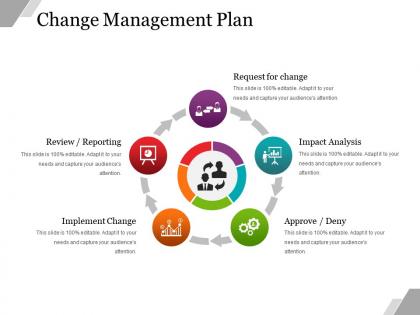
Presenting change management plan PowerPoint presentation examples design that can be used by corporate firms to make their team members understand the concept of change management in the business unit. The purpose of any company to come up with change management plan is to check if they can sustain in this competitive work environment or not. Our PPT template has been designed with five aspects of change management plan that you can present among your audience which are request for change, impact analysis, approve or deny, implement change and review or reporting. The change management plan needs to be carefully considered after all considerations such as how it is going to impact the business and employees with the company. Proper planning with better execution is what is required to implement it in the right way. This PowerPoint graphic has been designed with an objective which is to give access to corporate leaders to make a strong communication about the need for change and steps for change in the corporate. Download it now. Increase the influx with our Change Management Plan Powerpoint Presentation Examples. Enable a faster flow of ideas.
People who downloaded this PowerPoint presentation also viewed the following :
Change management plan powerpoint presentation examples with all 5 slides:
Folks find your ideas to be highly inspirational due to our Change Management Plan Powerpoint Presentation Examples. It will impress the intellectuals.



FAQs for Change management plan
Key components of an effective change management plan include stakeholder assessment, communication strategy, training programs, timeline management, and resistance mitigation protocols. These elements work together by identifying affected parties, establishing clear messaging channels, and providing necessary skills development, while many organizations find that structured implementation with regular feedback loops ultimately delivers smoother transitions and higher adoption rates.
Assessing organizational readiness involves evaluating leadership commitment, employee engagement levels, current culture, communication systems, and available resources. Organizations typically conduct stakeholder surveys, analyze past change experiences, review financial capacity, and assess operational flexibility, with many finding that early readiness assessment significantly reduces implementation risks and enhances change adoption success rates.
Communication serves as the foundation of successful change management by building trust, reducing resistance, ensuring alignment, and maintaining transparency throughout the transformation process. Through strategic messaging, regular updates, and two-way feedback channels, organizations streamline adoption, enhance employee engagement, and minimize disruption, with many companies finding that clear communication ultimately delivers faster implementation and sustainable organizational change.
Stakeholder engagement can be incorporated through regular communication touchpoints, collaborative planning sessions, feedback collection mechanisms, and role-specific training programs throughout the change process. Organizations across sectors like healthcare and financial services find that early stakeholder involvement, transparent progress updates, and addressing concerns proactively ultimately delivers smoother transitions, reduced resistance, and higher adoption rates.
Change management frameworks include Kotter's 8-Step Process, ADKAR model, Lean Change Management, Prosci methodology, and McKinsey's 7-S Framework. These approaches streamline transformation by establishing clear communication channels, stakeholder engagement strategies, and performance metrics, with many organizations finding that combining multiple frameworks delivers enhanced employee adoption, reduced resistance, and ultimately sustainable competitive advantage in increasingly dynamic business environments.
**INPUT**: How do you measure the success of a change management initiative? **OUTPUT**: Success measurement combines quantitative metrics like adoption rates, productivity improvements, and cost reductions with qualitative indicators including employee satisfaction, engagement scores, and cultural alignment assessments. Organizations increasingly track these through employee surveys, performance analytics, and milestone achievement reviews, with many finding that sustained behavioral change and improved operational efficiency ultimately deliver the strongest indicators of successful transformation. **Word count: 60 words**
Common pitfalls include inadequate stakeholder engagement, underestimating resistance, lack of clear communication strategies, insufficient leadership support, and unrealistic timelines. These oversights often derail initiatives by creating confusion, reducing buy-in, and overwhelming teams, with many organizations finding that comprehensive planning, transparent communication, and phased implementation ultimately deliver smoother transitions and sustained adoption.
Resistance to change can be anticipated through stakeholder analysis, communication audits, and identifying potential impact areas across departments and roles. Effective management involves transparent communication, early employee involvement, comprehensive training programs, and addressing concerns proactively, with many organizations finding that phased implementation and continuous feedback loops ultimately deliver smoother transitions and higher adoption rates.
**INPUT**: What strategies can ensure continuous improvement post-implementation of changes? **OUTPUT**: Post-implementation continuous improvement strategies include regular performance monitoring, feedback collection systems, iterative process refinement, stakeholder engagement programs, and data-driven analysis protocols. These approaches streamline organizational adaptation by identifying optimization opportunities, enhancing employee buy-in, and measuring outcomes against benchmarks, with many organizations finding that systematic review cycles ultimately deliver sustained competitive advantage and operational excellence.
Change management plans can be tailored by assessing cultural dimensions like hierarchy, communication styles, risk tolerance, and decision-making processes, then adapting strategies accordingly. Organizations with collaborative cultures may benefit from participatory approaches and cross-functional teams, while hierarchical structures often require top-down communication and formal approval processes, ultimately ensuring higher adoption rates and smoother transitions.
Employee performance change metrics should include productivity indicators, quality measurements, engagement scores, absenteeism rates, and retention statistics. These assessments enable organizations to track adaptation progress through quantifiable data, identify areas requiring additional support, and measure the overall success of change initiatives, with many companies finding that combining leading and lagging indicators delivers comprehensive insights into workforce transformation effectiveness.
Leadership influences change management effectiveness by setting clear vision, securing necessary resources, modeling desired behaviors, and maintaining consistent communication throughout the transformation process. Strong leaders drive organizational buy-in through transparent decision-making and active engagement, with many companies finding that committed leadership increases change success rates by over 70%, ultimately delivering smoother transitions and sustained adoption.
**INPUT**: What techniques can be utilized to train employees to adapt to new changes successfully? **OUTPUT**: Effective employee adaptation techniques include interactive workshops, mentorship programs, hands-on simulations, microlearning modules, and peer-to-peer knowledge sharing sessions. These approaches streamline the transition process by building confidence, reinforcing new behaviors, and creating supportive learning environments, with many organizations finding that combining multiple methods ultimately delivers faster adoption rates and enhanced employee engagement during transformation initiatives. **Word count: 60 words**
External factors significantly influence change management planning by determining timing, resource allocation, stakeholder priorities, and implementation strategies, with market volatility, regulatory changes, and competitive pressures directly shaping approach and pace. Organizations in sectors like retail and financial services find that economic conditions, consumer behavior shifts, and industry disruptions require adaptive planning frameworks that enable rapid pivots while maintaining operational stability and competitive advantage.
Technology streamlines change management through communication platforms, project management systems, training modules, analytics dashboards, and feedback tools. These digital solutions enhance transparency, accelerate implementation timelines, and enable real-time monitoring of adoption rates, with many organizations finding that automated workflows and data-driven insights ultimately deliver smoother transitions and measurable outcomes.
-
Presentation Design is very nice, good work with the content as well.
-
Very well designed and informative templates.