

Transition management plan powerpoint presentation slide template




Try Before you Buy Download Free Sample Product
 Impress Your
 Audience
 100%
100% Editable
 Save Hours
 of Time


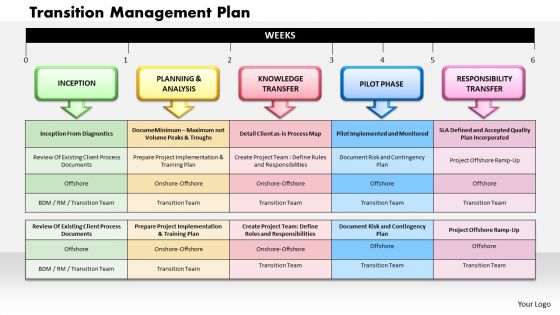
Managing the transition phase in the corporate unit is not an easy job as you need to manage both certain things at one time. This transition management plan PowerPoint presentation slide crafted for the business professionals to understand as how the things needs to be managed during the transition time. The presentation visual design demonstrates the management concept which is quite helpful in today’s business environment. This PPT background image is crafted with the week’s layout which allows showing the information in the right manner. The five most vital points that are highlighted in the slide are inception, planning and analysis, knowledge transfer, pilot phase and responsibility transfer. Now you may present them by using this presentation illustration. Apart from this, if there is any other factor that you would like to exhibit with this design is possible as the PowerPoint template is entirely amendable. Now don’t think much at this time and download this amazing transition management plan design. Really wow them at your next presentation. Transition Management Plan powerpoint presentation slide template in a range of modern designs are available.
People who downloaded this PowerPoint presentation also viewed the following :
Transition management plan powerpoint presentation slide template with all 5 slides:
Feel fully equipped with our Transition Management Plan powerpoint presentation slide template. Acquire the best at your fingertips.



FAQs for Transition management plan powerpoint
Key components of an effective Transition Management Plan include stakeholder communication strategies, resource allocation frameworks, risk assessment protocols, timeline management systems, and performance monitoring mechanisms. These elements work together by ensuring seamless organizational changes, minimizing operational disruptions, and maintaining employee engagement throughout transitions, with many organizations finding that structured planning ultimately delivers faster implementation timelines and higher success rates.
Organizations assess their current state through comprehensive audits examining existing processes, technology infrastructure, resource allocation, stakeholder readiness, and operational capabilities. These assessments involve conducting stakeholder interviews, analyzing performance metrics, and mapping current workflows, with many companies finding that thorough baseline evaluation enables more strategic transition planning and ultimately delivers smoother implementation timelines.
Stakeholder engagement ensures comprehensive buy-in, identifies potential roadblocks early, and facilitates smoother implementation across all organizational levels. Through regular communication, feedback loops, and collaborative planning sessions, organizations streamline change adoption, minimize resistance, and accelerate transition timelines, with many companies finding that engaged stakeholders become active champions who drive sustainable transformation outcomes.
Organizations identify transition risks through comprehensive risk assessment processes, stakeholder impact analysis, change readiness evaluations, resource gap assessments, and timeline vulnerability reviews. Through systematic risk mapping, companies in sectors like manufacturing and healthcare can anticipate resistance patterns, resource shortfalls, and operational disruptions, ultimately enabling proactive mitigation strategies and smoother transitions.
Key metrics for evaluating Transition Management Plan success include timeline adherence, budget variance, stakeholder satisfaction scores, operational performance indicators, and risk mitigation effectiveness. These measurements enable organizations to assess progress across financial services, healthcare systems, and manufacturing operations, while identifying areas needing adjustment, ultimately delivering measurable improvements in efficiency and minimizing disruption during organizational changes.
Change communication strategies integrate into Transition Management Plans through stakeholder mapping, multi-channel messaging frameworks, feedback loops, timeline alignment, and resistance management protocols. These approaches streamline organizational transformation by establishing clear information flows, addressing concerns proactively, and maintaining employee engagement throughout transitions, with many companies finding that strategic communication significantly reduces implementation timeframes and increases adoption rates.
**INPUT**: What tools or software are recommended for managing transition processes effectively? **OUTPUT**: Recommended transition management tools include Microsoft Project, Asana, ServiceNow, Jira, and Smartsheet for comprehensive planning, tracking, and collaboration. These platforms streamline workflows by automating task assignments, enabling real-time communication, and providing detailed progress analytics, with many organizations finding that integrated dashboards significantly enhance visibility and accelerate successful transitions. [Word count: 54 words]
A Transition Management Plan should be reviewed weekly during active transition phases and monthly during stable periods, with major updates triggered by scope changes, stakeholder feedback, or milestone completions. Many organizations find that regular review cycles enable proactive risk mitigation, resource reallocation, and timeline adjustments, ultimately ensuring smoother transitions and higher success rates.
**INPUT**: What strategies can be employed to ensure team buy-in during transitions? **OUTPUT**: Effective team buy-in strategies include transparent communication, involving employees in planning processes, providing comprehensive training, establishing clear timelines, and recognizing early adopters. These approaches streamline resistance by addressing concerns proactively, creating ownership through participation, and demonstrating immediate value, with many organizations finding that regular feedback sessions and celebrating quick wins ultimately delivers stronger engagement and faster adoption rates.
Organizations balance agility and structure in Transition Management Plans by establishing flexible frameworks with defined checkpoints, modular implementation phases, and adaptive governance models. This strategic combination enables teams to respond quickly to unexpected challenges while maintaining oversight and accountability, with many financial services and healthcare organizations finding that structured flexibility ultimately delivers faster transitions and reduced operational risk.
Common pitfalls include inadequate stakeholder engagement, unrealistic timelines, insufficient resource allocation, poor communication strategies, and lack of risk assessment frameworks. Organizations often underestimate change resistance and complexity, while failing to establish clear success metrics, with many finding that comprehensive planning, regular stakeholder feedback, and flexible implementation approaches ultimately deliver smoother transitions and better outcomes.
Corporate culture significantly influences transition management effectiveness by shaping employee attitudes, communication patterns, resistance levels, and adaptability to change. Organizations with collaborative, transparent cultures typically experience smoother transitions, while rigid or hierarchical environments may face greater resistance, with many companies finding that aligning cultural values with transition goals ultimately delivers faster adoption, reduced friction, and sustained organizational transformation.
Training and development serve as critical enablers during transitions by equipping employees with new skills, reducing resistance to change, and accelerating adoption of new processes or technologies. Through targeted learning programs, organizations streamline knowledge transfer, enhance workforce adaptability, and maintain productivity levels, with many companies finding that comprehensive training ultimately delivers smoother transitions and stronger competitive positioning.
Organizations ensure knowledge transfer during transitions by establishing formal documentation processes, conducting structured handover sessions, and creating cross-training programs between outgoing and incoming stakeholders. Through mentorship pairings, detailed process mapping, and collaborative workshops, companies streamline information flow, minimize operational disruptions, and maintain institutional memory, ultimately delivering seamless transitions and preserving critical business expertise.
External factors significantly impact Transition Management Plans through economic volatility affecting budgets and timelines, regulatory changes requiring compliance adjustments, market shifts influencing strategic priorities, and policy updates demanding operational modifications. Organizations must build flexibility into their transition frameworks, with many companies finding that incorporating scenario planning, regulatory monitoring, and adaptive resource allocation helps maintain momentum while navigating unpredictable external pressures.
-
Very well designed and informative templates.
-
Very unique and reliable designs.