


Transition plan execution stages powerpoint presentation templates




Try Before you Buy Download Free Sample Product
 Impress Your
 Audience
 100%
100% Editable
 Save Hours
 of Time


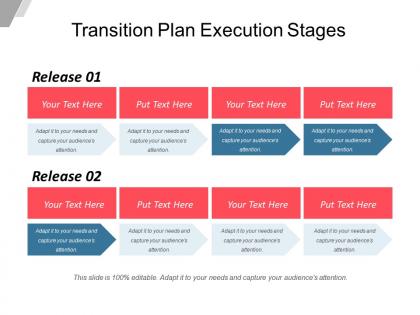
The creative transition plan execution PowerPoint template is useful in demonstrating reports, plans as well as discuss the work hierarchy. The transition plan template design contains stages which further categorize the stakeholders such as, executive users and suppliers who direct to the appropriate path. Project manager and the team can use the transition plan example slide for PowerPoint to deliver the desired outcomes. Further, the transition planning process presentation template act as a methodology of executing controlled completion of any project. A user can share basic processes such as start project, initiation, directing, controlling, managing delivery, manage stage transitions, close project etc. by using transition plan sample slide. The transition plan sample presentation slide has an amazing visual illustration of managers and stakeholders who involve in the project. Moreover, it represents a process design of displaying the management roles in a proper sequence. The transition plan example PowerPoint slide enables an organization to modify methods of management as per the requirements. The present can use this transition planning process template to illustrate use-case scenarios, delegation of a communication plan to the team as well as board. Address the confusion with our Transition Plan Execution Stages Powerpoint Presentation Templates. Ensure the emergence of greater clarity.
People who downloaded this PowerPoint presentation also viewed the following :
Transition plan execution stages powerpoint presentation templates with all 5 slides:
Our Transition Plan Execution Stages Powerpoint Presentation Templates excel at energy conservation. They don't allow it to fritter away.



FAQs for Transition plan execution stages
Key components include stakeholder communication strategies, resource allocation frameworks, risk mitigation protocols, timeline management systems, and performance monitoring mechanisms. These elements work together by ensuring clear accountability, maintaining operational continuity, and enabling real-time adjustments, with many organizations finding that structured execution ultimately delivers smoother transitions and measurable business outcomes.
Stakeholder readiness assessment involves evaluating communication effectiveness, training completion rates, resource availability, and change adoption behaviors across all affected groups. Through structured feedback sessions, competency evaluations, and readiness surveys, organizations can identify potential resistance points, skill gaps, and support needs, ultimately ensuring smoother implementation and higher success rates.
Risk mitigation strategies during transition phases include comprehensive stakeholder communication, phased implementation approaches, robust backup systems, continuous monitoring protocols, and dedicated contingency planning. These strategies work by minimizing operational disruptions, ensuring resource continuity, and maintaining service quality, with many organizations finding that proactive risk assessment combined with flexible response mechanisms ultimately delivers smoother transitions and sustained competitive advantage.
Communication can be optimized through regular stakeholder updates, transparent progress reporting, dedicated communication channels, clear escalation procedures, and structured feedback loops. These strategies streamline information flow by establishing consistent messaging protocols, reducing uncertainty, and enabling rapid issue resolution, with many organizations finding that proactive communication ultimately delivers enhanced stakeholder confidence and accelerated transition timelines.
Key metrics include timeline adherence, budget variance, stakeholder satisfaction scores, system uptime during transitions, and employee productivity levels. These measurements enable organizations to assess progress across operational, financial, and human dimensions, with many companies finding that regular metric monitoring enhances decision-making, minimizes disruptions, and ultimately delivers smoother transitions with measurable business outcomes.
Cultural considerations significantly impact transition plan execution by influencing employee acceptance, communication effectiveness, change readiness, and collaboration patterns across different organizational levels and geographic regions. These cultural factors shape how teams respond to new processes, with many organizations finding that acknowledging cultural nuances, adapting communication styles, and respecting existing workplace traditions ultimately accelerates adoption and minimizes resistance throughout the transition.
Leadership drives successful transitions by establishing clear vision, maintaining transparent communication, and securing necessary resources throughout the implementation process. Effective leaders foster stakeholder buy-in, address resistance proactively, and provide consistent support during uncertainty, with many organizations finding that strong leadership commitment reduces transition timelines by up to 40% while enhancing employee engagement.
Feedback mechanisms can be integrated through regular stakeholder surveys, milestone review sessions, performance dashboards, and structured communication channels at each execution stage. These systems enable organizations to identify bottlenecks, adjust timelines, and refine processes in real-time, with many companies finding that continuous feedback loops ultimately enhance transition success rates and minimize costly delays.
Team alignment during transitions requires clear communication protocols, regular progress meetings, shared documentation systems, defined role responsibilities, and collaborative decision-making frameworks. These techniques streamline coordination by establishing transparent expectations, facilitating cross-functional dialogue, and maintaining consistent messaging, with many organizations finding that structured check-ins and unified project dashboards ultimately deliver enhanced accountability and seamless execution across all transition phases.
Handling resistance during transition plan execution involves transparent communication, stakeholder engagement, comprehensive training programs, and establishing clear feedback channels. These strategies help organizations address concerns proactively, with many companies finding that involving resistant team members in planning committees, providing role-specific support, and celebrating early wins significantly reduces opposition while accelerating adoption rates.
Tools for monitoring transition progress include project management platforms like Microsoft Project and Asana, real-time dashboards through Tableau and Power BI, automated reporting systems, stakeholder communication portals, and integrated analytics solutions. These technologies streamline oversight by centralizing data collection, automating status updates, and delivering real-time visibility across all transition stages, with many organizations finding that comprehensive monitoring platforms significantly reduce implementation risks while accelerating project completion timelines.
Task prioritization during transition execution involves assessing criticality, dependencies, resource availability, stakeholder impact, and timeline constraints at each stage. Early phases typically focus on foundational elements and high-risk activities, while later stages emphasize optimization and knowledge transfer, with many organizations finding that regular reassessment ensures resources align with evolving priorities and business objectives.
Staff training during transition execution should include comprehensive change management workshops, role-specific skill development, new system tutorials, communication protocols, and ongoing mentoring programs. Through structured learning paths, organizations enable smoother adaptation, reduce resistance, and maintain productivity, with many companies finding that continuous support and feedback loops ultimately deliver faster adoption rates and improved employee confidence throughout the transition process.
Lessons learned from previous transitions can be applied through comprehensive documentation of successes and failures, standardized process templates, risk mitigation strategies, and stakeholder feedback integration. Organizations increasingly develop transition playbooks that capture timing insights, communication protocols, and resource allocation patterns, with many finding that systematic knowledge transfer reduces implementation time by 30-40% while enhancing overall execution quality.
Timelines provide critical structure for transition plan execution by establishing clear milestones, coordinating resource allocation, and maintaining stakeholder accountability throughout each stage. They enable organizations to track progress systematically, identify potential bottlenecks early, and ensure seamless handoffs between phases, ultimately delivering predictable outcomes and minimizing operational disruptions during complex organizational changes.
-
Enough space for editing and adding your own content.
-
Use of icon with content is very relateable, informative and appealing.