


Transitional Change Management Training Plan





Try Before you Buy Download Free Sample Product
 Impress Your
 Audience
 100%
100% Editable
 Save Hours
 of Time


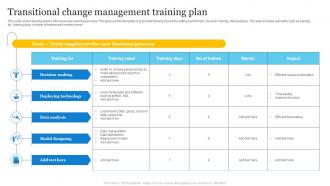
This slide covers training plan to introduce new business process. The purpose this template is to provide training course for setting benchmark, decision making, data analysis. This plan includes elements such as training for, training days, number of trainee and mentor name.
People who downloaded this PowerPoint presentation also viewed the following :
Transitional Change Management Training Plan with all 6 slides:
Use our Transitional Change Management Training Plan to effectively help you save your valuable time. They are readymade to fit into any presentation structure.





FAQs for Transitional Change
**INPUT**: What are the key stages in a transitional change management process? **OUTPUT**: Transitional change management involves preparation and planning, communication and stakeholder engagement, implementation and execution, monitoring and adjustment, and institutionalization phases. These stages enable organizations to navigate complex transformations by establishing clear roadmaps, securing buy-in, and maintaining momentum, with many companies finding that structured approaches significantly reduce resistance while accelerating adoption and sustainable outcomes.
Organizations can effectively communicate change by establishing transparent, multi-channel communication strategies, involving employees in planning processes, clearly articulating benefits and rationale, and providing regular updates throughout implementation phases. Through town halls, team meetings, and digital platforms, companies like manufacturing firms and financial institutions deliver consistent messaging, address concerns proactively, and create feedback loops, ultimately building trust and reducing resistance while ensuring smoother transitions.
Leadership plays a pivotal role in transitional change by setting clear vision, communicating transparently, and modeling adaptive behaviors throughout the organization. Effective leaders facilitate successful transitions by building trust, allocating resources strategically, and empowering teams to navigate uncertainty, with many organizations finding that strong leadership communication and consistent decision-making ultimately accelerate adoption and minimize resistance.
Organizations can assess their readiness for transitional change by evaluating leadership commitment, employee engagement levels, cultural flexibility, resource availability, and existing change management capabilities. Through comprehensive readiness assessments, companies in sectors like healthcare, manufacturing, and financial services identify potential resistance points, skill gaps, and infrastructure needs, ultimately enabling more strategic implementation planning and higher success rates.
Common pitfalls in transitional change management include inadequate communication, insufficient stakeholder engagement, resistance to new processes, lack of clear timelines, and poor resource allocation. These challenges can be avoided by establishing transparent communication channels, involving key stakeholders early, providing comprehensive training programs, and creating detailed implementation roadmaps, ultimately delivering smoother transitions and higher success rates.
Technology streamlines transitional change through automation tools, real-time analytics, collaboration platforms, and communication systems that enhance transparency and coordination. These digital solutions enable organizations to track progress more effectively, facilitate remote team alignment, and accelerate decision-making processes, with many companies finding that integrated technology platforms ultimately reduce transition timelines while improving employee engagement and organizational adaptability.
Organizations should measure transitional change success through employee engagement scores, productivity metrics, customer satisfaction ratings, financial performance indicators, and implementation timeline adherence. These metrics enable comprehensive assessment by tracking workforce adaptation, operational efficiency, and revenue impact, with many companies finding that combining quantitative data with qualitative feedback delivers clearer insights into transformation effectiveness.
Employee feedback can be integrated through structured surveys, focus groups, suggestion platforms, regular check-ins, and cross-functional committees that capture insights throughout transition phases. These mechanisms enable organizations to identify resistance points, refine implementation strategies, and enhance communication approaches, with many companies finding that continuous feedback loops significantly improve employee buy-in and accelerate successful change adoption.
Training programs supporting transitional change should incorporate interactive workshops, scenario-based learning, peer mentoring systems, and continuous feedback mechanisms. These approaches enhance engagement by addressing real workplace challenges, building confidence through practice, and creating support networks, with many organizations finding that hands-on training combined with ongoing coaching significantly improves adoption rates and reduces resistance.
Strategies include transparent communication, involving employees in planning processes, providing comprehensive training programs, recognizing contributions, and offering flexible support systems. These approaches enhance morale by reducing uncertainty, building trust, and demonstrating investment in workforce development, with many organizations finding that proactive engagement ultimately delivers higher retention rates and smoother transitions.
Organizational cultures significantly influence transitional change through communication patterns, decision-making processes, risk tolerance, and employee engagement levels. Hierarchical cultures like traditional banks require structured, top-down change approaches, while collaborative cultures in tech companies enable faster adaptation through cross-functional teams, ultimately determining whether transitions succeed or face resistance across different organizational environments.
Best practices for stakeholder engagement during transitional change include early communication, regular feedback loops, transparent progress updates, role clarification sessions, and collaborative planning workshops. These approaches streamline adoption by building trust, addressing concerns proactively, and ensuring alignment across departments, with many organizations finding that engaged stakeholders become change champions, ultimately accelerating implementation timelines.
Organizations ensure sustainability of change after transitions through embedded reinforcement mechanisms, continuous monitoring systems, cultural integration practices, and ongoing stakeholder engagement. These approaches streamline long-term adoption by establishing feedback loops, celebrating incremental wins, and maintaining leadership commitment, with many companies finding that sustained communication and performance measurement ultimately deliver lasting competitive advantage.
Emotional intelligence enables leaders to recognize, understand, and manage both their own emotions and those of team members during organizational transitions. Through empathy, self-awareness, and social skills, emotionally intelligent managers can address resistance, build trust, and maintain morale while navigating uncertainty, with many organizations finding that these capabilities significantly reduce transition-related stress and accelerate successful change adoption.
Transitional change varies significantly across industries, with healthcare focusing on regulatory compliance and patient safety protocols, financial services emphasizing risk management and security frameworks, and manufacturing prioritizing operational continuity and supply chain stability. These sector-specific approaches reflect unique stakeholder requirements, regulatory environments, and operational complexities, with organizations increasingly finding that industry-tailored change strategies deliver faster adoption and sustainable outcomes.
-
Great designs, Easily Editable.
-
“Slides are formally built and the color theme is also very exciting. This went perfectly with my needs and saved a good amount of time.”