

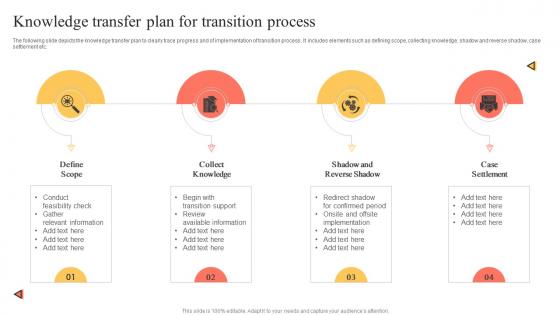
Knowledge Transfer Plan For Transition Process




Try Before you Buy Download Free Sample Product
 Impress Your
 Audience
 100%
100% Editable
 Save Hours
 of Time


The following slide depicts the knowledge transfer plan to clearly trace progress and of implementation of transition process . It includes elements such as defining scope, collecting knowledge, shadow and reverse shadow, case settlement etc.
People who downloaded this PowerPoint presentation also viewed the following :
Knowledge Transfer Plan For Transition Process with all 6 slides:
Use our Knowledge Transfer Plan For Transition Process to effectively help you save your valuable time. They are readymade to fit into any presentation structure.





FAQs for Knowledge Transfer Plan
Start with templates that grab both the obvious stuff (procedures, data) and the harder-to-capture experiences. Document WHY you made decisions, not just what you did - seriously, you'll hate yourself later if you skip this part. Mix it up with written guides, screen recordings, maybe some quick training sessions since everyone absorbs info differently. Include timelines, who's involved, and how you'll measure success. Here's my test: could someone else actually do this using only your notes? If not, add more detail. Oh, and set reminders to update everything regularly or it becomes useless fast.
Honestly, remote knowledge sharing got so much easier once we started using the right tools. Video calls with screen sharing are clutch for walking someone through complex stuff - way better than trying to explain it over text. We dump everything in shared drives and wikis so people can find what they need without hunting around. Loom recordings are pretty solid too since people can watch tutorials whenever. One thing I learned the hard way though - don't go overboard with platforms. Pick like 2-3 tools everyone actually uses instead of scattering info everywhere. Otherwise you'll spend more time searching than actually working.
Dude, company culture totally makes or breaks knowledge transfer. When people feel safe and trusted, they'll actually share what they know instead of hoarding it. But those cutthroat, competitive places? Forget it - everyone's protecting their turf. Trust is huge here. People need to feel okay saying "I don't know" without getting judged. Your company also has to actually reward knowledge sharing, not just talk about it in meetings. I've seen too many places where they preach collaboration but only celebrate individual wins. It's pretty obvious when the culture doesn't match the talk.
Honestly, measuring knowledge transfer is trickier than people think. I'd start with tracking how fast new hires hit their productivity goals - that's usually your best indicator. Follow-up assessments show if info actually stuck, not just whether someone sat through training. Employee surveys are clutch too; they'll tell you straight up if your methods suck or actually work. Here's the brutal test though: does critical knowledge disappear when veterans quit? That tells you everything. Don't overcomplicate it - pick maybe 2-3 metrics that match what you're trying to accomplish and go from there.
Honestly, the biggest pain points are always time and people acting like their knowledge is some precious secret. Everyone's slammed with work, so proper handoffs never happen. Most of the good stuff just stays trapped in someone's brain instead of getting written down. Some people get weird about sharing too - like they think it'll make them replaceable or something. Your team culture plays a huge role here. If nobody cares about knowledge sharing, it just won't stick. Try setting up regular sessions where people actually talk through what they know. Make documenting things part of the regular routine, not some extra task.
People remember stories way better than boring facts - it's just how our brains work. Instead of dumping procedures on someone, frame it like "here's what we were dealing with, tried this approach, then discovered what actually worked." I've watched this transform project handoffs completely. Rather than drowning people in technical specs, you walk them through how the system evolved over time. Creates actual context instead of just... information overload, you know? Stories stick because there's emotion and narrative flow. Next time, structure it with a clear beginning, middle, end. Works every time.
Honestly, the best knowledge sharing happens when people actually work side by side. Set up mentoring programs or have folks shadow each other - that's where the real learning kicks in. Cross-functional teams are great too since they force different departments to collaborate. Communities of practice sound fancy but they're basically just giving people space to chat about work stuff informally. Some of my best insights have come from random coffee conversations, not formal meetings. Oh, and definitely do regular "lessons learned" sessions where everyone can talk through what went wrong (or right). People love telling war stories if you give them the chance.
Here's the thing about mixed-age teams - everyone learns totally differently. Older folks usually want actual face-to-face meetings and proper documentation. Younger people? They're all about quick video tutorials and digital everything. But honestly, the cool part happens when you mix these approaches. Like getting your most experienced person to make short videos, or setting up reverse mentoring pairs. Oh, and don't pick just one method - that's a recipe for disaster. Run multiple knowledge transfer styles at once since what works for your 25-year-old definitely won't work for your 55-year-old.
Honestly, leadership can totally make or break this stuff. If your boss isn't actually backing it with real resources and showing up themselves, forget about it. I've watched so many knowledge sharing programs crash because executives thought people would just... start collaborating magically? Doesn't work that way. Your leaders need to be the ones modeling it first - can't hoard info then expect everyone else to share. Get them visibly championing the whole thing from day one. Oh, and make sure there's actual incentives, not just "this would be nice" energy. That never sticks.
Okay, first thing - don't just randomly pair people up. I've watched programs crash and burn because of terrible matching. You'll want 6-12 months with weekly check-ins, maybe bi-weekly if schedules are crazy. Give mentors actual frameworks so they're not winging every conversation. One skill focus per session works well. Here's the thing though - make sure knowledge gets documented somehow, not just talked about and forgotten. Mix it up with shadowing, working on projects together, plus those formal sit-down sessions. Oh, and track what's actually being learned, not just how often they meet.
Honestly, feedback is what makes knowledge sharing actually work. You share something with someone, but how do you know they understand it? Or that they're doing it right? Without checking in, you're basically just dumping info and crossing your fingers. The back-and-forth helps spot where people are getting stuck and fixes those "wait, what?" moments. Plus it builds their confidence when they realize they're on the right track. I learned this the hard way in my last job - always ask questions and make it okay for people to say "I'm totally lost here."
Honestly, visuals are a game-changer because people absorb info way better when they can actually *see* what you're talking about. Like, if you're explaining some complicated process, a quick diagram or flowchart makes it click instantly. Nobody wants to sit through an hour of just talking - that's brutal. I always sketch stuff out on a whiteboard while I'm presenting. Keeps everyone awake, you know? Plus it gives people something to connect new ideas to. Before/after screenshots work great too if you're showing how changes actually impact things. Your brain just processes visual stuff differently than words.
Honestly, the key is giving people actual reasons to share stuff. Set up regular lunch-and-learns or let teams shadow each other - way better than hoping people will magically collaborate. Pair your veterans with newbies for mentoring (works every time). Skip the dusty wiki approach though - nobody reads those things. Go for platforms where people can actually build on each other's ideas. But here's what really matters: celebrate when people share knowledge. Like, actually recognize it. Otherwise everyone just hoards their expertise because why wouldn't they? Make sharing feel worth their time.
Look for who everyone bugs with questions - those people are your goldmine. Performance reviews and peer feedback help too, plus anyone who's been in key roles forever. Getting them to actually share is the real challenge though! I'd start small - maybe 2-3 hours a week having your top people train others. Set up some mentoring pairs or get them documenting stuff before they retire or leave. Honestly, most companies don't realize how much knowledge just walks out the door until it's gone. Knowledge-sharing meetings work pretty well if you can get people to show up.
So here's the thing - when teams actually share what they know, that's where the magic happens. You get those breakthrough moments because people can build off each other's work. Like if Sarah learns something huge in marketing but never tells the product team? Total missed opportunity. Knowledge flowing between departments helps everyone spot connections they wouldn't see otherwise. Also saves you from that annoying cycle where someone quits and you're back to square one. My advice? Set up regular cross-team meetings where people share real lessons learned, not just boring status updates.
-
Great combination of visuals and information. Glad I purchased your subscription.
-
I've been looking for a good template source for some time. I'm happy that I discovered SlideTeam. Excellent presentations must try!