


Build operate transfer engagement model powerpoint template




Try Before you Buy Download Free Sample Product
 Impress Your
 Audience
 100%
100% Editable
 Save Hours
 of Time


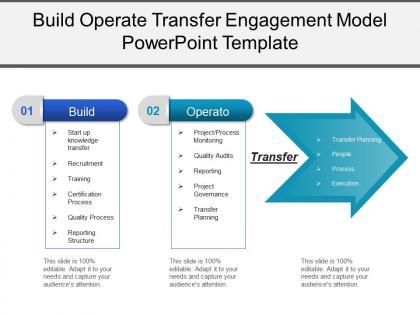
Showcase the BOT process with this Build Operate Transfer Engagement Model PowerPoint Template. This BOT implementation layout comprises three basic steps in the process such as building, operating and transferring knowledge. Utilize this project scope management PPT and show various components of the process such as recruitment, training, quality process, quality audits, transfer planning, etc. Employ this business operations infographic to understand project requirements, fill gaps and get your team ready for action. Attach rate of increase to a combination of internal and external variables for reaching a satisfactory internal rate of return on investment. Employ this project financing visual to elucidate the working of the BOT contract. Moreover, you can present the variations of the BOT model such as build-lease-transfer contract, design-build-operate-transfer, etc. in this project structure graphic. Hence, download this amazing project financing background image to present to your financer and get the best investment in your industry.
People who downloaded this PowerPoint presentation also viewed the following :
Build operate transfer engagement model powerpoint template with all 5 slides:
Make hay all day with our Build Operate Transfer Engagement Model Powerpoint Template. They keep the sun shining brightly.



FAQs for Build operate transfer engagement
So BOT projects work in three stages - pretty straightforward actually. Your private partner builds the whole thing with their own money first. After that's done, they get to operate it for like 15-30 years to make their investment back plus profit. Makes sense, right? Then at the end, they just hand it over to the government for free. The tricky part is each phase has totally different risks involved. I'd definitely nail down who's responsible for what in your contracts upfront - saves headaches later. Oh, and performance standards too.
BOT means a private company builds and runs your project, then gives it back after like 20-30 years. Traditional financing? You borrow the cash upfront and deal with everything yourself. Think of it like leasing versus buying - except way messier obviously. BOT pushes all the construction headaches and risks onto the private partner since they need to turn a profit during their operating years. With traditional routes, those risks hit you immediately. Honestly, it's pretty tempting if your budget's tight right now. You get infrastructure without the massive upfront costs, but you'll definitely pay more long-term through those operating deals.
Okay so first things first - figure out if you can actually afford the upfront costs and have the technical chops to make this work. The regulatory stuff is where things get tricky (and boring, but super important). Timeline for the handover is crucial too - nail down exactly when and how that happens. Legal framework gets complicated quick, so don't cheap out on a lawyer who actually knows BOT deals. Oh and your risk tolerance matters big time since you're betting on those future revenue streams. Map out your cash flow early and find legal counsel who's done this before, not just any business attorney.
So the main thing with BOT projects is figuring out who handles which risks best. Government usually takes the political/regulatory stuff, you handle construction and operations. Currency risk though? That's always a nightmare to negotiate - everyone wants the other guy to eat it. Make sure your contracts spell out exactly who owns what from the start. Seriously, vague assumptions will destroy you later when shit hits the fan. Get solid dispute mechanisms in there too, and don't forget insurance for the big scary stuff like force majeure. Being crystal clear upfront saves so much headache down the road.
Honestly, revenue never hits what you project - that's just reality. Maintenance costs will blow up your budget too. Then there's tech becoming outdated way faster than you planned for (seriously annoying). Labor issues are huge, especially overseas where laws change constantly. Oh, and currency swings can wreck everything if you don't hedge right. Regulatory stuff shifts too - super frustrating when it messes with your whole setup. My take? Add way more cushion to your financial model than feels necessary. Also get tight with local regulators from day one.
BOT deals are everywhere in infrastructure - roads, bridges, power plants, airports, you name it. Governments love them because they don't have to fork over billions upfront. Private companies get long-term contracts (usually 15-30 years) and can actually make decent money from user fees or government payments. Telecom and energy sectors use this model a ton too. Makes sense really - these projects need serious technical know-how that most government agencies just don't have. If you're thinking about getting into this space, stick with stuff that has predictable cash flows. Nobody wants to build a bridge to nowhere, right?
Honestly, regulations can totally make or break your BOT project. Before you even bid, check out the permit process, environmental rules, pricing structures - all that boring but crucial stuff. The real headache? Regulations shift during your 20-30 year contract, which is honestly pretty nerve-wracking. Countries with predictable regulatory systems see way better BOT success rates because investors don't feel like they're gambling. Do your homework on the regulatory landscape first. Then build some wiggle room into contracts for when things inevitably change down the line.
So BOT projects need constant stakeholder communication - you're dealing with government agencies, communities, lenders, all of them. Set up steering committees and do quarterly check-ins. Community sessions are crucial too. Here's the thing though: priorities change constantly over these long timelines, which is honestly exhausting. During construction, locals worry about noise and disruption. Once you're operational? It's all about service quality. Pro tip - document every single stakeholder commitment from day one and track them obsessively. I can't stress this enough because I've seen projects get absolutely crushed later when promises were forgotten.
Track ROI and payback period first - those are your bread and butter metrics. During operations, watch revenue targets, uptime, and service quality. Knowledge transfer is honestly where everything falls apart if you're not careful. Set up stakeholder satisfaction tracking too. The real moment of truth? Whether they can actually handle things post-handover without calling you every five minutes. Oh, and build that dashboard early - trust me on this one. You don't want to be hunting for data when transfer time hits. Local capability building matters too, but it's harder to measure.
BOT models work pretty well because operators know they're stuck with the facility for decades, so they actually care about maintenance. Makes sense - why would you cheap out on upfront quality if you're the one dealing with breakdowns later? But here's the thing you can't mess up: be super specific about handover conditions in your contract. I've seen deals where they got back facilities that were basically falling apart because nobody defined what "good condition" actually meant. Honestly, lawyers love this stuff but it's worth getting right upfront.
Honestly, the make-or-break factor is nailing down who's responsible for what risks upfront. Construction delays, traffic shortfalls, regulatory changes - spell it all out in bulletproof contracts. The Channel Tunnel folks learned this the hard way when their traffic projections were laughably wrong. Political stability matters huge too. Chile and Malaysia's toll roads worked because governments actually stuck with their commitments instead of flip-flopping every election cycle. Do crazy thorough due diligence on your financial models - I can't stress this enough. Oh, and definitely study similar projects in comparable markets first. Saves you from reinventing the wheel.
Honestly, BOT projects work so much better when everyone's actually talking to each other. You've got the public side bringing all that regulatory stuff and understanding what the community actually needs. Private partners? They're the ones with the money and know-how to make things happen efficiently. The trick is getting everyone on the same page from the start - like, before you even think about construction. Map out who's good at what first. Then set up those regular check-ins so nobody goes rogue with the budget. Trust me, clear communication channels will save you from those nightmare scope changes later.
Most BOT projects split financing 70-80% debt, rest equity. Banks and development finance institutions usually handle the debt side. Your project sponsors put in equity - basically their money on the line. Export credit agencies jump in for international stuff too. Green bonds are getting popular for renewable projects, which is pretty cool. Here's the thing though - lenders care way more about your project's future cash flows than how strong your sponsors look on paper. Honestly, I'd start by figuring out your revenue streams first. That'll show you which financing route makes sense for what you're building.
Honestly, start with mapping out your current BOT workflow - that'll show you where you're wasting time on manual stuff. Asana or Monday work great for tracking all your phases in one spot. Digital dashboards are seriously worth it for real-time visibility on milestones and budget burns. Cloud tools keep everyone on the same page during build, operate, and transfer stages. Oh, and automated reporting saves you from those annoying status update emails. Don't go crazy with too many platforms though - stick to 2-3 solid tools. Document management systems are clutch for handoffs so nothing disappears into the void.
BOT projects are tricky - they bring infrastructure to places that desperately need it, but then you've got private companies focused on profits over green priorities. Transportation and energy deals show this tension all the time. The long contract periods (usually 20-30 years) actually help though, since companies want to build stuff that lasts rather than cheap solutions that'll break. Honestly, the key is getting environmental standards written into the original contracts from day one. Don't let them treat sustainability like some bonus feature they can add later if they feel like it.
-
It saves your time and decrease your efforts in half.
-
Much better than the original! Thanks for the quick turnaround.