


Transition plan business document powerpoint templates




Try Before you Buy Download Free Sample Product
 Impress Your
 Audience
 100%
100% Editable
 Save Hours
 of Time


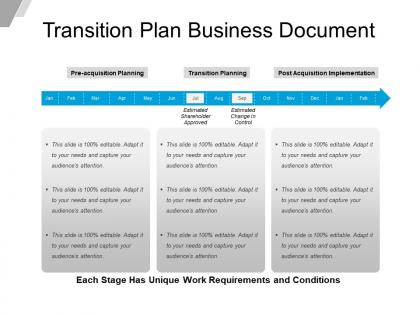
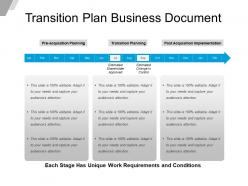
Are you fed up with failure? Looking for managing the transition phase to satisfy your business requirements? If yes, then use our predesigned transition plan business document PowerPoint templates PPT template to manage it efficiently. You can use this project transition plan template to display series of tasks and activities to be performed to successful transition of project from implementation to maintenance phase. Design can also be used to prepare technology transition plan, strategic transition to operations plan. This document layout transition management PPT is perfectly fine to display various stages such as pre-acquisition, transition and post-acquisition planning of business system transition plan. Preparing a project management transition plan in a well-structured format will provide you an extra edge over the competitor firms. The design structure is so powerful, that it will attract your audience’s interest and let you explain each important business aspect in most understandable. So, don’t think too much, just download this amazing project transition plan template and use it to design unique presentations to meet your business requirements successfully. Create a host of alluring designs with our Transition Plan Business Document Powerpoint Templates. It allows you to fashion the clay.
People who downloaded this PowerPoint presentation also viewed the following :
Transition plan business document powerpoint templates with all 5 slides:
Help them figure out the best career to follow with our Transition Plan Business Document Powerpoint Templates. Guide them in finding their calling.

FAQs for Transition plan business
Effective transition plan templates should include clear timelines with milestones, detailed role assignments and accountability matrices, comprehensive communication protocols, risk assessment frameworks, and resource allocation guidelines. These components work together to streamline organizational changes, minimize operational disruptions, and ensure seamless knowledge transfer, with many companies finding that structured templates reduce transition time by 40% while maintaining service continuity.
Visual elements enhance transition plan clarity by incorporating flowcharts, timelines, progress indicators, milestone markers, and color-coded phases that simplify complex information. These design components streamline communication across stakeholders, enable faster decision-making, and reduce misunderstandings, with many organizations finding that visual presentations accelerate approval processes and enhance executive buy-in.
Common pitfalls include insufficient stakeholder involvement, unrealistic timelines, inadequate resource allocation, poor communication protocols, and lack of contingency planning. These oversights often derail transitions in organizations across sectors like healthcare mergers or technology implementations, with many companies finding that comprehensive templates addressing these areas ultimately deliver smoother transitions and minimize operational disruptions.
Stakeholders can be effectively engaged through structured communication frameworks, regular feedback sessions, role-specific training programs, collaborative workshops, and transparent progress reporting. These approaches streamline alignment by establishing clear expectations, addressing concerns proactively, and ensuring buy-in across departments, with many organizations finding that early stakeholder involvement ultimately reduces resistance and accelerates implementation timelines.
Timeline allocation serves as the structural backbone of transition plan templates, establishing clear phases, milestones, dependencies, and resource distribution across the entire transition process. It enables organizations to coordinate complex handovers systematically, minimize operational disruptions, and maintain accountability through defined deadlines, with many companies finding that strategic timeline management ultimately delivers smoother transitions and reduced implementation costs.
Cultural considerations significantly impact international transition plans through communication styles, decision-making processes, hierarchy structures, time orientations, and change acceptance patterns. These factors influence stakeholder engagement, training approaches, and implementation timelines, with many global organizations finding that culturally-adapted transition strategies deliver higher adoption rates, smoother integration, and ultimately stronger project outcomes across diverse markets.
Transition plan success metrics include timeline adherence, budget variance, stakeholder satisfaction scores, performance indicators, and risk mitigation effectiveness. These measurements enable organizations to track progress through quantifiable data, employee feedback, and operational benchmarks, with many companies finding that combining financial metrics with qualitative assessments ultimately delivers comprehensive insights and sustainable competitive advantage.
Technology integration in transition plan templates enhances collaboration through cloud-based platforms, real-time editing capabilities, automated workflow notifications, digital approval systems, and integrated communication tools. These solutions streamline handover processes by enabling simultaneous access, tracking progress updates, and maintaining version control, with many organizations finding that collaborative platforms reduce transition timelines while improving knowledge transfer accuracy.
Best practices for customizing transition plan templates include adapting timelines to industry-specific regulatory requirements, incorporating sector-relevant stakeholder roles, aligning communication protocols with industry standards, and integrating compliance checkpoints unique to each field. Healthcare organizations require HIPAA considerations while financial services need regulatory approval stages, with manufacturing focusing on operational continuity, ultimately ensuring seamless transitions that minimize disruption and maintain competitive advantage.
Transition plans align with organizational change management strategies by integrating communication frameworks, stakeholder engagement protocols, and phased implementation timelines that address resistance and build buy-in. Through strategic combination of change readiness assessments, training programs, and feedback mechanisms, organizations streamline transformation processes while minimizing disruption, ultimately delivering smoother transitions and enhanced employee adoption rates.
Nonprofits face unique challenges including limited budgets for transition planning, heavy reliance on volunteers who may lack succession expertise, and difficulty retaining institutional knowledge when key leaders depart. These organizations often struggle with board governance complexities, donor relationship continuity, and maintaining mission focus during leadership changes, with many finding that strategic transition templates help streamline processes while preserving organizational culture and stakeholder trust.
Feedback loops can be incorporated through regular milestone reviews, stakeholder assessment checkpoints, performance metric tracking, and iterative plan adjustments based on real-time data. These mechanisms enable organizations to identify implementation gaps early, adapt strategies dynamically, and ensure continuous improvement throughout transitions, with many companies finding that structured feedback cycles reduce project delays and enhance overall success rates.
Risk management strategies in transition plans involve identifying potential disruptions, establishing contingency protocols, defining clear escalation procedures, and creating rollback mechanisms for critical failures. Through systematic risk assessment frameworks, organizations can prioritize vulnerabilities, assign accountability for mitigation efforts, and maintain business continuity during transitions, ultimately delivering smoother implementations and reduced operational exposure.
Organizations can access transition plan templates, change management frameworks, stakeholder communication guides, timeline tracking tools, and risk assessment matrices to enhance their planning processes. These resources streamline project handovers, leadership transitions, and operational changes by providing structured methodologies, clear accountability measures, and proven implementation strategies, with many companies finding that comprehensive templates reduce transition timeframes while minimizing disruptions.
Success stories and case studies enhance transition plan templates by providing real-world validation, demonstrating proven methodologies, and building stakeholder confidence through tangible examples of successful transformations. These narratives enable organizations to showcase measurable outcomes like reduced implementation timelines, cost savings, and improved adoption rates, while illustrating best practices from similar industries, ultimately delivering strategic credibility and stakeholder buy-in.
-
Easy to edit slides with easy to understand instructions.
-
Best Representation of topics, really appreciable.