

Transition process





Try Before you Buy Download Free Sample Product
 Impress Your
 Audience
 100%
100% Editable
 Save Hours
 of Time


Create a stunning presentation by employing this Transition Process slideshow. Showcase the steps in the transition process such as setting objectives, agenda development, identification of methods for transition, defining timelines and roles and responsibilities, etc. Discuss the importance of managing the transition. You can showcase various ways by which you can help your employees to adapt to things that are going to be. Utilize this business transformation PPT layout, to discuss how you can help your employees to make a difficult process less stressful and disruptive. By taking the assistance of this content-ready change over PowerPoint visual, you can identify ‘whats’ and ‘hows’ of the proposed change and assess the impact on employees. Discuss strategies and principles, roles and responsibilities, organizational structure, budget responsibilities, individual capabilities, etc. Showcase the phases of transition by explaining the stages like ending, neutral zone, and beginning. Hence increase transition awareness among employees and managers at all levels by downloading this business change PowerPoint presentation.
People who downloaded this PowerPoint presentation also viewed the following :
Content of this Powerpoint Presentation
Description:
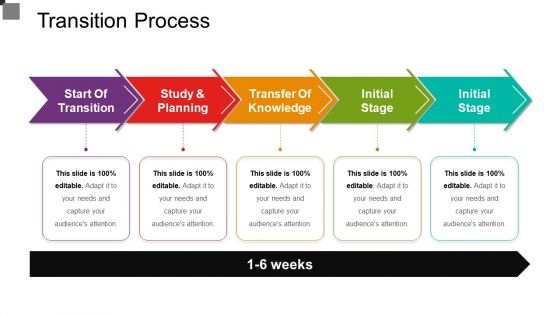
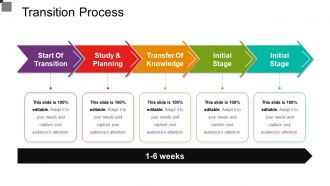
The image depicts a PowerPoint slide titled "Transition Process," which outlines the stages of a transition within a project or organization over a time frame of 1-6 weeks. The slide has a flowchart with five arrows, each representing a different phase of the process, and is designed to be fully editable for the user's specific needs.
The five stages are:
1. Start of Transition:
This is the beginning phase where the transition process is initiated.
2. Study & Planning:
In this phase, detailed planning and study take place to ensure a smooth transition.
3. Transfer of Knowledge:
Here, knowledge transfer occurs, which is critical to the success of the transition.
4. Initial Stage:
This represents the early stages of implementation.
5. Initial Stage:
This is likely a continuation of the previous phase, possibly a typo and should indicate a subsequent phase, such as the "Final Stage" or "Completion."
Use Cases:
This type of transition slide can be particularly useful in the following industries:
1. Information Technology:
Use: Illustrating a software migration plan
Presenter: IT Project Manager
Audience: Stakeholders, IT team
2. Human Resources:
Use: Outlining the onboarding process for new employees
Presenter: HR Manager
Audience: New employees, HR staff
3. Education:
Use: Describing the curriculum transition plan
Presenter: Academic Coordinator
Audience: Teachers, administrative staff
4. Healthcare:
Use: Detailing a new healthcare program implementation
Presenter: Health Services Manager
Audience: Medical staff, administrators
5. Manufacturing:
Use: Planning for a shift in production methods
Presenter: Operations Manager
Audience: Floor managers, production team
6. Marketing:
Use: Deploying a new marketing campaign
Presenter: Marketing Director
Audience: Marketing team, sales force
7. Consulting:
Use: Presenting a change management strategy
Presenter: Lead Consultant
Audience: Client company representatives, consulting team
Transition process with all 5 slides:
Abandon all fears of failure. Our Transition Process are geared to win.


FAQs for Transition process
Honestly, it all comes down to getting your leaders to actually show up - not just fire off those "embrace change!" emails while they keep doing the same old stuff. Communication is huge too. Map out who has real influence on your team and win them over first. People resist when they're scared, so tackle the "what's in it for me" question right away. Don't skip training or rush timelines either. Oh, and definitely celebrate those small victories! Your team needs to feel involved from the start, not like change is just happening to them.
Honestly, just talk to people constantly during transitions - way more than feels necessary. I've watched so many changes crash and burn because managers disappeared when things got messy. Use everything - emails, quick huddles, random check-ins. People get super anxious when they don't know what's happening, so be transparent about the good AND the bad stuff. Oh, and actually let them ask questions instead of just broadcasting updates. Set up those regular touchpoints early because the first few weeks are always chaos no matter how well you plan. Trust me, you can't overcommunicate this stuff.
Honestly, you're like the steady presence when everything's chaos. Be super clear about what's changing and why - people hate being left in the dark. Yeah, transitions suck (they just do), so don't pretend otherwise. Make yourself available for questions, even the dumb ones. Here's the thing though - don't just tell people what's happening TO them. Get them involved in figuring out how you'll all handle it together. That makes a huge difference. Balance being real about the challenges while still showing you believe things will work out. Oh, and be visible! Can't stress that enough.
Honestly, the worst thing you can do is try changing everything overnight. People get overwhelmed and nothing actually sticks. Communication is huge too - when folks don't know what's going on, they start freaking out and making up stories. I always think I can get stuff done faster than reality allows (whoops). Getting key people involved early saves so much headache later. You can't just drop a bombshell announcement and expect magic to happen. Oh, and buffer time! Things always take longer than planned. Start with small changes, over-communicate everything, and give yourself breathing room for when stuff inevitably goes sideways.
Honestly, data analytics is like having a GPS for your transition - shows you what's really going on vs what you think is happening. Track your KPIs to spot which parts are struggling during the change. You'll catch bottlenecks early before they blow up into bigger headaches. Employee adoption rates are huge to monitor too. Predictive stuff helps you see problems coming, which is clutch when you're already drowning in everything else. I'd pick maybe 3-5 metrics that actually matter for your success and check them weekly. Don't go overboard with tracking every little thing.
Honestly, the biggest thing is just talking to people constantly during the transition. Walk through stuff with them first before handing over written guides - I know it's more work but trust me on this. Check in regularly so small issues don't blow up later. Train more than one person on the important stuff (learned that one the hard way). Give everyone practice time before you flip the switch. Oh, and ask for feedback on how the training's going - you'll probably need to tweak your approach anyway. Most transitions are messier than you expect, so stay flexible.
Honestly, company culture can totally make or break how smoothly you transition. Supportive places will have your back and give you real feedback. Rigid environments though? Good luck - even basic stuff becomes a nightmare. What really matters is whether people feel safe admitting they're lost or confused. That's when you actually learn fast. Oh, and here's what I'd focus on early: watch how decisions really get made, not what their fancy handbook claims. People's actual communication style tells you way more. Then you can figure out how to fit in without losing your mind.
Look, getting stakeholders involved early is honestly make-or-break for any transition. People hate feeling like change is happening *to* them instead of *with* them. When you bring them into planning from the start, they actually help solve problems instead of creating new ones. Plus they know all the weird quirks about current processes that you'd never think of - stuff that could totally derail things later. The trick is figuring out who really has influence (not just who's loudest) and getting their input during planning, not just sending them updates after decisions are made. Trust me, it saves so much headache down the road.
Honestly, you need both the hard numbers and the softer feedback stuff. Check if you're hitting deadlines and staying on budget - that's the obvious part. Employee satisfaction surveys are clutch though, because unhappy people will just leave. I'd also do some quick pulse surveys or informal chats to see how people actually feel about the changes (not just what they think you want to hear). Track how well the knowledge transfer went too. Maybe set up a simple monthly check-in so you can fix things before they get worse. Oh, and don't ignore adoption rates for new processes - that tells you if changes are actually sticking.
Honestly, start with project management tools like Asana or Monday - they're game changers for tracking handoffs. Cloud storage means everyone can grab the latest files without that awkward "which version?" conversation. Slack threads will save your sanity instead of those never-ending email chains (seriously, my inbox used to be a nightmare). Automation handles the boring repetitive stuff so you can focus on decisions that actually matter. Map out what's driving you crazy first, then tackle your biggest pain point with one tool. Don't try to fix everything at once - that's how you end up overwhelmed.
Honestly? Most corporate changes fail because of terrible communication, not bad ideas. Leadership says one thing, middle managers hear something else, then frontline people get totally different messages. Yahoo's constant restructuring was like watching this trainwreck in slow motion. Companies also rush everything without giving people actual support. Humans need time to adjust - skip that and you get pushback everywhere. Over-communicate what you're doing and give folks proper training. Seems obvious but apparently it's not.
Honestly, just start small and don't blow up your whole operation trying to innovate. Pilot programs are your friend here - I've watched way too many companies go big and face-plant hard. Build those feedback loops so you can pivot fast when things go sideways. Give your team clear boundaries on what risks they can take, then let them loose within those limits. There's this 70-20-10 thing that actually works pretty well: most of your stuff should be proven approaches, some calculated risks, and maybe 10% crazy experiments. The "safe-to-fail" mindset is clutch - you want people testing ideas without gambling the business away.
Yeah, transitions mess with people's heads big time. Most folks go through those grief stages - denial, anger, the whole thing. Nobody likes not knowing what's coming next, so anxiety goes through the roof. You'll see productivity tank at first and people either shut down or get super resistant. Communication is huge here - like, over-communicate if you have to. The grieving thing sounds dramatic but it's real - people mourn their old routines more than you'd think. Just normalize that it sucks for a while.
Honestly, getting different departments to actually talk to each other is a game-changer for transitions. HR, IT, your new manager, facilities - when they're all on the same page, you won't be sitting there laptop-less on day one. Trust me, those little details matter way more than people think. Have one person run point between everyone so there's no confusion about who's doing what. A shared checklist helps too - nobody wants that awkward "wait, I thought YOU were handling the parking pass" situation. It's basically about avoiding all those weird gaps that make new people feel lost.
Look, feedback mechanisms are honestly your lifesaver during transitions. Set up regular check-ins and surveys from day one - you'll catch problems while they're still manageable instead of waiting for everything to blow up. Multiple touchpoints work best in my experience. Pulse meetings, quick surveys, whatever gets people talking. The whole point is getting real insights from actual users, not just guessing what might work. Small issues turn into nightmares fast if you're not paying attention. When people give you feedback, actually do something with it - otherwise why bother asking?
-
Best way of representation of the topic.
-
Use of different colors is good. It's simple and attractive.