


Change Management Proposal Powerpoint Presentation Slides





Try Before you Buy Download Free Sample Product
 Impress Your
 Audience
 100%
100% Editable
 Save Hours
 of Time


Showcase your advanced tools and high skills to overcome the business challenges by using our content ready Change Management Proposal PowerPoint Presentation Slides. With the aid of this engaging business process proposal PPT layout, you can highlight various problem-solving methods that your company offers that makes it easier for the client to resolve business-related queries. You can portray your technical expertise that helps the user to implement the desired change in their organization needs. Talk about your various offerings like design services, digital services, marketing sales, analytics and data interpretations, operations, risk management, and finance strategy that hold the attention of your consumer. Take the assistance of business transformation proposal PowerPoint graphic to elaborate on three phases of action plan like research and inspection, material purchase, programming and testing that guides the client to monitor their day-to-day work. In this PPT template, you can portray your client testimonials and a huge customer base with ease. Determine the work efficiency & potential capabilities of your employees and introduce them to your clients to hold their interest. Use corporate management proposal PowerPoint presentation slides to illustrate different solutions like leverage formal solutions, lead with the culture, and leverage informal solutions. You can also demonstrate multiple business functions that are useful to lead the business path to acquire customer insights. With the help of this PowerPoint layout, you can display the timeline plans and new communication strategies that easily accomplish the project. Employ the business transition proposal PowerPoint theme and emphasize on computerized frameworks to deal with the business operations. You can showcase the problem-solving approaches that help your clients to tackle the errors and issues related to the business. Download our ready-to-use organizational development proposal PPT layout and list out the several principles of change management to benefit your client’s business in every possible way.
People who downloaded this PowerPoint presentation also viewed the following :
Content of this Powerpoint Presentation
Slide 1: This slide introduces Change Management Proposal. State Client details and begin.
Slide 2: This slide displays Cover Letter for Change Management Proposal.
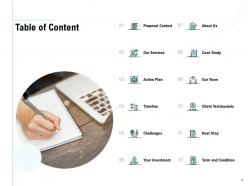
Slide 3: This slide displays Table of Content.
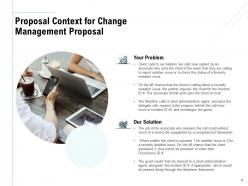
Slide 4: This slide showcases Proposal Context for Change Management Proposal.
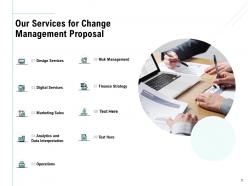
Slide 5: This slide depicts Our Services for Change Management Proposal.
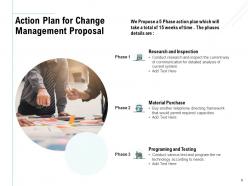
Slide 6: This slide displays Action Plan for Change Management Proposal. We Propose a 5 Phase action plan which will take a total of 15 weeks of time.
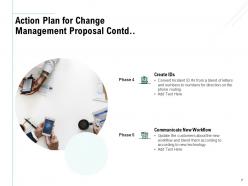
Slide 7: This slide is continued with Action Plan for Change Management Proposal.
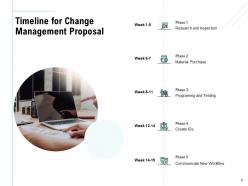
Slide 8: This slide depicts Timeline for Change Management Proposal.
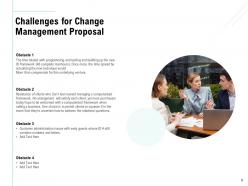
Slide 9: This slide presents Challenges for Change Management Proposal.
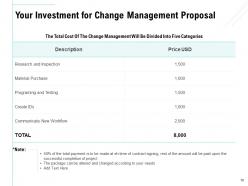
Slide 10: This slide depicts Your Investment for Change Management Proposal.
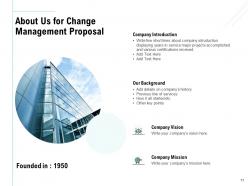
Slide 11: This is About Us slide with Company Mission, Vision, and Goals.
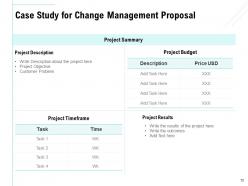
Slide 12: This slide displays Case Study for Change Management Proposal.
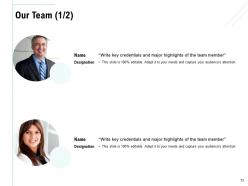
Slide 13: This is Our Team slide with names and designations.
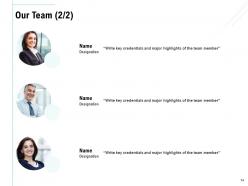
Slide 14: This is Our Team slide with names and designations.
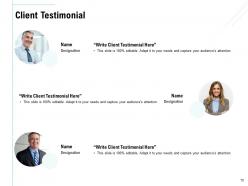
Slide 15: This slide represents Client Testimonial with names and designations.
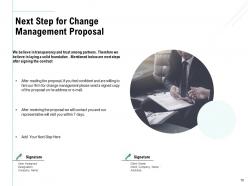
Slide 16: This slide represents Next Step for Change Management Proposal.
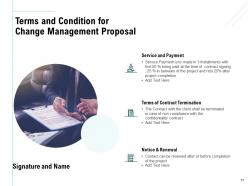
Slide 17: This slide showcases Terms and Condition for Change Management Proposal.
Slide 18: This is Contact Us slide with Company logo, Company name, Website and Phone number.
Slide 19: This slide is titled as Additional Slides for moving forward.
Slide 20: This is Our Mission slide with Mission, Vision and Goals.
Slide 21: This slide depicts Timeline process.
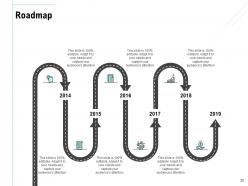
Slide 22: This slide displays Roadmap process.
Slide 23: This is 30 60 90 Days Plan slide.
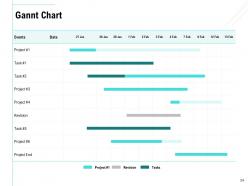
Slide 24: This slide displays Gannt Chart.
Change Management Proposal Powerpoint Presentation Slides with all 24 slides:
Use our Change Management Proposal Powerpoint Presentation Slides to effectively help you save your valuable time. They are readymade to fit into any presentation structure.
FAQs for Change Management Proposal
Honestly, most of it comes down to getting people involved instead of just dropping changes on them. Leadership has to actually care - can't fake that part. Communication is huge too, but focus on explaining WHY you're changing things, not just what's happening. People will push back (totally normal btw), so plan for it. Get your supporters on board early since they'll carry you through the rough patches. Oh, and don't expect anyone to figure out new stuff without proper training - that's just asking for disaster.
Honestly, start with your people - survey them about how they handle change because that'll tell you everything. Past experiences really matter here. Check if your current processes can actually bend without breaking, then look at whether leadership genuinely supports this stuff (spoiler: they often say they do but don't really). Your communication setup matters too - can you actually reach everyone when things get messy? I'd make a basic scorecard to track all this. The whole point is catching problems before they blow up your plans, which... trust me, they will if you don't prep properly.
Honestly, leadership makes or breaks these things. If they're not bought in, you're screwed from day one. They need to explain WHY you're changing, not just dump the new process on everyone. I've watched so many projects crash because executives gave some kickoff speech then vanished completely. Your leaders have to actually walk the walk - model what they want to see. Deal with pushback directly too. Oh, and give people the tools they need to succeed. Seriously though, don't even start if leadership isn't genuinely committed. Total waste of time.
Start by figuring out who you're talking to and what they actually want to hear. Executives? They want ROI numbers and big picture strategy stuff. Regular employees are mostly worried about how this'll mess with their daily routine. Middle managers are just trying not to get crushed between the two - honestly feel bad for them sometimes. Then think about HOW you're delivering the message. Executives love those clean dashboard summaries, but your frontline people need real details. FAQs work great, or better yet, do town halls where they can actually ask questions. Match your approach to what each group responds to best.
Oh man, the worst thing companies do? They just drop major changes on people without explaining why. Gets everyone immediately pissed off. Communication is everything - honestly, most leadership sucks at this part. Also, they think change happens way faster than it actually does. Like, add six months to whatever timeline you're thinking lol. Here's what really gets me though: they focus on all the process stuff but completely ignore that people are freaking out emotionally. Give folks time to vent their concerns first, then move forward.
Talk to them constantly - seriously, you can't overcommunicate during change. People need to hear things like 3-4 times before it actually clicks. Be super transparent about what's going down and how it'll hit their day-to-day work. Set up town halls, feedback sessions, whatever works for your culture. Coffee chats are honestly underrated for this stuff. Listen to their concerns and jump on addressing them fast. Here's the key though - get them involved in planning when you can. Once people help build the plan, they're way more bought in. Trust me on that one.
For big transformations, Kotter's 8-step process works really well. ADKAR is solid for getting individuals on board with changes. If your company moves fast and pivots a lot, Lean Change Management might be better - though honestly I used to think methodology was everything until I learned the hard way that leadership buy-in trumps everything else. Start with change readiness assessments and stakeholder mapping. Pulse surveys help you track how things are going. The key is figuring out your specific situation first, then picking whatever framework actually fits your timeline and culture.
Missed meetings and sudden "I'm too busy" excuses are dead giveaways. Also listen for classics like "we've always done it this way" – total red flag territory. Get the complainers involved in planning instead of fighting them. Address their actual concerns, not just what you think they should care about. People need to understand WHY you're changing things, not just get a list of new rules. Quick wins help too since momentum is everything. Oh, and here's the thing – treat pushback as useful feedback rather than sabotage. Half the time they're pointing out real problems you missed anyway.
Honestly, you need both the numbers and the feelings stuff. Track your adoption rates, productivity, error rates - the usual suspects. But don't ignore employee engagement and how people actually feel about the changes. I learned this the hard way once. Numbers can lie sometimes - like if 90% of people are using the new system but they hate it, that's gonna bite you later. Do pulse surveys for sure, but also just walk around and talk to people. Oh and timeline stuff matters too obviously. The soft metrics tell you if changes will actually stick long-term.
Think of your company culture and structure like DNA - they totally dictate how change happens. Rigid hierarchy means everything crawls through approval chains. People sit around waiting for the green light. But collaborative cultures? Change actually spreads because folks talk to each other (crazy concept, right?). Structure controls who makes decisions and how info flows. Culture decides if your team will embrace change or fight it tooth and nail. You can't bulldoze through either one. Map out who the real influencers are - not just the people on the org chart, but who actually moves things behind the scenes.
Honestly, the biggest mistake people make is treating change like a checkbox - do the training, send the email, done. Wrong approach entirely. You've got to bake it into everything: how people get rewarded, what processes look like, daily habits. Leadership has to keep modeling the behavior months later or everyone just goes back to the old way. Quick wins help a ton for keeping people motivated. Oh, and build in ways to catch when things are sliding backward - because they will. Start by figuring out what systems actually need to change to support this new direction.
Honestly, tech makes change management so much less of a headache. Slack or Teams keeps everyone talking instead of playing telephone. Project management tools let you actually see who's on board and who's dragging their feet. Analytics help you catch the complainers before they derail everything - which is clutch because there's always that one department that fights change just because. E-learning platforms beat boring PowerPoints any day for training people. The best part? Having all your data centralized so you're not guessing what's broken. Just pick whatever fixes your biggest mess first and go from there.
Oh man, don't wait until the last minute - that's when everyone panics and retains nothing. Break training into smaller chunks because honestly, after like 90 minutes people's brains just shut off. Explain WHY you're changing things, not just what buttons to click. People hate feeling clueless about the reasoning. Mix it up with videos, hands-on practice, maybe pair people up for peer coaching. And definitely check in with your team to see what's clicking and what isn't - you'll probably need to tweak your approach anyway.
Don't wait until the end to ask for feedback - that's a rookie mistake I see all the time. Build it right into each step instead. Quick pulse surveys work great, plus those 15-minute team check-ins (honestly, people love having their voices heard). Anonymous channels are clutch too since not everyone's comfortable speaking up directly. Here's the thing though - you've gotta actually DO something with what they tell you. Share back what you learned and how you're tweaking things. Weekly retrospectives are perfect for starting this habit. Trust me, feedback should be ongoing, not some one-and-done thing.
Oh man, Netflix is like the poster child for this - they basically killed their own DVD cash cow before anyone else could. Smart move. Microsoft did something similar when Nadella took over, moving away from being all about Windows to focusing on cloud stuff. Even tiny local businesses during COVID had to completely flip their models. What's interesting is the successful ones always made sure everyone understood *why* they were changing, not just what was changing. Leaders who got their teams on board at every level seemed to pull it off better. You should definitely dig into how they actually communicated those changes.
-
Enough space for editing and adding your own content.