


Cyber Security Incident Response Plan Checklist





Try Before you Buy Download Free Sample Product
 Impress Your
 Audience
 100%
100% Editable
 Save Hours
 of Time


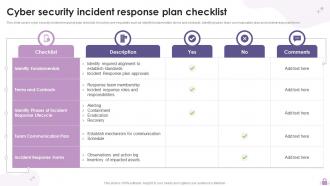
This slide covers cyber security incident response plan checklist. It involves pre requisites such as identify fundamentals, terms and contracts, identify phases, team communication plan and incident response forms.
People who downloaded this PowerPoint presentation also viewed the following :
Cyber Security Incident Response Plan Checklist with all 6 slides:
Use our Cyber Security Incident Response Plan Checklist to effectively help you save your valuable time. They are readymade to fit into any presentation structure.





FAQs for Cyber Security Incident
The most common cyber threats include phishing attacks, ransomware, malware, data breaches, and insider threats. These security challenges impact organizations by compromising sensitive information, disrupting operations, and creating financial losses, with many businesses finding that proactive cybersecurity measures and employee training ultimately deliver enhanced protection and competitive advantage.
Organizations can enhance cybersecurity awareness through regular training programs, simulated phishing exercises, role-specific security protocols, interactive workshops, and continuous education updates. These comprehensive approaches streamline security culture by reducing human error, improving threat recognition, and strengthening incident response capabilities, with many companies finding that engaged, well-trained employees ultimately deliver stronger organizational resilience and significantly lower breach risks.
Artificial intelligence enhances modern cybersecurity through automated threat detection, behavioral analytics, predictive risk assessment, real-time response systems, and adaptive learning capabilities. AI enables organizations to identify sophisticated attacks faster than traditional methods, with financial institutions and healthcare providers finding that machine learning algorithms significantly reduce response times while minimizing false positives, ultimately delivering proactive defense and operational efficiency.
Data breaches significantly erode customer trust and damage brand reputation by exposing sensitive information, creating financial liability concerns, and demonstrating security vulnerabilities. These incidents often result in customer churn, reduced market confidence, and long-term reputational damage, with many companies finding that recovery requires extensive transparency efforts, enhanced security investments, and consistent communication to rebuild stakeholder trust.
Key cybersecurity compliance regulations include GDPR for data protection, HIPAA for healthcare data, PCI DSS for payment processing, SOX for financial reporting, and ISO 27001 for information security management. These frameworks enhance organizational security by establishing standardized protocols, mandatory risk assessments, and regular auditing procedures, ultimately delivering regulatory compliance and competitive advantage in increasingly regulated markets.
Small businesses can effectively manage cybersecurity through strategic prioritization, including employee training, regular software updates, strong password policies, and cloud-based security solutions. Many small enterprises find that combining affordable tools like multi-factor authentication, automated backups, and managed security services delivers comprehensive protection while minimizing costs, ultimately enabling competitive operations without compromising digital security.
Strong password practices include using 12+ character combinations with uppercase, lowercase, numbers, and symbols, avoiding personal information, enabling multi-factor authentication, and implementing unique passwords per account. Password managers like Bitwisan or LastPass streamline this process by generating complex passwords, securing credentials across platforms, and enabling single sign-on capabilities, with many organizations finding that centralized password management significantly reduces security breaches while enhancing operational efficiency.
Remote work significantly expands an organization's attack surface by introducing unsecured home networks, personal devices, and weaker endpoint controls, while reducing IT visibility and oversight. However, many organizations are finding that strategic investments in cloud-based security tools, zero-trust architectures, and enhanced employee training ultimately deliver stronger, more adaptive security frameworks than traditional perimeter-based approaches.
IoT expansion significantly amplifies cybersecurity risks through increased attack surfaces, device vulnerabilities, weak authentication protocols, and data privacy concerns across interconnected networks. With smart homes, industrial systems, and healthcare devices creating millions of entry points, organizations face escalating threats requiring comprehensive security frameworks, ultimately demanding strategic investment in monitoring and protection infrastructure.
Organizations measure cybersecurity effectiveness through key performance indicators like incident response times, threat detection rates, vulnerability assessment scores, compliance audit results, and security awareness training completion rates. These metrics enable leadership teams to track risk reduction, operational resilience, and regulatory compliance, while benchmarking against industry standards ultimately delivers measurable ROI and enhanced stakeholder confidence.
Emerging cybersecurity technologies include artificial intelligence for threat detection, zero-trust architecture, quantum encryption, behavioral analytics, and automated response systems. These technologies enhance security by predicting attacks before they occur, eliminating implicit trust assumptions, and enabling real-time threat mitigation, with many organizations finding that strategic combinations deliver significantly stronger defenses.
Businesses respond to ransomware attacks through incident response protocols, system isolation, backup restoration, and forensic analysis, while avoiding ransom payments when possible. Organizations strengthen defenses by implementing multi-layered security, regular backup testing, employee training, and zero-trust architectures, with many finding that proactive measures significantly reduce recovery time and operational disruption.
Ethical cybersecurity considerations include informed consent for data collection, transparent privacy policies, minimizing data retention, ensuring secure storage practices, and respecting user rights to access or delete information. These principles help organizations balance security needs with privacy expectations, with many financial services and healthcare institutions finding that ethical data practices ultimately enhance customer trust, reduce regulatory risks, and deliver competitive advantage in increasingly privacy-conscious markets.
Effective incident response plans are developed through comprehensive threat assessment, clear role definitions, detailed communication protocols, regular training programs, and systematic testing procedures. Organizations across sectors like healthcare, finance, and retail streamline recovery efforts by establishing automated detection systems, predefined escalation pathways, and cross-functional response teams, ultimately minimizing downtime and protecting critical assets.
Regular security audits and vulnerability assessments are critical for identifying system weaknesses, ensuring compliance requirements, monitoring threat landscapes, and maintaining robust defense mechanisms. These strategic evaluations enable organizations across sectors like banking, healthcare, and retail to proactively address security gaps, reduce breach risks, and enhance operational resilience, ultimately delivering stronger customer trust and competitive advantage.
-
The visual appeal of the templates is just unparalleled! I was so worried about the design of my presentation but SlideTeam made it all so easy.
-
“I've always gotten excellent slides from them and the customer service is up to the mark.”