


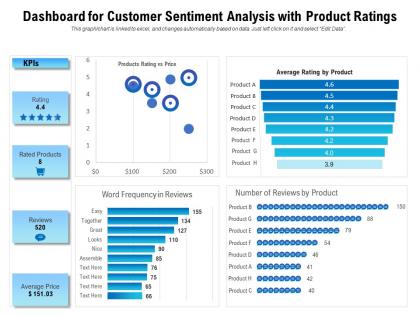
Dashboard for customer sentiment analysis with product ratings




Try Before you Buy Download Free Sample Product
 Impress Your
 Audience
 100%
100% Editable
 Save Hours
 of Time


Our Dashboard For Customer Sentiment Analysis With Product Ratings are explicit and effective. They combine clarity and concise expression.
People who downloaded this PowerPoint presentation also viewed the following :
Dashboard for customer sentiment analysis with product ratings with all 2 slides:
Give your audience a fulfilling experience. They will find our Dashboard For Customer Sentiment Analysis With Product Ratings elevating.
FAQs for Dashboard for customer sentiment analysis
Key customer sentiment metrics include Net Promoter Score (NPS), Customer Satisfaction Score (CSAT), sentiment polarity ratings, response volume trends, and emotion classification breakdowns across touchpoints. These metrics enable organizations to track brand perception shifts, identify service pain points, and measure campaign effectiveness in real-time, with many retail and hospitality companies finding that comprehensive sentiment tracking ultimately delivers faster issue resolution and enhanced customer experiences.
Natural language processing enhances sentiment analysis in dashboards by automatically categorizing emotions, identifying contextual nuances, and processing multiple languages simultaneously. Through advanced NLP algorithms, organizations can analyze customer feedback, social media mentions, and support interactions in real-time, while detecting sarcasm and sentiment intensity, ultimately delivering more accurate insights and faster response capabilities.
Best practices for visualizing customer sentiment data include color-coded sentiment scales, trend line charts, geographic heat maps, category breakdowns, and real-time monitoring dashboards. These visualization methods enhance decision-making by enabling quick pattern recognition, sentiment distribution analysis, and actionable insights identification, with many retail and hospitality organizations finding that strategic dashboard design ultimately delivers faster customer issue resolution and improved satisfaction rates.
Sentiment data should be updated in real-time or hourly for customer service applications, daily for marketing campaigns, and weekly for strategic planning initiatives. Through automated monitoring systems, organizations in retail, banking, and hospitality can detect emerging trends, respond to negative feedback promptly, and adjust strategies quickly, ultimately delivering more responsive customer experiences and competitive advantage.
Tools for integrating sentiment analysis into dashboards include Tableau with sentiment connectors, Power BI's cognitive services, Google Data Studio with natural language APIs, Qlik Sense analytics, and specialized platforms like Brandwatch or Hootsuite Insights. These solutions streamline data visualization by automatically processing customer feedback, social media mentions, and survey responses, ultimately delivering real-time sentiment insights that enhance decision-making across marketing, customer service, and product development teams.
Businesses can use customer sentiment dashboards to improve product development by analyzing feedback patterns, identifying feature gaps, prioritizing development resources, and tracking satisfaction trends across customer segments. Through real-time sentiment analysis, companies in retail, software, and consumer goods can streamline product iterations, enhance user experiences, and accelerate time-to-market, ultimately delivering products that better align with customer expectations.
Social media plays a pivotal role in customer sentiment tracking by providing real-time feedback, unfiltered opinions, and authentic customer interactions across platforms like Twitter, Facebook, and Instagram. These channels enable businesses to monitor brand perception, identify emerging issues, and gauge customer satisfaction instantly, with many retail and hospitality companies finding that social sentiment data delivers faster response times and enhanced customer relationship management.
Sentiment analysis enables crisis management by monitoring real-time public opinion across social media, news outlets, and customer feedback channels, allowing organizations to detect emerging issues early and gauge response effectiveness. Through automated sentiment tracking, companies can quickly identify negative sentiment spikes, assess reputational impact, and adjust communication strategies accordingly, ultimately delivering faster crisis containment and more targeted stakeholder messaging.
**INPUT**: What are the challenges in interpreting sentiment data accurately? **OUTPUT**: Interpreting sentiment data accurately faces challenges including context confusion, sarcasm detection, cultural nuances, mixed emotions, and language variations that automated systems struggle to parse. These complexities require strategic combination of AI tools with human oversight, with many organizations finding that layered approaches using multiple sentiment models, regular calibration, and industry-specific training ultimately deliver more reliable customer insights and competitive advantage. [Word count: 60 words]
Customer segmentation significantly enhances sentiment analysis accuracy by grouping customers with similar characteristics, behaviors, and preferences, enabling more targeted and contextual interpretation of feedback. Different segments often express sentiments differently based on their expectations and experiences, with luxury customers focusing on service quality while budget-conscious segments prioritize value, ultimately delivering more actionable insights for personalized strategies.
Relying solely on sentiment analysis presents challenges including misinterpretation of sarcasm, cultural context gaps, data bias, and overlooking quantitative metrics like sales performance or operational efficiency. While sentiment analysis enhances customer understanding, organizations increasingly combine it with behavioral data, financial metrics, and direct feedback, ultimately delivering more comprehensive insights for strategic decision-making.
Sentiment analysis can be tailored through industry-specific lexicons, customized model training, and sector-relevant data sources that account for unique terminology and context. Financial services leverage transaction-based sentiment indicators, while healthcare focuses on patient experience metrics and retail emphasizes product feedback, ultimately delivering more accurate insights and strategic competitive advantage across diverse business environments.
Ethical considerations include data privacy compliance, transparent consent processes, algorithmic bias prevention, secure data storage, and respectful customer communication boundaries. Organizations must balance valuable sentiment insights with responsible data stewardship, ensuring analysis enhances customer experiences while protecting individual privacy rights, with many companies finding that ethical practices ultimately strengthen customer trust and loyalty.
Machine learning algorithms enhance sentiment dashboard accuracy by processing natural language patterns, contextual nuances, and evolving customer expressions more effectively than traditional rule-based systems. These algorithms continuously learn from feedback data, adapt to industry-specific terminology, and distinguish subtle emotional indicators, with many retail and financial services organizations finding significantly improved prediction rates and reduced false sentiment classifications.
Comparing customer sentiment over time reveals patterns in satisfaction, identifies seasonal trends, tracks the impact of product launches or service changes, and highlights emerging issues before they escalate. These temporal insights enable businesses to measure campaign effectiveness, predict customer behavior, and optimize retention strategies, with many organizations finding that sentiment tracking ultimately delivers proactive customer management and sustained competitive advantage.
No Reviews