


Data AI Intelligence For App Lifecycle Strategize Data AI Artificial Intelligence AI SS




Try Before you Buy Download Free Sample Product
 Impress Your
 Audience
 100%
100% Editable
 Save Hours
 of Time


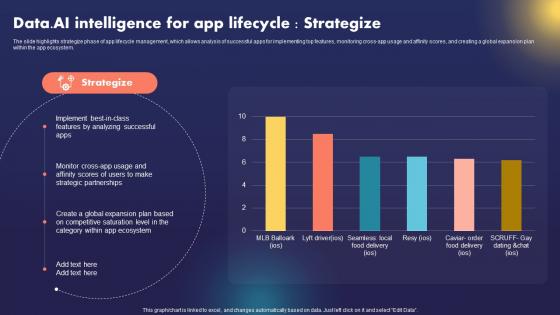
The slide highlights strategize phase of app lifecycle management, which allows analysis of successful apps for implementing top features, monitoring cross-app usage and affinity scores, and creating a global expansion plan within the app ecosystem.
People who downloaded this PowerPoint presentation also viewed the following :
Data AI Intelligence For App Lifecycle Strategize Data AI Artificial Intelligence AI SS with all 10 slides:
Use our Data AI Intelligence For App Lifecycle Strategize Data AI Artificial Intelligence AI SS to effectively help you save your valuable time. They are readymade to fit into any presentation structure.








FAQs for Data AI Intelligence For App Lifecycle Strategize Data AI Artificial
Traditional data analysis relies on predefined rules, statistical models, and manual interpretation, while AI-driven analysis uses machine learning algorithms, pattern recognition, and automated insights generation. Through AI technologies, organizations streamline complex data processing, uncover hidden correlations, and predict future trends more accurately, with many financial services and retail companies finding that AI delivers faster decision-making and competitive advantages.
Businesses can leverage AI intelligence by implementing predictive analytics, real-time data processing, automated pattern recognition, and machine learning algorithms that analyze vast datasets quickly and accurately. Through these technologies, organizations in sectors like retail, healthcare, and finance streamline operations, minimize risks, and identify market opportunities faster, ultimately delivering competitive advantages and more informed strategic outcomes.
Machine learning contributes to data accuracy and reliability through automated error detection, anomaly identification, data validation algorithms, predictive cleaning techniques, and pattern recognition systems. These technologies streamline data quality processes by identifying inconsistencies, flagging outliers, and correcting errors in real-time, with many organizations finding that automated ML-driven validation ultimately delivers significantly more reliable datasets and faster decision-making capabilities.
Organizations should prioritize data privacy, algorithmic transparency, bias mitigation, consent management, and accountability frameworks when implementing AI data solutions. These considerations help ensure fair outcomes across diverse populations, maintain customer trust, and support regulatory compliance, with many financial institutions and healthcare providers finding that proactive ethical governance ultimately delivers competitive advantage and sustainable growth.
AI algorithms manage unstructured data through natural language processing, machine learning models, computer vision, and advanced analytics techniques that convert raw information into structured formats. These technologies streamline data processing by automating text analysis, image recognition, and pattern detection, with many organizations finding that AI-powered systems significantly reduce processing time while enhancing accuracy and operational efficiency.
Natural language processing enables organizations to extract meaningful insights from textual data by analyzing sentiment, identifying key themes, extracting entities, and understanding context within documents, emails, and customer feedback. Through NLP algorithms, companies in sectors like finance and healthcare can automate document analysis, monitor brand perception, and uncover customer preferences, ultimately delivering faster decision-making and enhanced operational efficiency.
**INPUT**: How can predictive analytics powered by AI impact customer relationship management? **OUTPUT**: AI-powered predictive analytics revolutionizes customer relationship management by analyzing behavioral patterns, predicting customer needs, identifying churn risks, and personalizing engagement strategies. Through advanced algorithms, businesses across retail, banking, and telecommunications can anticipate customer preferences, optimize timing for interactions, and deliver targeted offers, ultimately enhancing satisfaction while reducing acquisition costs. **Word count: 55 words**
Integrating AI tools into existing data infrastructure presents challenges including data silos, legacy system compatibility, security concerns, skill gaps, and scalability limitations. While these obstacles require strategic planning and investment, organizations across industries like healthcare and finance are finding that phased integration approaches, combined with staff training and robust data governance, ultimately deliver enhanced operational efficiency and competitive advantage.
Companies ensure data security and privacy through encryption, access controls, data anonymization, compliance frameworks, and regular security audits. These measures work by protecting sensitive information at rest and in transit, limiting unauthorized access, and meeting regulatory requirements like GDPR, with many organizations finding that strategic privacy-by-design approaches ultimately deliver competitive advantage while maintaining customer trust.
Organizations should track accuracy rates, processing speed, cost reduction percentages, user adoption rates, and ROI metrics to measure AI data initiative effectiveness. These measurements enable businesses to assess model performance, operational efficiency, and strategic value, with many financial services and healthcare institutions finding that combining quantitative metrics with qualitative feedback ultimately delivers comprehensive insights into AI impact and guides future investment decisions.
AI intelligence facilitates real-time data analysis by processing massive datasets instantly, identifying patterns through machine learning algorithms, and generating automated insights across multiple data streams simultaneously. Through advanced analytics platforms, organizations in banking, healthcare, and retail can detect anomalies, predict trends, and deliver immediate reports, ultimately enabling faster decision-making and competitive advantage.
Risks include algorithmic bias, data quality issues, lack of contextual understanding, over-reliance on historical patterns, and reduced human oversight in critical decisions. While AI streamlines analysis and accelerates insights, organizations increasingly find that combining AI capabilities with human judgment, domain expertise, and ethical oversight delivers more robust decision-making frameworks and sustainable competitive advantage.
Data quality variations significantly impact AI model performance through inconsistent accuracy, unreliable predictions, and compromised decision-making capabilities, with poor data leading to biased algorithms and flawed insights. Organizations across healthcare, finance, and retail find that investing in data cleansing, validation protocols, and quality management systems ultimately delivers more reliable AI outcomes, reduced operational risks, and enhanced competitive advantage.
Future trends in AI and data intelligence include autonomous decision-making systems, real-time predictive analytics, conversational AI interfaces, edge computing integration, and privacy-preserving machine learning techniques. These technologies streamline operations by automating complex processes, enhancing customer experiences, and delivering faster insights, with many organizations finding that early adoption provides significant competitive advantage in an increasingly data-driven marketplace.
Small and medium enterprises can leverage AI through cloud-based platforms, open-source tools, automated customer service chatbots, predictive analytics for inventory management, and AI-powered marketing automation. These cost-effective solutions enable SMEs to streamline operations, enhance customer experiences, and compete with larger organizations, with many finding significant returns through improved efficiency and reduced operational costs.
-
I had them make a presentation for an office retirement party. They were very helpful in understanding what we wanted and delivered the perfect presentation. Highly recommended!
-
The customer care of SlideTeam is very responsive. I was having a payment issue and they fixed it for me in no time.