


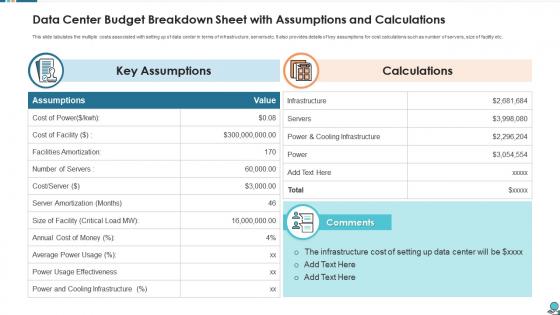
Data center budget breakdown sheet with assumptions and calculations




Try Before you Buy Download Free Sample Product
 Impress Your
 Audience
 100%
100% Editable
 Save Hours
 of Time


Our Data Center Budget Breakdown Sheet With Assumptions And Calculations are topically designed to provide an attractive backdrop to any subject. Use them to look like a presentation pro.
People who downloaded this PowerPoint presentation also viewed the following :
Data center budget breakdown sheet with assumptions and calculations with all 9 slides:
Use our Data Center Budget Breakdown Sheet With Assumptions And Calculations to effectively help you save your valuable time. They are readymade to fit into any presentation structure.








FAQs for Data center budget breakdown sheet with
Primary data center establishment costs include real estate and construction, power and cooling infrastructure, networking equipment, servers and storage systems, and security implementations. These components typically represent 60-70% of initial investment, with power infrastructure alone accounting for 25-30%, while organizations increasingly find that strategic planning across these areas delivers long-term operational efficiency and competitive advantage.
Energy consumption significantly impacts data center budgets by representing 20-40% of total operational costs, driving decisions around cooling systems, server efficiency, and infrastructure design. Higher energy usage increases monthly utility bills, requires more robust cooling solutions, and affects equipment lifespan, with many organizations finding that strategic energy optimization delivers substantial cost reductions and competitive advantage.
Location significantly influences data center cost efficiency through real estate prices, energy costs, climate conditions, and regulatory environments. Strategic placement in regions with lower electricity rates, favorable climates for natural cooling, and business-friendly policies can reduce operational expenses by 20-40%, with many enterprises finding that geographic optimization delivers substantial competitive advantages while enhancing service reliability.
Staffing costs significantly impact data center budgets through specialized technical personnel, 24/7 operational coverage, and ongoing training requirements. These expenses typically represent 20-30% of total operational costs, with organizations increasingly finding that investing in skilled staff reduces downtime incidents, enhances system efficiency, and ultimately delivers better service reliability than cost-cutting approaches.
Hardware procurement typically accounts for 40-60% of data center budgets, encompassing servers, storage systems, networking equipment, power distribution units, and cooling infrastructure. Organizations must balance initial capital expenditure with total cost of ownership, factoring in energy efficiency ratings, scalability requirements, and maintenance contracts, with many enterprises finding that investing in higher-efficiency hardware reduces long-term operational costs significantly.
Virtualization technologies significantly reduce data center costs by consolidating physical servers, minimizing hardware requirements, and decreasing power consumption and cooling expenses. These efficiencies enable organizations to reallocate budget from infrastructure maintenance to strategic initiatives, with many enterprises finding that virtualization delivers 30-50% operational savings while enhancing scalability and resource utilization.
Maintenance and support costs significantly impact data center budgets by typically consuming 15-25% of total operational expenses annually, encompassing hardware repairs, software updates, preventive maintenance, and technical support services. These ongoing expenses compound over time, with many organizations finding that proactive maintenance strategies ultimately reduce emergency repair costs and extend equipment lifecycles, delivering improved operational efficiency and predictable budget planning.
Cooling solutions typically consume 30-40% of a data center's operational budget through energy costs, equipment procurement, and maintenance expenses. These systems directly impact profitability by reducing server downtime, extending hardware lifespan, and optimizing energy efficiency, with many organizations finding that strategic cooling investments deliver significant long-term cost savings and competitive operational advantages.
Hidden data center costs include power infrastructure upgrades, cooling system redundancies, compliance certifications, emergency backup systems, and ongoing maintenance contracts often overlooked in initial planning. These expenses can increase total project costs by 20-40%, with many organizations finding that underestimating operational overhead, security implementations, and scalability requirements ultimately compromises budget accuracy and operational efficiency.
Cloud services integration fundamentally shifts data center budgets from capital-intensive hardware investments to operational expenditure models, reducing upfront costs while enabling scalable resource allocation. This transformation allows organizations to minimize physical infrastructure spending, decrease maintenance overhead, and optimize power consumption, with many enterprises finding that hybrid approaches deliver enhanced flexibility and predictable monthly costs.
Disaster recovery and redundancy typically require 15-25% of total data center budget, covering backup infrastructure, secondary site operations, network redundancy, and recovery testing procedures. Financial institutions and healthcare organizations often allocate higher percentages, with many finding that strategic investment in redundancy delivers significant cost savings during outages, ultimately protecting revenue streams and maintaining competitive advantage.
Compliance and regulatory requirements significantly impact data center budgets through mandatory security infrastructure, specialized monitoring systems, audit preparation costs, and staff training expenses. Industries like healthcare and financial services often allocate 15-25% of their data center budget to compliance measures, with many organizations finding that proactive compliance investment ultimately reduces long-term regulatory risks and potential penalties.
Data center budget optimization strategies include infrastructure consolidation, energy efficiency upgrades, predictive maintenance implementations, cloud hybrid migrations, and automated resource management systems. These approaches streamline operations by reducing power consumption, minimizing equipment redundancy, and enhancing operational efficiency, with many organizations finding that strategic combinations of virtualization and intelligent monitoring ultimately deliver 20-30% cost reductions while improving performance.
Data center budgets should be reviewed quarterly for operational adjustments and annually for strategic planning, with continuous monitoring of key cost drivers like energy, hardware refresh cycles, and capacity utilization. Many organizations increasingly implement monthly dashboards tracking power consumption, cooling efficiency, and infrastructure performance, enabling proactive budget modifications that optimize resource allocation, prevent costly overruns, and maintain competitive operational efficiency.
Capital expenditures include server hardware, networking equipment, storage systems, cooling infrastructure, and facility construction costs, while operating expenditures encompass power consumption, maintenance contracts, staffing, software licenses, and ongoing facility operations. Many organizations find that balancing these investments strategically enables better cash flow management, improved operational efficiency, and enhanced scalability, ultimately delivering competitive advantage in an increasingly data-driven business environment.
-
Innovative and attractive designs.
-
Easy to edit slides with easy to understand instructions.
-
Editable templates with innovative design and color combination.