

Data Lineage And Data Provenance Ppt Powerpoint Presentation Diagram Graph Charts




Try Before you Buy Download Free Sample Product
 Impress Your
 Audience
 100%
100% Editable
 Save Hours
 of Time


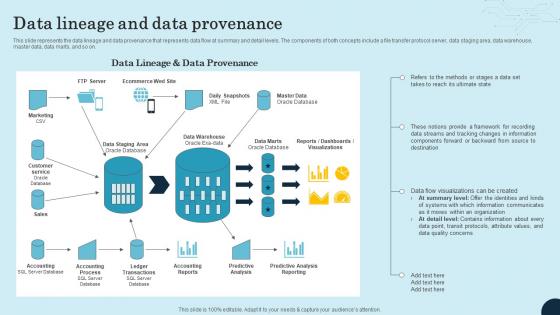
This slide represents the data lineage and data provenance that represents data flow at summary and detail levels. The components of both concepts include a file transfer protocol server, data staging area, data warehouse, master data, data marts, and so on.
People who downloaded this PowerPoint presentation also viewed the following :
Data Lineage And Data Provenance Ppt Powerpoint Presentation Diagram Graph Charts with all 6 slides:
Use our Data Lineage And Data Provenance Ppt Powerpoint Presentation Diagram Graph Charts to effectively help you save your valuable time. They are readymade to fit into any presentation structure.





FAQs for Data Lineage And Data Provenance Ppt Powerpoint Presentation
Key components of data lineage in modern data architecture include data sources, transformation processes, storage systems, processing engines, and consumption endpoints. These components work together by tracking data movement across pipelines, documenting transformation logic, and maintaining metadata relationships, with many organizations finding that comprehensive lineage enables faster troubleshooting, regulatory compliance, and enhanced data trust.
Data lineage enhances governance and compliance by providing complete visibility into data movement, transformation processes, and usage across systems, enabling organizations to track sensitive information and demonstrate regulatory adherence. Through automated lineage mapping, financial institutions, healthcare organizations, and retail companies can quickly identify data sources for audit requirements, ensure GDPR compliance, and maintain data quality standards, ultimately delivering transparency and reducing compliance risks.
Real-time data lineage tracking tools include Apache Atlas, Collibra, DataHub, Informatica Enterprise Data Catalog, and streaming platforms like Apache Kafka with lineage connectors. These technologies streamline monitoring by automatically capturing data transformations, maintaining comprehensive audit trails, and providing visual mapping capabilities, with many financial services and healthcare organizations finding that real-time visibility ultimately enhances compliance and accelerates decision-making processes.
Organizations leverage data lineage to improve data quality by tracking data sources, identifying transformation errors, and monitoring data flow inconsistencies throughout their systems. This visibility enables data teams to quickly pinpoint quality issues, implement targeted corrections, and establish automated quality checks at critical pipeline stages, with many enterprises finding that comprehensive lineage tracking reduces data errors by up to 40% while accelerating issue resolution.
Data lineage plays a critical role in migration and integration projects by providing comprehensive visibility into data sources, transformation processes, dependencies, and destination systems throughout the entire workflow. This mapping enables organizations to identify potential integration conflicts, validate data accuracy during migration phases, and ensure seamless connectivity between legacy and new systems, ultimately minimizing project risks and accelerating implementation timelines.
Visualizing data lineage enhances decision-making by providing clear transparency into data sources, transformations, and dependencies, enabling leaders to assess information reliability and identify potential risks. Through comprehensive data mapping, organizations streamline compliance reporting, accelerate root-cause analysis, and build stakeholder confidence in analytics, ultimately delivering faster strategic decisions and competitive advantage.
Implementing data lineage in legacy systems presents challenges including outdated documentation, complex interdependencies, incompatible data formats, manual tracking processes, and limited integration capabilities. These systems often lack modern APIs and metadata management, requiring significant investment in mapping existing data flows, while many organizations find that strategic modernization ultimately delivers improved compliance, operational efficiency, and competitive advantage.
Data lineage contributes to transparency by providing complete visibility into data sources, transformation steps, processing workflows, and analytical dependencies throughout the entire analytics pipeline. This comprehensive tracking enables organizations to understand exactly how insights are derived, validate analytical accuracy, and demonstrate compliance requirements, with many financial services and healthcare institutions finding that transparent lineage processes ultimately enhance stakeholder trust and regulatory confidence.
Data lineage facilitates better collaboration by providing shared visibility into data flows, transformations, and dependencies that both IT and business teams can understand. Through comprehensive lineage mapping, IT teams can quickly resolve data issues while business users gain transparency into how their reports and analytics are generated, ultimately reducing miscommunication and accelerating problem resolution across departments.
Regulatory requirements significantly shape data lineage practices by mandating comprehensive tracking, documentation, and auditability of data flows across systems and processes. Industries like banking, healthcare, and pharmaceuticals implement robust lineage frameworks to ensure compliance with regulations such as GDPR, HIPAA, and SOX, ultimately delivering enhanced data governance, reduced audit risks, and streamlined regulatory reporting capabilities.
Organizations should establish automated lineage tracking tools, standardize metadata documentation protocols, implement regular lineage audits, maintain clear data ownership assignments, and create visual lineage maps for stakeholders. These practices streamline compliance reporting, enhance data governance transparency, and accelerate impact analysis, with many financial services and healthcare institutions finding that comprehensive lineage documentation reduces regulatory audit times while enabling faster data-driven decision making.
Machine learning enhances data lineage tracking by automatically discovering data relationships, predicting data flow patterns, and identifying anomalies in real-time through advanced algorithms. These AI-driven systems streamline lineage mapping across complex environments, enabling organizations like financial institutions and healthcare providers to achieve faster compliance reporting, improved data quality monitoring, and enhanced regulatory transparency.
Common misconceptions about data lineage include believing it's only for compliance, that it's too complex for smaller organizations, and that manual documentation is sufficient. Many companies also assume lineage tools automatically solve data quality issues or that implementation requires complete system overhauls, when strategic approaches actually enable incremental deployment, enhanced operational efficiency, and competitive advantage across various organizational sizes.
Data lineage in structured environments follows predefined schemas and clear table relationships, while unstructured data presents more complex tracking challenges across diverse formats, sources, and transformations. Structured systems like databases enable automated lineage capture through metadata catalogs, whereas unstructured environments require advanced parsing techniques and machine learning to trace data flows through documents, images, and multimedia content, ultimately delivering comprehensive visibility across increasingly hybrid data landscapes.
Cloud computing significantly transforms data lineage strategies by enabling automated tracking across distributed environments, real-time visibility into data flows, and centralized governance through cloud-native lineage tools. While presenting challenges with multi-cloud complexity, it ultimately streamlines lineage implementation by providing scalable infrastructure, integrated analytics platforms, and enhanced collaboration capabilities, with many organizations finding that cloud environments deliver more comprehensive and cost-effective data lineage solutions.
-
Wide collection of templates available. SlideTeam has made it easier to create presentations in just a few minutes.
-
Thanks to SlideTeam, we have an ideal template to present all the info we need to cover. Their slides give our numbers and projections a more clear and enchanting look.