

Data Migration Project Team With RACI Matrix




Try Before you Buy Download Free Sample Product
 Impress Your
 Audience
 100%
100% Editable
 Save Hours
 of Time


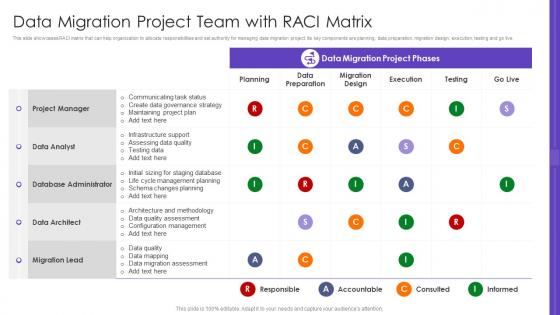
This slide showcases RACI matrix that can help organization to allocate responsibilities and set authority for managing data migration project. Its key components are planning, data preparation, migration design, execution, testing and go live.
People who downloaded this PowerPoint presentation also viewed the following :
Data Migration Project Team With RACI Matrix with all 6 slides:
Use our Data Migration Project Team With RACI Matrix to effectively help you save your valuable time. They are readymade to fit into any presentation structure.





FAQs for Data Migration Project Team
So basically you need **Responsible** people (data engineers, ETL devs) doing the actual work, an **Accountable** person who owns it all - usually project manager or data lead. Then **Consulted** folks like architects and analysts give input, while **Informed** people (end users, execs) just get updates. The real pain point? Figuring out who's actually accountable vs just "helping out." I learned this the hard way on my last project. You'll want to nail down decision-making authority right away or you'll end up in those awkward meetings where nobody knows who can actually approve changes.
First thing - figure out who actually touches your data. Business users, IT, data owners, compliance people, plus the executives who'll need to approve everything. Oh, and don't forget security (learned that one the hard way). Map out your RACI roles next: who's doing the work, who makes final calls, who you need input from, and who just wants updates. The decision-makers are crucial - that's where projects usually die. Build a stakeholder matrix and run it by your sponsor before diving in. Trust me, getting this right upfront saves you tons of headaches later.
So basically, the "Responsible" people are your doers - they run the actual migration scripts, watch the data transfers, check quality as stuff moves over. These are your tech folks getting their hands dirty with the real work. Someone else might be accountable for the whole project succeeding, but these guys are executing it day-to-day. You definitely want to spell out who owns which specific pieces though, because trust me, when everything's on fire at 2am, nobody wants to argue about whose job it is to fix the ETL process. Just map out the tasks clearly upfront and you'll save yourself major headaches later.
Honestly, complex migrations are where standard RACI breaks down. Compliance officers don't quite own decisions but do way more than just advising. Cloud security specialists get deep in the weeds without final authority. Legacy system experts are huge - especially when you're stuck with some dinosaur mainframe only Bob from accounting remembers how to touch. Multi-vendor stuff creates the weirdest gaps too. Vendor liaisons end up somewhere between responsible and consulted, which makes zero sense on paper. My advice? Map everyone out first, then see where forcing traditional roles feels awkward.
Break down your migration into really specific tasks - "data extraction," "transformation validation," stuff like that. Don't just say "testing" because that's way too broad. Only assign ONE person as responsible for each task. I've watched teams implode when everyone thinks they own the same thing - it gets messy fast. Others can help, but one person calls the shots. Before you finalize anything, actually walk through scenarios with your team. Have them role-play a bit. Sounds silly but you'll catch gaps and confusion early. Way better than dealing with chaos during the actual migration when everyone's stressed out.
Honestly, just check if people actually did their jobs well. Timeline stuff is huge - did your Accountable people hit their deadlines? Data quality scores tell you if the Responsible folks knew what they were doing. Don't forget to survey the Consulted stakeholders about satisfaction (that feedback's gold). The Informed people are tricky though - half the time they don't even read the updates you send them. Budget variance, accuracy post-migration, role clarity from team surveys - track it all against your original RACI matrix. Weekly dashboard works great for this.
So for cloud migrations, you'll definitely want to add cloud architects and security folks to your RACI - they're not optional anymore. The data validation piece gets super confusing if you don't clearly split who handles what between cloud and on-premises. Your cloud provider should stay in the "consulted" column unless you're paying for their managed migration service. Here's the thing though - your traditional IT ops team might feel left out, but honestly they're still critical during the transition. Oh, and create separate RACI matrices for before, during, and after migration. Trust me on this one. Responsibilities shift way too much between phases to cram it all into one chart.
Honestly, the worst thing you can do is make roles too fuzzy or have them overlap - total recipe for chaos when stuff hits the fan. Only ONE person can be "Accountable" for each task, seriously. And don't leave out important people entirely, that backfires fast. Here's what drives me nuts though: when everyone gets marked as "Consulted" on everything. People get so burned out from all the meetings and decisions take forever. Keep it clean and specific about who's doing what. Oh, and definitely test it out with some real scenarios before you lock it in - saves headaches later.
RACI basically saves your butt by mapping out who does what for each migration task. No more guessing games about roles. When something needs doing, you'll instantly know who's responsible for the actual work, who makes final decisions, who to consult, and who just needs a heads up. Trust me, it prevents those awkward "wait, wasn't that your job?" conversations that totally kill momentum. Without it? Pure chaos - people either duplicate work or assume someone else is handling critical stuff. Honestly wish more teams used this from day one instead of figuring it out mid-disaster.
The 'Consulted' person is basically your data expert who catches stuff you'll miss. They review your migration plans and validate how you're mapping everything - super helpful since they know the data better than anyone. Loop them in before big steps and definitely show them sample outputs. Oh, and actually listen to their feedback instead of just going through the motions (I've seen that happen way too many times). They're not doing the heavy lifting but they're your quality checkpoint. Short version: they're the ones who'll spot the business logic issues that could totally mess up your data integrity.
So basically a RACI chart for data migration keeps your compliance stuff organized. You'll assign someone as "Responsible" for encryption, privacy controls, audit docs - all that fun regulatory stuff. Then make sure the right people are "Accountable" for approvals. Trust me, when auditors show up later you'll be glad you did this! The chart tracks who does what compliance task and when. Nothing gets missed and you can prove to regulators you followed the rules. Oh, and definitely map your specific requirements to RACI roles from the start - saves headaches later.
Update your RACI at major milestones - kickoff, design freeze, testing, go-live. But here's the thing: actually tell people when roles change instead of just fixing some random spreadsheet nobody checks. Testing phases get messy because suddenly everyone needs to know what's happening, and accountability usually shifts from business folks to the tech team during cutover. I set monthly calendar reminders to review mine. Oh, and try this - ask your team "who actually made that decision?" after recent calls. You'll be surprised how often your RACI doesn't match reality. That's when you know it needs fixing.
Monday.com or Smartsheet are pretty solid for building RACI matrices - they'll automatically track who's doing what and ping people when stuff changes hands. Confluence works well too if your team's already using it (honestly, don't add another tool they'll ignore). The real trick is setting up dashboards so you can actually see where accountability gaps are happening across your migration. Oh, and automate those RACI review reminders because people forget. I learned that one the hard way. Version control becomes clutch when you're dealing with tons of stakeholders who keep changing their minds about responsibilities.
So it really depends on what you're doing in the project. Responsible/Accountable people need the heavy technical stuff - data mapping, ETL processes, whatever platform you're using. Honestly the learning curve sucks at first but you get it pretty fast. For Consulted folks, they need deep training on their specific data domains since they're the experts giving advice. Informed team members just need updates and basic overview stuff - don't overcomplicate it for them. I'd start with workshops based on roles, then do hands-on sessions with real data samples. Oh and definitely set up some mentoring pairs - having someone to bug with questions makes everything way easier.
Honestly, having a solid RACI model is like having emergency contacts in your phone - you don't think about it until you really need it. When your migration's done, you'll know exactly who monitors what and who to call when stuff breaks. Trust me, at 3 AM nobody wants to play "guess who fixes this." It stops all that finger-pointing too. Make sure you map out the ongoing stuff like monitoring and updates, not just the actual migration part. Otherwise you're setting everyone up for confusion later when systems need tweaking or something goes wrong.
-
The Designed Graphic are very professional and classic.
-
I am a big fan of their newsletters because that is how I found my perfect requirement at the time of urgency. Thank God, I kept opening those.