


RACI Matrix For Agile Projects Agile Methodology IT Ppt Powerpoint Presentation Show




Try Before you Buy Download Free Sample Product
 Impress Your
 Audience
 100%
100% Editable
 Save Hours
 of Time


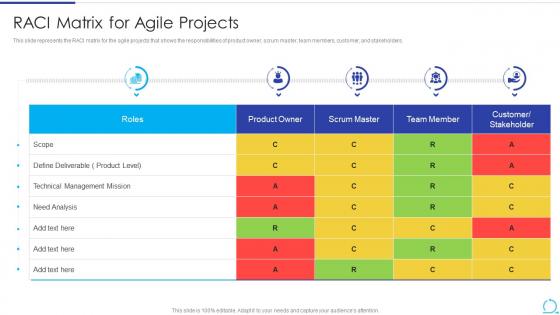
This slide represents the RACI matrix for the agile projects that shows the responsibilities of product owner, scrum master, team members, customer, and stakeholders.
People who downloaded this PowerPoint presentation also viewed the following :
RACI Matrix For Agile Projects Agile Methodology IT Ppt Powerpoint Presentation Show with all 6 slides:
Use our RACI Matrix For Agile Projects Agile Methodology IT Ppt Powerpoint Presentation Show to effectively help you save your valuable time. They are readymade to fit into any presentation structure.





FAQs for RACI Matrix For Agile Projects Agile Methodology IT Ppt
So RACI breaks down like this: R = Responsible (actually does the work), A = Accountable (owns the whole thing), C = Consulted (you ask their opinion first), I = Informed (just loop them in). Basically you slap these letters on people for each task. Game changer is everyone finally knows their role - no more "wait, wasn't that your job?" disasters. Only rule I'd stress: pick ONE person as Accountable per task. Trust me, having two people "accountable" just means nobody actually is. Oh, and the Responsible person might not be the Accountable one - kinda weird but it works.
List your deliverables down the left side, stakeholders across the top. At each intersection, pick ONE person who's Responsible (does the work) and ONE who's Accountable (owns it). Don't make everyone "Consulted" on everything - that's how you end up in meeting purgatory. Multiple people can be Informed though, that's fine. Run the draft by your main stakeholders first to spot gaps. Honestly, the best part is using it later when someone inevitably goes "wait, who's supposed to handle this?" You'll actually have an answer ready.
Honestly, the biggest screw-up I see is overcomplicating everything. You don't need the whole team involved in every single decision! Never have multiple people "responsible" for the same thing - that's just asking for chaos. And please don't stick someone in every box just because they exist on your team (I've watched so many people do this). One person owns it, one person's accountable. Only loop in others who genuinely need to weigh in or stay informed. Oh, and start small with your most important stuff first before you go crazy rolling it out everywhere.
So first, map out your actual workflow and figure out who touches what. Standard RACI works most of the time, but honestly? You might need extra categories like "Support" or "Review" if your approval process is a nightmare - some companies just love their layers. Team size matters too. Small teams mean one person probably wears multiple hats for the same task, which is completely normal. The whole point is making sure everyone knows their role, so tweak the matrix until it actually matches how stuff moves through your org. Don't overthink it.
So basically a RACI matrix stops all that "wait, whose job was this again?" chaos. Nobody can pull the "I didn't know" card when everything's laid out clearly from the start. Plus it prevents those awkward moments where half the team shows up thinking they're running the meeting. When stuff goes wrong - and it will - people can't just vanish because their name's right there on paper. Honestly, the best part is eliminating all that duplicate work that drives everyone crazy. People know exactly who to ask for decisions instead of playing email tag with five different people. Just try it once.
Check your RACI matrix whenever big stuff happens - project kickoff, phase changes, scope shifts, people joining or leaving the team. Monthly works for longer projects, but honestly? It really depends on how crazy things get. If you're always moving people around or bringing in new stakeholders, look at it way more often. The whole point is spotting role confusion before everyone's stepping on each other's toes. And seriously, don't just create it once and forget about it in some random folder. Keep updating the thing so it actually shows who's responsible for what today.
Honestly just use Excel or Google Sheets to start - they're perfect for RACI matrices since it's basically just a grid anyway. If your team needs to collaborate more, Lucidchart and Miro are solid choices. Notion works too if you're already using it (why add another tool to the mess, right?). Visio's good if you have it. The real trick isn't finding some fancy platform though. Pick whatever your team can actually access and update together. I've seen too many beautiful RACI charts that nobody ever looks at again. Better to have a simple one that stays current.
Honestly, RACI matrices are game-changers for avoiding those "wait, whose job was this?" disasters. You assign each task to someone who's Responsible for doing it, Accountable for the outcome, needs to be Consulted, or just Informed. No more endless email threads where everyone's confused about who should actually respond - been there, done that, it's exhausting. The whole thing prevents work from falling through cracks or having three people accidentally doing the same task. Takes maybe 15 minutes to set up at the start, but you'll dodge so much chaos later. Trust me on this one.
Oh man, RACI matrices are seriously helpful! Healthcare uses them to nail down patient handoffs between departments - cuts down on medical screwups. Construction is probably where they shine most though, since you've got contractors, architects, engineers all doing their thing and it gets chaotic fast without clear ownership. Software teams dig them too for feature releases. Developers know exactly what they're building while stakeholders stay in the loop without being annoying about it. Honestly, any project with multiple people who need to work together without drama benefits from these. You should totally try one next time you're dealing with a messy cross-team situation.
Look, RACI matrices are great when your Agile team gets messy - like when nobody knows who owns what user story or when stakeholders should actually speak up. Cross-functional teams especially need this stuff. Some Agile people hate them because they're "too structured" but honestly? They work. Larger projects get chaotic without clear ownership. Just don't overthink it - map your biggest deliverables first, keep it simple, and update as you go. Oh, and they're lifesavers for remote teams where everything feels scattered. Start small though.
Honestly, just throw them into a workshop where they build RACI matrices using your actual past projects - way more effective than boring hypotheticals. Have them argue over who should be Responsible vs Accountable (they'll definitely get confused at first, everyone does). Give them the basic template and let them figure it out together on some upcoming work. The group dynamic is clutch here because they'll spot when someone's trying to be accountable for everything or when roles overlap weirdly. After they've done a few as a team, it becomes second nature. They'll start naturally thinking "wait, who's actually responsible for this?" when planning new stuff.
So RACI is all about who's responsible, accountable, consulted, and informed - basically task execution stuff. DACI and RAPID? They're way more decision-focused and actually spell out who gets to make the final call. Honestly, I've watched teams argue for hours about which framework to pick (such a waste of time). RACI works best for day-to-day operations. The other two are perfect when you need to make specific project decisions. My advice? Just pick whichever one makes sense to your team and don't overthink it.
RACI matrices are great for spotting risks because they force you to map out who does what. You'll catch those awkward gaps where nobody's actually responsible for something important, or worse - when like five people think they're in charge of the same task. I've seen projects crash because of that exact mess. Look for bottlenecks too, where one person ends up accountable for everything. During your planning meetings, scan through it and think "okay, what's gonna break here?" The biggest win is catching communication gaps before key people get blindsided by decisions.
Honestly, getting stakeholders involved upfront is such a game-changer for RACI matrices. People actually understand what they're supposed to do instead of scrambling later. You'll spot those annoying gaps and overlaps way easier too. Here's the thing - when people help create their own responsibilities, they're way more likely to actually follow through. It's just how we're wired, I guess. You'll also catch any drama or pushback early when you can still fix it, rather than dealing with people who just ignore the whole thing later. Trust me, the extra time upfront saves you so many headaches.
Don't just build your RACI matrix and call it done - that's where most people mess up. Check it monthly or whenever you hit major milestones. Seriously, I've watched teams where someone was still "responsible" for stuff that got scrapped weeks ago. Add it to your regular team meetings as a discussion point. When people join or leave (which happens constantly these days), update their roles right away. The trick is making reviews automatic instead of reactive. Otherwise you'll be scrambling when roles get confusing and nobody knows who's supposed to do what.
-
The visual appeal of the templates is just unparalleled! I was so worried about the design of my presentation but SlideTeam made it all so easy.
-
Presentation Design is very nice, good work with the content as well.