


Agile it project management powerpoint presentation slides




Try Before you Buy Download Free Sample Product
 Impress Your
 Audience
 100%
100% Editable
 Save Hours
 of Time


Agile IT management refers to software development methodologies that are based on the concept of iterative development. Check out our competently designed Agile IT Project Management template that showcases a way of project management that divides a project into stages. The template includes continuing cooperation with stakeholders and continuous development at each point. The proposal covers the collaboration of self-organizing cross-functional teams, which leads to the evolution of criteria and solutions. Scrum and Kanban are two of the most common Agile methodologies used in this template. Further, the proposal provides information on Agile Methodologys phases and goals. Additionally, our template covers details on Agile techniques and scaling agile transformation model along with Agile Diagram IT Design Thinking and Lean Startup Phases, etc. Our IT proposal also covers information on the Agile-driven approach for IT development. Further, this module provides details on the Agile lifecycle, the role of the Agile team, and learning-oriented techniques for the Agile Team. It also highlights Agile performance evaluation metrics and Agile enterprise developed architecture Post Implementation attributes. Customize our 100 percent editable project management ppt templates now.
People who downloaded this PowerPoint presentation also viewed the following :
Content of this Powerpoint Presentation
Slide 1: This slide introduces Agile IT Project Management. State Your Company Name and begin.
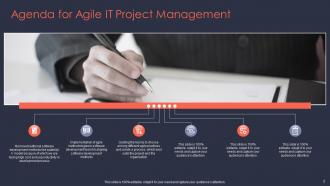
Slide 2: This slide shows Agenda for Agile IT Project Management.
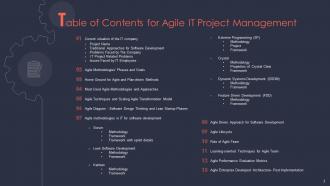
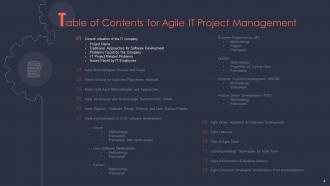
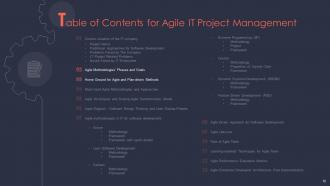
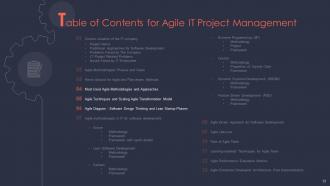
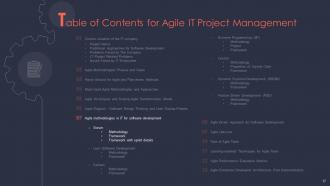
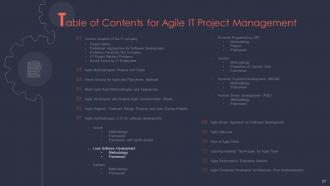
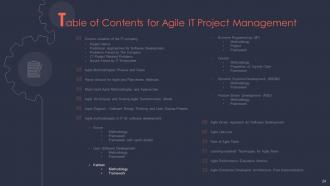
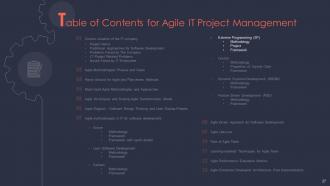
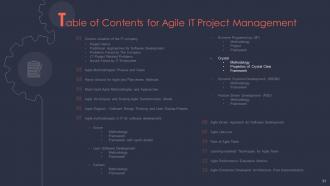
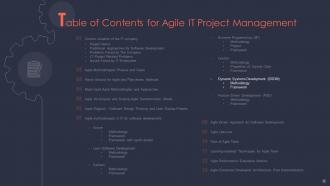
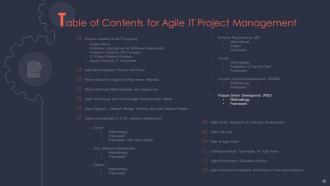
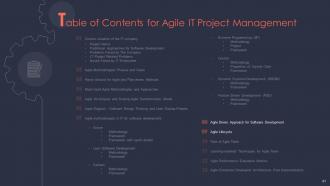
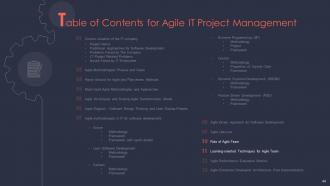
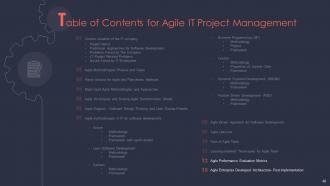
Slide 3: This slide presents Table of Contents for Agile IT Project Management.
Slide 4: This slide shows title for 'Current situation of the IT company'.
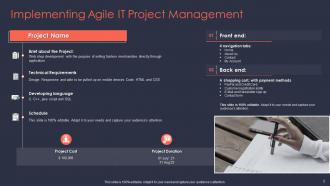
Slide 5: This slide depicts Implementation of agile methodology in IT company.
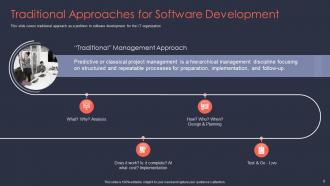
Slide 6: This slide covers traditional approach as a problem to software development for the I.T organization
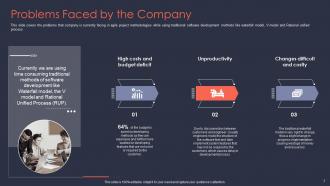
Slide 7: This slide covers the problems that company is currently facing in agile project methodologies.
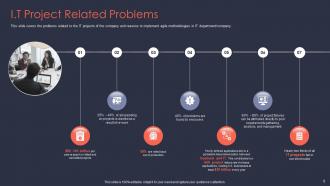
Slide 8: This slide covers the problems related to the IT projects of the company and reasons to implement agile methodologies in IT department/company.
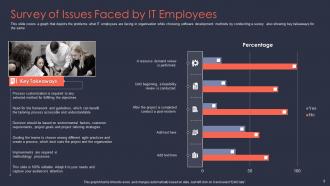
Slide 9: This slide covers a graph that depicts the problems what IT employees are facing in organisation.
Slide 10: This slide depicts title for 'Agile Methodologies phases & goals'.
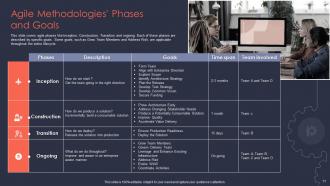
Slide 11: This slide covers agile phases like Inception, Construction, Transition and ongoing.
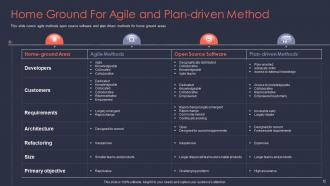
Slide 12: This slide covers agile methods open source software and plan driven methods for home ground areas.
Slide 13: This slide displays title for 'Most used agile methodologies and approaches.
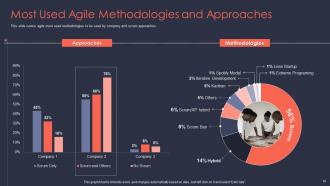
Slide 14: This slide covers agile most used methodologies to be used by company and scrum approaches.
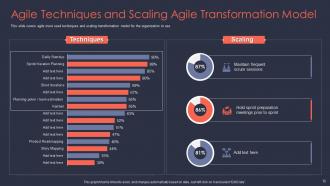
Slide 15: This slide covers agile most used techniques and scaling transformation model for the organization to use.
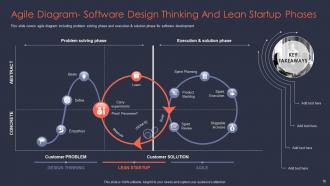
Slide 16: This slide covers agile diagram including problem solving phase and execution & solution phase for software development.
Slide 17: This slide presents title for 'Agile methodologies in IT for software development'.
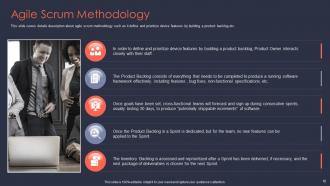
Slide 18: This slide covers details description about agile scrum methodology.
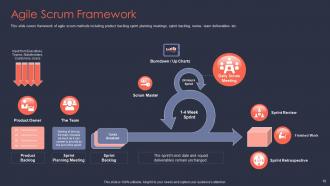
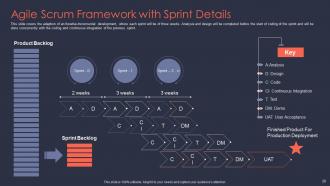
Slide 19: This slide covers framework of agile scrum methods including product backlog sprint planning meetings, etc.
Slide 20: This slide covers the adaption of an Iterative-Incremental development, where each sprint will be of three weeks.
Slide 21: This slide exhibits title for 'Lean software development'.
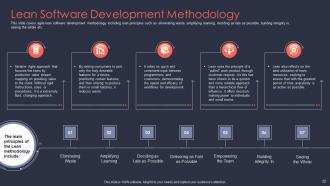
Slide 22: This slide covers agile lean software development methodology including lean principles.
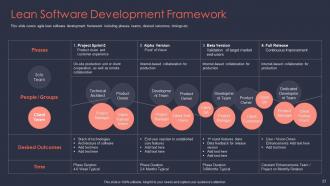
Slide 23: This slide covers agile lean software development framework including phases, teams, desired outcomes, timings etc.
Slide 24: This slide shows title for 'Lean software development framework'.
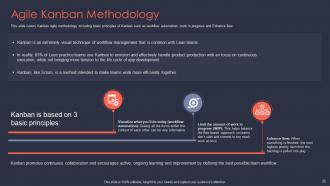
Slide 25: This slide covers Kanban agile methodology including basic principles of Kanban.
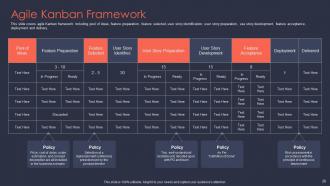
Slide 26: This slide covers agile Kanban framework including pool of ideas, feature preparation, etc.
Slide 27: This slide depicts title for 'Extreme programming'.
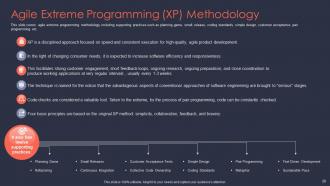
Slide 28: This slide covers agile extreme programming methodology including supporting practices.
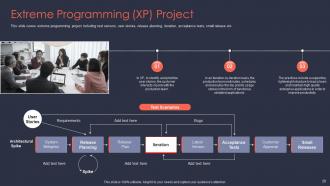
Slide 29: This slide covers extreme programming project including test sensors, user stories, etc.
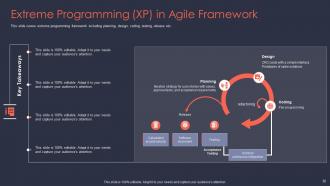
Slide 30: This slide covers extreme programming framework including planning, design, coding, testing, release etc.
Slide 31: This slide displays title for 'Crystal'.
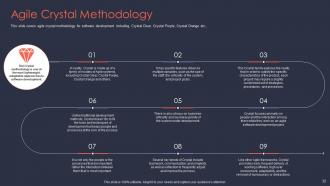
Slide 32: This slide covers agile crystal methodology for software development.
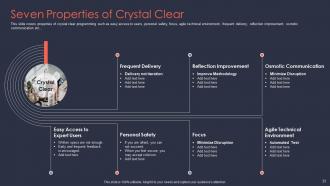
Slide 33: This slide covers properties of crystal clear programming.
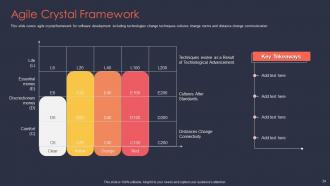
Slide 34: This slide covers agile crystal framework for software development.
Slide 35: This slide presents title for 'Dynamic systems development'.
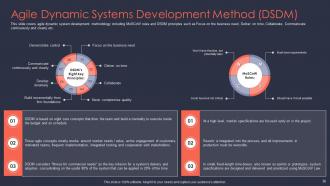
Slide 36: This slide covers agile dynamic system development methodology.
Slide 37: This slide covers agile Dynamic Systems Development Method framework.
Slide 38: This slide exhibits title for 'Feature driven development'.
Slide 39: This slide covers feature driven development (FDD) methodology.
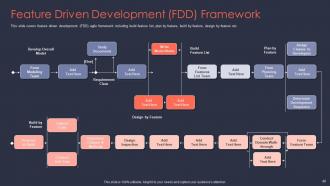
Slide 40: This slide covers feature driven development (FDD) agile framework.
Slide 41: This slide shows title for 'Agile lifecycle'.
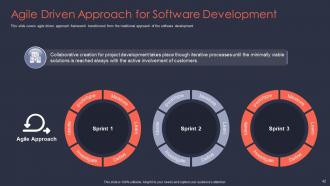
Slide 42: This slide covers agile driven approach framework transformed from the traditional approach of the software development.
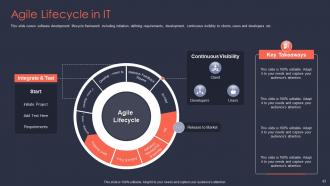
Slide 43: This slide covers software development lifecycle framework.
Slide 44: This slide depicts title for 'Role of agile team'.
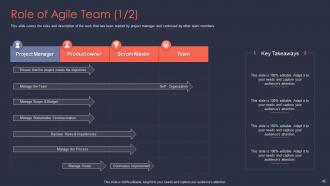
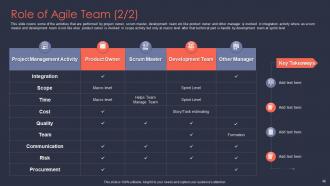
Slide 45: This slide covers the roles and description of the work that has been started by project manager and continued by other team members.
Slide 46: This slide covers some of the activities that are performed by project owner.
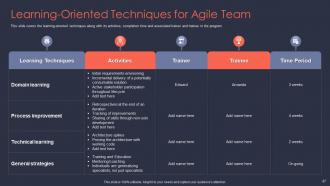
Slide 47: This slide covers the learning-oriented techniques.
Slide 48: This slide displays title for 'Agile performance evaluation metrics'.
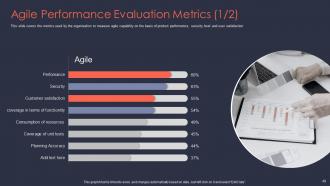
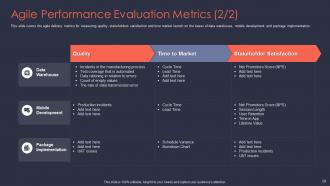
Slide 49: This slide covers the metrics used by the organisation to measure agile capability.
Slide 50: This slide covers the agile delivery metrics for measuring quality.
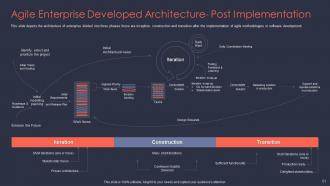
Slide 51: This slide depicts the architecture of enterprise divided into three phases.
Slide 52: This slide shows Icons for Agile IT Project Management.
Slide 53: This slide is titled as Additional Slides for moving forward.
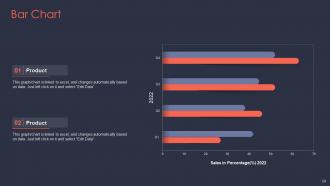
Slide 54: This slide presents Bar chart with two products comparison.
Slide 55: This is Our Mission slide with related imagery and text.
Slide 56: This is About Us slide to show company specifications etc.
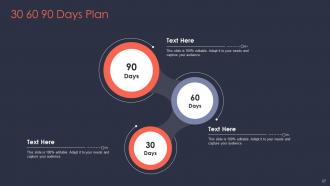
Slide 57: This slide provides 30 60 90 Days Plan with text boxes.
Slide 58: This slide presents Roadmap with additional textboxes.
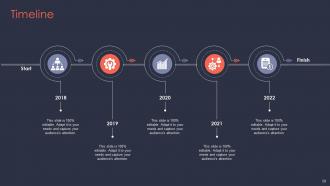
Slide 59: This is a Timeline slide. Show data related to time intervals here.
Slide 60: This is an Idea Generation slide to state a new idea or highlight information, specifications etc.
Slide 61: This is a Thank You slide with address, contact numbers and email address.
Agile it project management powerpoint presentation slides with all 69 slides:
Use our Agile IT Project Management Powerpoint Presentation Slides to effectively help you save your valuable time. They are readymade to fit into any presentation structure.















FAQs for Agile it project management
So Agile basically has four main ideas - putting people before rigid processes, actual working software over tons of docs, collaborating with customers instead of just following contracts, and being flexible when things change. Instead of planning everything upfront like waterfall (which honestly can be a nightmare), you work in these short 2-4 week sprints. Way less overwhelming! Each sprint you're delivering actual features and getting feedback constantly. My advice? Figure out your MVP first, then just plan that initial sprint. Don't stress about mapping out the whole project right away - that's kind of the whole point.
Honestly, Agile just gets people talking way more. Daily standups are a game-changer - everyone shares what they're doing and if they're stuck on anything. Sprint planning and retros keep the conversation going too. What I love is how transparent everything becomes. You can actually see the backlog, track progress, know who's handling what. My old team went from drowning in emails to... well, actually functioning like humans lol. The constant feedback loops are clutch because you're not building something for months only to find out it's totally wrong. If you're not doing standups yet, start there. That one change will flip everything.
Oh the Product Owner? They're basically stuck in the middle - connecting stakeholders with your dev team. Super tough job honestly, because everyone wants different things and you're the one making calls on what actually gets built. Your PO owns the product vision and ranks everything in the backlog. Business value, what customers want, technical stuff that's blocking other work - they weigh all of that. Some use MoSCoW prioritization or score things by value. But here's the thing - they're not just handing out tasks. Their real job is making sure you build what actually matters. Hit them up whenever scope gets fuzzy.
So agile basically breaks everything into these short 1-2 week sprints, which is honestly way better than trying to plan everything upfront (because that never actually works). You can pivot fast when stuff changes. At the end of each sprint, show your stakeholders what you built - they'll catch problems early before you go down the wrong path. Keep a backlog of features ranked by priority, then adjust it constantly. Oh, and those sprint reviews with stakeholders? That's where you'll get the best feedback. Way better than finding out you built the wrong thing after three months.
Honestly, I'd focus on velocity first - how many story points your team knocks out each sprint. Sprint burndowns are solid too, plus cycle time from when you start coding to actual deployment. Team happiness surveys matter way more than people think (grumpy developers write crappy code, just saying). Customer feedback scores and lead times for features give you the real picture of how you're doing. Oh, and track defect escape rates - nobody wants bugs slipping through. But seriously, don't go metric-crazy. Pick maybe 3-4 that your stakeholders actually care about and review them in retros.
So sprints are basically chunks of 1-4 weeks where you focus on shipping actual working stuff instead of drowning in one giant deadline. Way better than those old school waterfall projects, trust me. You'll need to be ruthless about priorities though - like, what really needs to get done this round? Between sprints you can pivot based on feedback or if requirements change (which they always do lol). The key thing is defining what "done" actually looks like upfront so you don't end up with half-finished features. Makes everything way more manageable.
For project management, go with Jira, Azure DevOps, or Monday.com to handle your sprints and stories. Jira's honestly kind of a beast but everyone uses it. Slack or Teams will save your sanity during standups - way better than endless email chains. Git is non-negotiable for version control, whether you use GitHub or GitLab. Oh, and grab something like FunRetro or Miro for retrospectives. Those meetings can get weird without proper tools. My advice? Pick one from each category first. Don't go crazy adding everything at once or you'll spend more time managing tools than actually working.
Honestly, the trickiest part is getting people to actually embrace the change - some folks will resist hard. Training is huge too, and I mean for everyone, not just the PMs. Don't try rushing into full Agile mode overnight (learned that one the hard way!). Daily standups feel weird when your team's used to waterfall, and suddenly everyone can see what you're working on. Get a solid Scrum Master first. Executive support matters more than you'd think. Oh, and celebrate those early wins! Even small ones help build momentum while people adjust.
Yeah totally! Most teams I know don't follow Scrum or Kanban by the book anyway. Skip ceremonies that feel pointless, or try shorter sprints if two weeks feels too long. Kanban's honestly better when random stuff keeps popping up - like bug fixes that can't wait for the next sprint. Some teams mix both, which sounds messy but actually works. Use Kanban boards but keep sprint planning. Figure out what's actually breaking first though. Scope creep? Bottlenecks? Then just grab whatever pieces from each framework fix those specific problems.
Basically, retros are when your team stops everything to talk about what's working and what sucks. Usually happens after each sprint. You go through what went well, what didn't, and figure out changes for next time. Here's the thing though - if you don't assign someone to actually own each action item, it's just complaining with snacks. I've watched teams completely turn around their processes just by making small changes consistently. The trick is following up on what you decided. Otherwise you're wasting time rehashing the same problems every two weeks.
Honestly, Agile is pretty smart about risk - you're catching issues while they're tiny instead of waiting months to find out everything's broken. Daily standups are where the magic happens because people actually speak up about blockers right away. Every sprint you get real user feedback, so you can change direction fast if needed. Making smaller bets more often means failures don't kill your whole project. I always tell people to treat sprint reviews like mini risk check-ins - works way better than crossing your fingers and hoping for the best at the end.
Honestly, Agile's great for remote work since it's all about constant communication anyway. Daily standups keep everyone on the same page, and sprint planning works fine over Zoom (though I still miss whiteboards sometimes). The whole iterative thing means you're checking in way more than with waterfall - like, who wants to wait weeks to find out something's totally off track? Retrospectives help you figure out what's actually working for your team remotely. Tools like Jira and Slack make the ceremonies pretty smooth. I'd start with shorter sprints at first so you can get into a good rhythm faster.
So here's the thing with Agile - you're literally showing people working software every week or two instead of disappearing for months. Your stakeholders see demos constantly, give feedback during sprint reviews, and you can actually pivot when something's off track. I've seen too many waterfall projects where teams built "perfect" software that users hated because nobody checked in until the end. Short feedback loops are everything. You catch problems early and build what people actually need, not what you assumed they wanted. Honestly? Start booking those demo sessions now - it'll save you so much headache later.
Honestly, go with SAFe or LeSS - they're built for big companies doing Agile. Keep teams synced up with regular meetings and shared backlogs. I've watched so many places crash and burn trying to figure it out themselves! Get your Scrum Masters talking to each other regularly. Same with Product Owners. They need to swap war stories and tips. Good tooling is huge too - you want visibility into what's blocking teams and how everything connects. Oh, and start with just a few teams first. Prove it works, then expand. Don't go full transformation mode right away or you'll hate your life.
Honestly, just get your dev and ops people talking daily - same standups, same goals. Your CI/CD should match your sprint rhythm, so automate testing right after each review instead of waiting till the end. Feature flags are a game changer here - deploy bit by bit and get that quick feedback Agile's all about. Oh, and treat your infrastructure like actual code in your user stories. Set up automated rollbacks connected to your retrospectives too. That way when stuff inevitably breaks (and it will), you're iterating fast instead of panicking at 2am trying to fix everything.
-
Attractive design and informative presentation.
-
Good research work and creative work done on every template.