


Data Minimization Principle Of Gdpr Law Data Privacy It




Try Before you Buy Download Free Sample Product
 Impress Your
 Audience
 100%
100% Editable
 Save Hours
 of Time


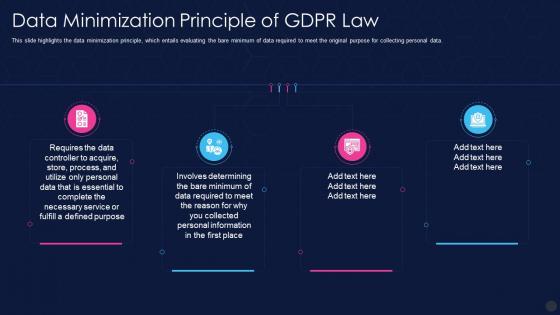
This slide highlights the data minimization principle, which entails evaluating the bare minimum of data required to meet the original purpose for collecting personal data.
People who downloaded this PowerPoint presentation also viewed the following :
Data Minimization Principle Of Gdpr Law Data Privacy It with all 6 slides:
Use our Data Minimization Principle Of Gdpr Law Data Privacy It to effectively help you save your valuable time. They are readymade to fit into any presentation structure.





FAQs for Data Minimization Principle Of Gdpr Law
Data minimization is a GDPR principle requiring organizations to collect, process, and retain only personal data that is adequate, relevant, and limited to what's necessary for specific purposes. This principle helps businesses reduce compliance risks, lower storage costs, and enhance customer trust by streamlining data practices, with many companies finding that focused data collection ultimately delivers better analytics and operational efficiency.
Organizations effectively implement data minimization strategies through comprehensive data auditing, purpose-specific collection protocols, automated retention policies, regular access reviews, and privacy-by-design frameworks. These approaches streamline compliance by identifying unnecessary data collection points, establishing clear retention schedules, and integrating minimal processing principles into system architectures, ultimately reducing regulatory risk while enhancing operational efficiency and customer trust.
All personal data under GDPR is subject to minimization, including basic identifiers like names and addresses, sensitive categories such as health records and biometric data, and behavioral information like browsing patterns and purchase histories. Organizations across sectors, from healthcare institutions managing patient records to retail companies tracking customer preferences, must ensure they collect only necessary data for specific purposes, ultimately reducing compliance risks while enhancing customer trust.
Data minimization enhances privacy by limiting collection to necessary information, reducing exposure during breaches, and decreasing unauthorized access risks. Through targeted data practices, organizations streamline compliance processes, minimize storage costs, and build stronger customer trust, with many financial institutions and healthcare providers finding that focused collection ultimately delivers enhanced security and regulatory confidence.
Non-compliance with GDPR data minimization requirements can result in fines up to 4% of annual global turnover, regulatory sanctions, mandatory audits, and significant reputational damage. Organizations face increased scrutiny from data protection authorities, potential litigation from affected individuals, and loss of customer trust, with many companies finding that compliance failures ultimately undermine competitive positioning and market credibility.
Businesses can assess their current data collection practices through comprehensive data audits, mapping all personal data flows, reviewing collection purposes against legal bases, and evaluating retention periods. This involves conducting privacy impact assessments, cataloging data sources across departments, and comparing actual usage with stated purposes, with many organizations finding that streamlined data practices ultimately reduce storage costs while enhancing customer trust and regulatory compliance.
Consent under GDPR data minimization ensures organizations only collect personal data that individuals have explicitly agreed to share for specific, legitimate purposes. This creates a strategic framework where businesses streamline data collection, enhance customer trust, and reduce compliance risks, with many companies finding that clear consent mechanisms ultimately deliver stronger customer relationships and operational efficiency.
Data minimization can coexist with analytics and big data through strategic approaches like data aggregation, anonymization techniques, purpose limitation, and retention policies that collect only necessary information. While organizations must balance compliance requirements with analytical needs, many find that focused data collection actually enhances analytics quality, reduces storage costs, and builds customer trust while maintaining competitive insights.
Data minimization examples include collecting only essential customer information during account opening in banks, storing minimal patient data for specific treatments in healthcare, and gathering necessary purchase details in retail. These practices streamline compliance processes, reduce storage costs, and minimize breach risks, with many organizations finding that strategic data collection enhances operational efficiency while maintaining regulatory adherence.
Data retention policies directly support data minimization by establishing specific timeframes for storing personal data, automatically deleting information when no longer necessary, and preventing indefinite accumulation of unused data. Through systematic retention schedules, organizations streamline compliance efforts, reduce storage costs, and minimize privacy risks, with many financial institutions and healthcare providers finding that clear deletion timelines enhance both regulatory adherence and operational efficiency.
Organizations should immediately conduct comprehensive data audits to identify excessive collection points, implement automated deletion processes for unnecessary data, and update privacy policies to reflect streamlined practices. Through strategic data minimization frameworks, companies can reduce storage costs, minimize compliance risks, and enhance customer trust, with many finding that focused data collection actually delivers more actionable insights and operational efficiency.
Organizations balance business needs with data minimization by conducting regular data audits to identify essential versus unnecessary information, implementing purpose-specific collection practices, and using privacy-by-design frameworks. Through strategic data governance and automated retention policies, companies like financial services and healthcare providers streamline compliance while maintaining operational efficiency, ultimately delivering better customer trust and reduced regulatory risk.
Data minimization creates significant compliance obligations for third-party processors, requiring them to process only necessary data, implement purpose limitation controls, establish clear data retention schedules, and maintain detailed processing records. Processors must redesign their systems to handle reduced datasets while ensuring service quality, with many cloud providers and marketing agencies finding that streamlined data practices ultimately enhance client trust and operational efficiency.
Data minimization significantly streamlines breach response strategies by reducing the scope of potentially compromised information, limiting notification requirements, and minimizing regulatory penalties under GDPR. Organizations with lean data practices can respond faster to incidents, conduct more focused forensic investigations, and demonstrate compliance more effectively, ultimately reducing both financial exposure and reputational damage while maintaining customer trust.
Organizations face challenges including identifying all data sources across complex systems, determining data necessity for business operations, managing legacy systems with embedded data practices, ensuring cross-departmental compliance coordination, and balancing operational needs with privacy requirements. These obstacles often require significant resource allocation and system overhauls, with many enterprises finding that strategic data auditing and automated retention policies ultimately streamline compliance while enhancing operational efficiency.
-
It saves your time and decrease your efforts in half.
-
Innovative and attractive designs.