

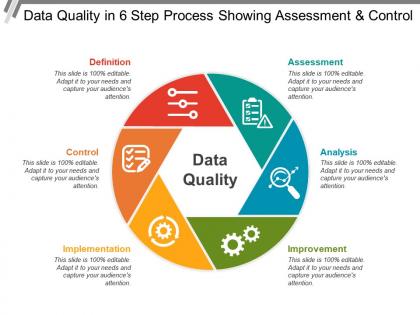
Data quality in 6 step process showing assessment and control





Try Before you Buy Download Free Sample Product
 Impress Your
 Audience
 100%
100% Editable
 Save Hours
 of Time


Future growth begins with our Data Quality In 6 Step Process Showing Assessment And Control. Your current actions will certainly be fruitful.
People who downloaded this PowerPoint presentation also viewed the following :
Data quality in 6 step process showing assessment and control with all 5 slides:
Equip folks to cater for the impact of external influences with our Data Quality In 6 Step Process Showing Assessment And Control. Identify the effects it can have.



FAQs for Data quality in 6 step process showing
Focus on accuracy, completeness, consistency, timeliness, validity, and uniqueness. Accuracy = data matches reality. Completeness means no missing critical fields. Consistency keeps formatting the same across systems. Timeliness is clutch - old customer data is worthless, honestly. Validity checks that stuff follows your rules (proper email formats and whatnot). Uniqueness stops duplicate records from messing up your database. Don't try tackling everything at once though. Pick the 2-3 that are screwing over your team most and start there.
Track your accuracy rates, completeness percentages, and consistency scores - that's your foundation. But honestly? The business impact stuff is what gets leadership excited. Monitor how often you're catching errors and fixing them. Look at downstream effects like fewer customer complaints or faster reporting. I'd set up regular data profiling to see where you're starting from, then track improvements. Oh, and definitely connect these metrics to real business outcomes. Decision-making speed, reduced costs from fewer data disasters - that's the language executives understand. The technical metrics matter, but the business case sells it.
Data profiling is like being a detective for your datasets - you're hunting for patterns, duplicates, missing stuff, and other weird inconsistencies before they mess up your analysis. It's honestly a lifesaver. You get actual numbers on how complete and accurate your data is, which beats guessing every time. Plus it helps you figure out what's worth fixing first instead of just randomly cleaning things. I'd start with whatever datasets you use most - trust me, you'll find some bizarre stuff hiding in there that'll make you question everything. Saves you from those awkward conversations with stakeholders later too.
Oh man, inconsistent data entry is probably your worst enemy - different teams just do their own thing. Duplicates build up like crazy too, and don't even get me started on missing info in key fields. Outdated records are another nightmare because nobody thinks to refresh anything. Integration between systems? Total pain when they don't talk to each other properly. I learned this the hard way, but set up validation rules early and do regular clean-ups. Way better than scrambling to fix a mess later when your boss is breathing down your neck.
Bad data will mess up every decision you make - seriously, you'll be working with outdated or totally wrong info. Like if your customer data is garbage, you might target completely the wrong people or miss obvious money-making opportunities. I've seen this happen way too often. Quality data means you can actually trust your analytics and leadership won't second-guess every insight. Your teams will move faster when they're confident in what they're seeing. Start with your most important datasets first and clean those up. You'll notice the difference in decision-making almost immediately.
Honestly, there's a bunch of solid options depending on what you need. Informatica Data Quality and Talend are the heavy hitters if you want full-featured platforms. For Python people, Great Expectations is pretty sweet - dbt too, especially for transformation testing. I've been seeing dbt everywhere lately, it's kinda having a moment. Cloud stuff like AWS Glue DataBrew or Google Cloud Data Prep work well if you're already in those ecosystems. Sometimes though? Just Pandas with some custom validation does the trick. Figure out where your data's messiest first, then match the tool to your team's budget and what they actually know how to use.
Here's the thing - data quality can't just be IT's headache anymore. Show people how crappy data actually screws up their day-to-day stuff. Sales missing leads, marketing sending the same email twice, that kind of thing. Get leadership to actually give a damn about it first. Don't throw people under the bus when they flag data problems - you want them calling this stuff out! Set up easy ways for teams to report issues and maybe even celebrate the catches. Oh, and do regular check-ins where different departments can compare notes on what they're seeing. Training helps too, but honestly the culture shift matters way more.
Honestly, you've gotta catch this stuff at the source before it messes up everything downstream. Put validation rules on your input forms - required fields, format checks, range limits, all that. Your data entry people need proper training too, can't just wing it. Real-time monitoring is clutch for getting alerts when things go sideways. I swear automated profiling saves so much headache by catching weird patterns early. Make it super hard for garbage data to even get in the system. Oh, and don't try to fix everything at once - start with whatever data matters most to your business first.
So governance is like the foundation that makes your data quality efforts actually work long-term. Without it, you're just putting band-aids on problems. It defines who's responsible for what data and sets the standards everyone follows. When stuff breaks (and trust me, it will), governance tells you who fixes it. Quality management handles the day-to-day "how do we clean this mess" while governance is more the "who decides what counts as clean." Honestly, I'd start by figuring out who your data stewards are first, then build your quality processes around whatever standards they set.
Bad data will absolutely destroy your customer relationships. You'll end up with duplicate accounts, wrong contact details, outdated preferences - the whole mess. Imagine sending emails to dead addresses or calling someone by the wrong name. It basically screams "we don't give a damn about you." I've watched companies lose huge clients over simple billing mistakes caused by crappy data. Clean data means you can actually personalize stuff, fix problems quicker, and figure out what customers want. My advice? Start with a data audit focusing on your biggest customer touchpoints first.
So first figure out what "good data" actually means for your situation, then track the big six: accuracy, completeness, consistency, timeliness, validity, and uniqueness. Don't go overboard though - pick maybe 3-5 metrics that actually matter for your decisions. Honestly, chasing perfection is pointless, so aim for realistic targets like 95% completeness. Automate the tracking when you can and show trends in your dashboards, not just static numbers. The key thing? Connect each metric to real business impact so people actually give a damn when quality drops.
Look, once you spot those data issues, prioritize by what'll actually hurt your business most. Fix the root problems - don't just slap temporary fixes on everything. Your critical data flows come first because honestly, nobody else is gonna clean up those messy customer records for you. Document what you find so you're not flying blind later. Set up some monitoring to catch this stuff earlier next time. The whole point is being smart about it instead of just scrambling to patch holes constantly. Oh, and tell everyone who uses that data when it's fixed - they need to know it's trustworthy again.
Bad data will totally screw you over on compliance stuff. Regulators hate when your reports are wrong or late - and trust me, they notice. You can't make smart risk decisions when half your info is garbage. It's like... imagine trying to drive somewhere with a GPS that's completely wrong. Everything falls apart - audits go sideways, customers lose faith, the whole thing becomes a mess. Honestly, I'd start small. Pick your most important data sources first and set up some basic checks there. Don't try to fix everything at once or you'll go crazy.
Yeah, ML can actually save you so much time on data quality stuff. Start with anomaly detection - those algorithms catch weird outliers way faster than doing it by hand. You can train models to spot different types of data issues, predict where problems might show up, and even fix basic stuff like formatting errors or duplicates automatically. I'd honestly just pick one thing you're already checking manually and try building a simple model around that first. Once you get the hang of it, you'll probably wonder why you waited so long. The automation part is pretty sweet once it's working.
So the big thing right now is AI doing the heavy lifting for data profiling and quality checks. Machine learning spots weird stuff automatically and suggests fixes - honestly cuts down on so much tedious work. Better lineage tracking is huge too, especially with messy pipelines. Oh and these self-healing systems? They'll actually fix common problems without you having to babysit everything. Cloud tools make scaling way easier now. Definitely check out automated profiling soon - I swear it'll catch data issues you had no clue were there.
-
Use of icon with content is very relateable, informative and appealing.
-
Enough space for editing and adding your own content.