


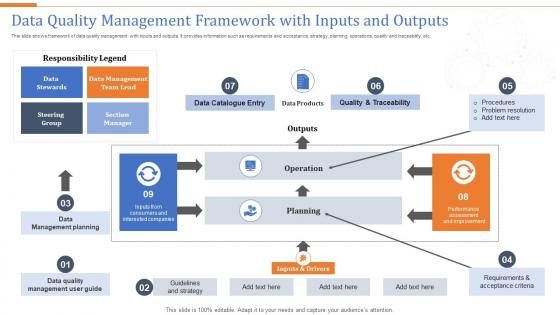
Data Quality Management Framework With Inputs And Outputs




Try Before you Buy Download Free Sample Product
 Impress Your
 Audience
 100%
100% Editable
 Save Hours
 of Time


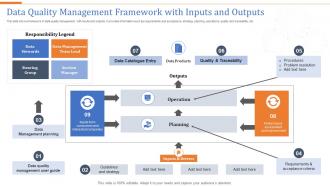
This slide shows framework of data quality management with inputs and outputs. It provides information such as requirements and acceptance, strategy, planning, operations, quality and traceability, etc.
People who downloaded this PowerPoint presentation also viewed the following :
Data Quality Management Framework With Inputs And Outputs with all 6 slides:
Use our Data Quality Management Framework With Inputs And Outputs to effectively help you save your valuable time. They are readymade to fit into any presentation structure.





FAQs for Data Quality Management Framework With
Focus on six key things: accuracy, completeness, consistency, timeliness, validity, and uniqueness. Accuracy is whether your data actually matches reality. Don't have missing info that matters - that's completeness. Keep formatting the same across everything for consistency. Stale data will screw up decisions fast, so timeliness matters more than people think. Validity checks if stuff follows your business rules and formats properly. Uniqueness just means no duplicates mucking things up. Honestly, I'd start with accuracy and completeness first - they'll give you the most impact when you're beginning this whole data quality thing.
Look, garbage data equals garbage decisions - it's that simple. I've seen companies blow tons of money on products that flopped because their customer research was completely wrong. Good data though? You'll actually trust your reports and move fast instead of second-guessing every number. The trick is catching bad data early with validation checks. Also audit your sources regularly - sounds boring but trust me, it beats explaining to your boss why you recommended expanding into a market that doesn't exist. Clean data = confident choices.
Think of data governance as setting up house rules for your data - who owns what, how things should look, and what to do when stuff breaks. Without it, you'll spend forever chasing random data issues (been there, not fun). Start by figuring out your most important data and assign actual people to own it. Set up some basic validation so you catch problems early instead of when they've already messed up your reports. The stewardship piece is honestly the biggest game-changer - having someone accountable makes all the difference.
Ugh, where do I even start? Inconsistent data entry is probably your biggest nightmare - everyone's typing stuff differently. Then you've got duplicate records everywhere, plus your systems aren't syncing so everything goes stale. Integration problems are the worst though. Your CRM and marketing platform basically speak different languages, which makes zero sense. Manual processes mean constant human error, and half the time nobody even knows whose job it is to fix the mess. Oh, and definitely audit what you've got first. Set up some basic validation rules - seriously, that alone will save you so much headache.
Start with the basics - completeness, accuracy, consistency percentages for your main datasets. Build dashboards that auto-track these daily or weekly. Most teams mess this up by setting it once then never looking again (classic mistake). Trends matter more than snapshots, so watch how things change over time. Set up alerts when quality tanks below your limits. Someone needs to own this stuff or nothing happens. Honestly? Just make it part of your regular meetings. If it's not visible, people forget it exists. Keep it simple but consistent.
So many options here! Enterprise stuff like Informatica and IBM InfoSphere are solid but pricey. Great Expectations is awesome for Python validation, and dbt works great for transformation testing. Apache Griffin's a decent open source pick too. Honestly though? Basic SQL queries with some checks will get you surprisingly far when you're starting out - I've seen people overthink this way too much. Start by profiling your data to see what mess you're dealing with, then pick tools based on whatever specific nightmare you uncover.
So here's the thing - every industry cares about totally different stuff when it comes to data quality. Healthcare is paranoid about accuracy and compliance (honestly, they should be since people's lives depend on it). Retail companies? They're more worried about having complete, up-to-date info so they don't run out of stock or piss off customers. Financial services need rock-solid audit trails - consistency and lineage are everything to them. Manufacturing moves fast, so they need real-time data quality or their production gets screwed. Tech companies are usually more chill and just automate their quality checks. You've gotta figure out what actually matters for your industry's money and regulations, then focus on those specific problems.
Define what "good data" actually means first - accuracy, completeness, consistency, timing. Pick someone to own this stuff because otherwise nobody will. Get your baseline measurements so you're not flying blind. Automate the monitoring instead of having people manually check everything (trust me, they'll forget). When you find problems, fix them where they start, not just slap band-aids on later. Oh, and don't go crazy trying to fix everything at once. Start with your most critical data and build from there. Way less overwhelming.
Dude, this combo actually works really well. Business people know what the data should look like and can catch weird stuff right away. IT handles the technical side - building validation rules, setting up monitoring, all that backend work. The key is having both teams sit down together regularly to review issues. I'd start small though, maybe pick one dataset that's super critical and do monthly walkthroughs. Business defines what "good" means, IT makes the systems follow those rules. It's honestly one of those things that sounds obvious but most companies still don't do it right.
Honestly, data quality and privacy compliance go hand in hand - you can't nail one without the other. Think about it: if your data's a mess with duplicates and typos everywhere, good luck handling deletion requests or retention policies. Picture trying to wipe someone's info when their name's spelled three different ways across your systems... nightmare fuel. Clean data makes compliance so much smoother since you can actually locate and manage personal info properly. My advice? Focus on sorting your data governance first - I know it sounds boring but it'll save you headaches down the road for both quality and compliance.
So ML can catch all those sneaky data issues - anomalies, duplicates, weird inconsistencies that you'd never spot manually. Honestly, it's pretty incredible how it picks up patterns we totally miss. The algorithms actually get better over time too, which is cool. They can flag problems before they mess up your whole pipeline. I'd start with anomaly detection on whatever data matters most to you. Oh, and definitely set up automated profiling - saves so much headache later. My teammate swears by this approach and their data quality improved like crazy.
Ugh, bad data is such a nightmare for customers. You'll send them totally irrelevant offers or call them by the wrong name - instant frustration. They have to keep repeating info you should already know, or you suggest stuff that makes no sense for them. Like when Spotify thinks I want death metal after I've been playing nothing but Taylor Swift lol. Customers lose trust fast when this happens. Set up some data cleanup processes now because winning back annoyed customers is honestly way more work than just fixing your data in the first place.
Start by figuring out which data actually affects your customers and revenue - that's where the pain hits hardest. Map your data flows first (trust me, it's messier than you think). Don't try fixing everything at once though. Go after the "golden records" that connect to multiple systems instead. Quick wins early on will give you momentum before you dive into the heavy governance stuff. Oh, and timing matters with your transformation rollout. Pick maybe 2-3 datasets that'll make a real difference, nail those first, then build out from there.
You need both training and culture shifts honestly. Get everyone doing basic data literacy workshops - not just the tech people. Cover validation, collection practices, that kind of stuff. Your managers have to lead by example though. I've watched companies completely bomb this when executives preach data quality but then pressure teams to skip checks when deadlines hit. Super frustrating to see. Host regular sessions where teams show off their wins and failures too. Short ones work fine. The whole point is getting everyone to own data quality, not dumping it all on IT.
Honestly, start with the stuff that's costing you the most money right now. Rework is a killer - all those hours fixing duplicate records and bad customer data add up fast. Missing revenue because your targeting is off or inventory numbers are wrong? That stings too. We had one team last year that spent three weeks chasing completely made-up sales figures - what a mess. Don't forget compliance headaches either, since regulators love going after companies with messy data. Oh, and customers will definitely bounce if their experience sucks because of data issues. Pick maybe 2-3 pain points that are hitting your bottom line hardest and track those first.
-
Unique and attractive product design.
-
Awesome presentation, really professional and easy to edit.