

Data Quality Performance Indicator Dashboard




Try Before you Buy Download Free Sample Product
 Impress Your
 Audience
 100%
100% Editable
 Save Hours
 of Time


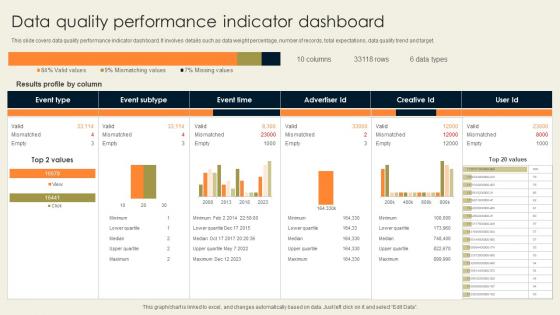
This slide covers data quality performance indicator dashboard. It involves details such as data weight percentage, number of records, total expectations, data quality trend and target.
People who downloaded this PowerPoint presentation also viewed the following :
Data Quality Performance Indicator Dashboard with all 7 slides:
Use our Data Quality Performance Indicator Dashboard to effectively help you save your valuable time. They are readymade to fit into any presentation structure.






FAQs for Data Quality
So the big ones are accuracy, completeness, consistency, timeliness, and validity. Accuracy = does your data match reality? Completeness means you're not missing key stuff. Consistency keeps everything formatted the same way across systems. Timeliness matters because old data will screw up decisions quick. Validity just checks that data follows your business rules. Oh and here's the thing - most teams go crazy trying to fix everything at once and totally burn out. Pick 2-3 dimensions that are actually hurting your business right now. Start there. You can add more quality checks down the road when you've got bandwidth.
Dude, garbage data will absolutely wreck your decisions. You're basically making choices based on lies when your info is wrong or outdated. My old team once spent three weeks analyzing what we thought were amazing trends - turned out to be data entry mistakes. So annoying. Quality data? That's when you can actually trust your gut AND the numbers. You'll spot real opportunities instead of chasing ghosts. Bad data means missing targets and wasting money on strategies that were doomed from day one. Honestly, just start by checking your most important data sources first.
Ugh, data quality is such a pain. Your biggest headaches will be teams entering stuff differently, missing records, and info going stale crazy fast. Plus your systems don't play nice together - hello duplicates and formatting disasters. People are messy too. Typos, skipped fields, everyone interpreting things their own way. When you're dealing with millions of records, tiny mistakes snowball into huge problems. Honestly, I learned this the hard way at my last job. Set up governance rules first and automate your validation checks. Seriously, fixing things upfront beats cleaning up disasters later.
Honestly, start simple - pick your core metrics like completeness and accuracy for the datasets that actually matter to your business. Don't go crazy measuring every single thing (learned that the hard way!). Set up dashboards to check these daily or weekly, whatever matches when your data updates. Get your baseline numbers first, then watch for trends instead of stressing about perfect scores. The real win is catching problems before they mess up your reports or annoy customers. Most teams overthink this stuff initially.
Look, data governance is basically your quality control system. You need rules and processes to keep your data clean - otherwise you'll be chasing problems forever. I learned that the hard way! Set up clear ownership so someone's actually responsible for each dataset. Create validation rules and formatting standards. The trick is starting small though - pick your most critical data first and build quality rules around that. You can't fix everything at once. Having actual data stewards who enforce standards makes all the difference. Without guardrails, bad data just keeps sneaking in.
Honestly, ML is pretty solid for the boring data cleanup stuff you're probably stuck doing by hand. Spotting weird outliers? Finding duplicates? It crushes that way faster than we can. You can even get it to fill in missing data based on patterns it picks up - though definitely double-check those suggestions first. The cool part is building automated checks that catch problems before they screw up everything downstream. Oh, and anomaly detection is probably your best starting point since it's straightforward to set up. Focus on your most important datasets first rather than trying to fix everything at once.
Dude, bad data will absolutely wreck your budget. Companies waste thousands on marketing campaigns that totally miss because they're targeting the wrong people with junk customer info. Your team ends up spending half their time cleaning up duplicate records instead of actually growing the business - which honestly drives me crazy. Decision-making goes out the window when you can't trust your numbers. Compliance becomes a nightmare too. I'd start measuring your data quality issues now so you can show the higher-ups exactly how much this mess is costing. Once you have those metrics, it's way easier to make the case for fixing things properly.
Look, start by figuring out what's actually breaking in your data - duplicates, missing stuff, weird formats, whatever. Then grab a tool that fixes those specific problems. Talend and Informatica are pretty solid if you've got budget. No money? Apache Griffin or Deequ work fine too. Honestly though, the tool doesn't matter as much as setting up automated checks and decent monitoring. Oh, and if you're already using Snowflake or Databricks, they've got quality features built right in now. Don't overthink it - just get something running that catches your biggest headaches first.
Honestly? Stop making data quality just the IT team's headache. Show people how messy data screws up *their* day - can't find customer details, reports don't match up, that kind of thing. Train everyone on basic data cleanup and give them simple tools to check stuff themselves. Here's the key part: don't punish people when they find problems. Actually celebrate it! I've seen too many places where people hide issues because they're scared. Give teams ownership over their data and they'll care way more about keeping it clean. Works every time.
For profiling, run statistical analysis to check data distributions and spot patterns - Apache Griffin or Talend work pretty well. Then tackle cleansing with standardization, deduplication, and validation rules. Honestly, garbage in really does mean garbage out (learned that the hard way). Set up reference data validation against trusted sources. Quality scorecards help you track progress over time, which is actually kinda motivating to see. My advice? Start with just one dataset. Profile it thoroughly first so you know what you're dealing with, then build your pipeline step by step.
Yeah, data integration can totally mess up your data quality if you're not on top of it. You're mixing stuff from different sources - weird formats, naming that doesn't match up, duplicates everywhere. Plus each system has its own annoying quirks, you know? I learned this the hard way at my last job. Start by checking what you're working with first, then standardize everything before you combine it. Set up some validation rules too, otherwise you'll spend forever cleaning up the chaos later. Trust me, garbage in really does mean garbage out.
Dude, bad data in compliance stuff will absolutely destroy you. Companies get slammed with fines from thousands to literally millions - I've watched it happen and it's brutal. Failed audits, legal trouble, the whole nightmare. Your reputation tanks too, which honestly might be worse than the money part. Regulators will be crawling all over you afterward. Some places even have to shut down operations until they sort out the disaster. Set up data checks and audit your stuff regularly now. Trust me, it's way less painful than explaining to your boss why you're facing a million-dollar fine.
Look, you gotta connect data quality straight to money - show the bosses how crappy data bleeds cash while clean data brings in revenue. Find your most critical processes first, then put dollar signs on the problems. Messy customer data? Calculate exactly what that's costing in blown sales and wasted marketing spend. Numbers make everything click for executives. I'd honestly start with your CFO since they get ROI better than anyone. Map out some quick wins plus bigger long-term fixes, and make sure someone senior actually owns this thing. Trust me, without executive buy-in you're just spinning your wheels.
Start by figuring out what "quality" actually means for your data - like is it accuracy you care about? Completeness? First, profile what you've got (trust me, this part's always surprising). Set up some automated checks for the obvious stuff - missing values, duplicates, weird outliers. Business users are gold here since they catch things you totally miss. Document everything and maybe create some kind of scoring system? That way you can actually see if things get better. Oh, and don't try to tackle everything at once - just pick your most important datasets first.
Customer complaints are actually goldmines for spotting bad data. When people call saying their address is wrong or billing info is outdated, that's free quality control right there. Set up your customer service team to log these issues - they're seeing your data problems firsthand every day. Make it super easy for customers to update their own info too. Honestly, most companies overthink this stuff. Just look at your top complaints first - like 90% of the time they'll show you exactly where your database is screwed up. Then build simple feedback loops so those fixes actually stick.
-
SlideTeam is my go-to resource for professional PPT templates. They have an exhaustive library, giving you the option to download the best slide!
-
Unique and attractive product design.