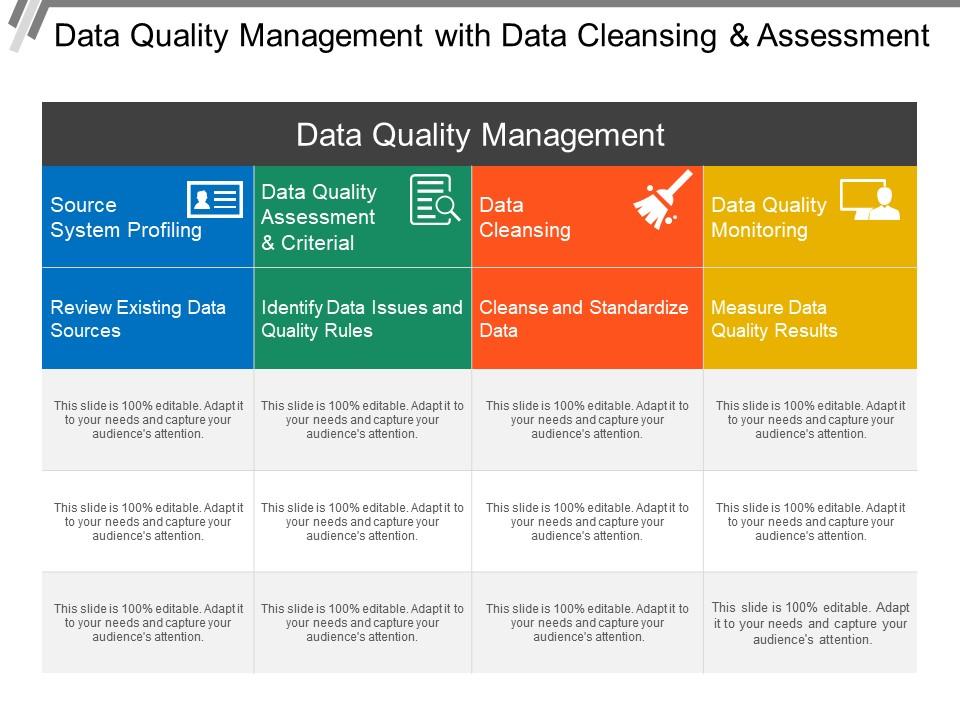
Data quality management with data cleansing and assessment
Try Before you Buy Download Free Sample Product
Audience
Editable
of Time
Data Quality Management With Data Cleansing And Assessment is a highly-visual custom tool. Use our PPT slide to represent data profiling, data reporting, data repair, and other pillars of information quality management. Consolidate data quality assessment criteria like uniqueness, completeness, timeliness, accuracy, validity, and consistency through this PowerPoint template. Highlight the data cleansing system with the help of this PPT layout. Using this data quality monitoring PowerPoint format, you can take advantage of the neat tabular format. Your audience will understand the subject better when you present the information in distinct chunks. This is exactly the motive behind the data visualization tool featured in this source system profiling PPT template. Our well-structured PowerPoint presentation is an invaluable virtual tool for those involved in the implementation process. This includes business or data analysts, organization change managers, and DQM program managers. So, hit the download button and build an informative and visually-impressive presentation within moments. Popularity is a byproduct of our Data Quality Management With Data Cleansing And Assessment. Your fan club will definitely grow.
People who downloaded this PowerPoint presentation also viewed the following :
Data quality management with data cleansing and assessment with all 5 slides:
Insert a bit of fun into the event with our Data Quality Management With Data Cleansing And Assessment. It will induce huge grins.
FAQs for Data quality management with data
Honestly, focus on these five things: accuracy (is it actually right?), completeness (missing stuff?), consistency (same data across different systems), timeliness (how fresh is it?), and validity (proper format). Bad data will totally screw your decisions - you'll end up targeting wrong customers or making forecasts with ancient info. I've watched teams burn weeks on garbage data insights, which... yeah, not fun. Oh, and don't try to fix everything at once. Pick whichever dimension hurts most for your situation first, then expand from there.
Start with data profiling - check completeness, accuracy, all that stuff across your main datasets. Automated tools help if you've got them, but honestly? Sometimes manually spot-checking a sample tells you way more about what's actually broken. Missing values, error rates, contradictions between systems - track all of it. The people using this data every day are gold mines of info, so definitely chat with them about where things get messy. They'll know exactly what's frustrating. Oh, and set up some basic metrics you can watch over time so you're not flying blind.
Okay so data governance is basically your quality control system - it's who owns what data, how you check if it's actually good, and what happens when things go wrong. Picture having a manager who genuinely cares about doing things right (shocking concept, right?). You'll want clear rules about validation and monitoring. Most companies skip this step and then wonder why their reports are garbage. Honestly, just start small - pick your most important datasets and assign someone to actually own them. That one change fixes like 80% of quality issues right away.
Incomplete data is the worst - missing fields everywhere. Then you've got duplicates clogging everything up, plus different formats between systems that don't play nice together. Old records just sit there forever too, which is honestly ridiculous when you think about it. Manual data entry creates so many accuracy problems, especially without validation checks. Here's what I learned the hard way: set up automated validation from the start. Don't be like me trying to clean years of messy spreadsheets later, wondering which version of the same customer is actually right. Such a nightmare.
So data profiling is like getting a full scan of your dataset before you dive in. It catches all the messy stuff - missing values, duplicates, weird formats, outliers that'll totally screw up your results. Honestly, I learned this the hard way after spending hours wondering why my analysis looked completely wrong. The tool shows you patterns and relationships you'd never notice just scrolling through spreadsheets. Pretty much saves you from those "oh crap, my data is garbage" moments later. Always run it on new datasets first - trust me on this one.
Honestly, start by just looking at what data you actually have - it's usually way messier than people think. Put some automated checks at the entry points so bad data gets caught early. Make sure someone owns each dataset, otherwise it becomes nobody's problem (classic). I know audits sound boring but they're super helpful. The trick is getting everyone involved, not dumping it all on IT. Focus on your most important data first and work outward. You'll probably notice things improving faster than expected. Oh, and don't try to fix everything at once - that never works.
Messy data is honestly such a nightmare for customer experience. You'll send people totally irrelevant emails or - even worse - mess up their billing. Customers pick up on this stuff instantly and it just screams "we don't actually know you." With clean data though, you can actually personalize things and predict what they want before they even ask. Your team stops wasting time wondering if the numbers are even accurate. I'd start with whatever data touches customers most directly - that's where you'll notice the difference fastest. It's crazy how much bad data costs you without realizing it.
Honestly? Start with **dbt** for transformations and **Great Expectations** for validation - they're solid choices. **Monte Carlo** or **Datafold** work great for monitoring too. But here's the thing - I've watched way too many teams try to build the perfect data quality setup from day one and just burn out. Begin simple. **Pandas Profiling** or **DataPrep** will get you basic insights without much setup. Then add automated testing piece by piece. Oh, and if you're already on AWS, **Deequ** is worth checking out. Pick whatever meshes with your current tools first though. Master one before moving on.
You should try ML for your data cleanup - it's way better at catching weird patterns and outliers than doing it by hand. Missing values? AI beats those basic averaging methods every time. The cool part is the models actually learn from when you fix stuff, so they get smarter about your specific data quirks. I'd start with anomaly detection on whatever datasets matter most to your team. Oh, and it saves tons of time on those boring consistency checks across different sources. Honestly wish I'd started using this stuff sooner.
Bad data is such a money pit, honestly. Your marketing campaigns will target completely wrong people, inventory gets screwed up from fake sales numbers, and your team wastes hours fixing messy spreadsheets instead of actually working. Compliance fines hit hard too. Customers bail when they have terrible experiences because of data errors. The whole thing snowballs - you can't trust your analytics, so you miss obvious revenue opportunities. I'd start with whatever datasets affect your biggest money decisions first. Fix those and work down from there.
Honestly, you can't just dump this on your data team and call it a day. Get everyone involved by showing them how crappy data actually screws with their daily work - that usually gets their attention. Set some basic standards for what decent data looks like, then train people on it. But here's the thing that really works: when leadership starts making decisions based on quality metrics, suddenly everyone cares. Create ways for teams to see how their data mistakes mess things up downstream. Oh, and definitely celebrate when someone catches an issue instead of just blaming people when stuff breaks.
Track the basics first - missing data percentages, error rates, duplicates, and how current everything is. Also check if your data actually makes sense (like valid email formats or realistic dates). Don't try to monitor everything at once though, you'll burn out fast. Just pick 2-3 things that actually matter for what you're doing and build some simple dashboards. The real trick? Set clear thresholds so you know when something's broken vs just normal fluctuations. Otherwise you're just staring at charts all day wondering if you should panic or not.
Honestly? Start with quarterly - that's the bare minimum that won't bite you later. But it really comes down to how much your data changes. Customer stuff that updates daily? Check it monthly or you're asking for trouble. Reference data that barely moves? Every six months is probably fine. I've watched teams stress themselves out trying to audit everything all the time - don't do that to yourself. Pick your most critical datasets first, set those calendar reminders (seriously, do it now), then see what breaks. You can always adjust from there. Consistency beats perfection every time.
Honestly, start with automated validation rules - catches the messy stuff right when people enter it. Monthly quality reviews are clutch too, don't skip those. Set up some dashboards to track your metrics over time (learned this the hard way). Standardize formats across everything and actually get people to follow governance policies - easier said than done but worth it. Oh, and assign stewards to your critical datasets. Makes data cleaning ongoing instead of this massive project you dread. Regular profiling helps spot weird inconsistencies before they become real problems.
So your industry's regulations basically set the bare minimum for data quality - but they're all over the place depending on what you do. Healthcare has HIPAA and FDA breathing down your neck, demanding perfect accuracy and those audit trails. Financial services? SOX and Basel III want real-time validation and lineage tracking. Manufacturing's got ISO standards, though honestly they care more about consistency than perfection. Here's the thing - regulators define what "good enough" data quality actually means for your specific situation. They'll spell out acceptable error rates, retention periods, all that stuff. Start by figuring out what regulations hit your industry, then build up from those minimums.
-
Very unique, user-friendly presentation interface.
-
Great experience, I would definitely use your services further.