

Data Steward Vs Data Owner Ppt Powerpoint Presentation File Show




Try Before you Buy Download Free Sample Product
 Impress Your
 Audience
 100%
100% Editable
 Save Hours
 of Time


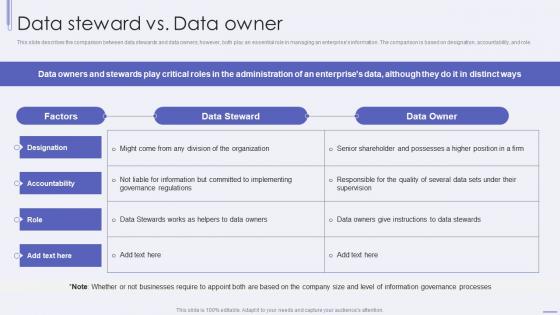
This slide describes the comparison between data stewards and data owners however, both play an essential role in managing an enterprises information. The comparison is based on designation, accountability, and role.
People who downloaded this PowerPoint presentation also viewed the following :
Data Steward Vs Data Owner Ppt Powerpoint Presentation File Show with all 6 slides:
Use our Data Steward Vs Data Owner Ppt Powerpoint Presentation File Show to effectively help you save your valuable time. They are readymade to fit into any presentation structure.





FAQs for Data Steward Vs Data Owner Ppt Powerpoint
Data owners are the decision-makers - they set access rules and handle the big picture compliance stuff. Stewards do the actual grunt work though. Quality checks, fixing problems, updating documentation, making sure everyone follows what the owner decided. It's kinda like... okay this is a weird comparison but think landlord vs property manager? Owner makes the rules, steward deals with tenants calling about broken toilets lol. If you're sorting out your team, just figure out who's actually responsible for each dataset from a business standpoint. That's your owner right there.
So data stewards are like the quality control people for your data - they're constantly checking it, cleaning it up, and making sure everything stays accurate across different systems. They set up rules to catch errors early (because honestly, once bad data gets in there it spreads like wildfire). Regular audits are part of their thing too. Plus they create standards and documentation so everyone's on the same page about what good data looks like. When issues pop up, they work with users to fix them fast. Got data problems? Hit up your steward first.
Data owners are the ones calling the shots - they decide who gets access and set all the compliance rules. Stewards handle the day-to-day stuff though. Quality checks, managing metadata, dealing with user requests. It's like... okay this analogy might be dumb but think house owner vs property manager. Owner makes the rules, manager deals with tenants and fixing broken toilets. There's definitely overlap since stewards are closest to the actual problems, so they end up influencing owner decisions a lot. Just make sure you clearly map out who owns which datasets and which stewards support them. Otherwise you'll have people fighting over who approves what.
So data steward is basically half tech nerd, half people person. You gotta know your company's data systems inside out, plus all the quality control stuff. But here's what gets people - the communication part is actually harder than the technical side. You're constantly translating between IT guys and business folks who speak totally different languages. Detail-oriented mindset is key for catching weird data patterns. Oh, and you'll need some project management skills too. Domain knowledge helps a ton. Honestly? Just shadow someone doing it now and mess around with the governance tools yourself.
So basically, think of data owners as the decision-makers - usually business leaders who set policies and handle compliance stuff. Data stewards are more like the day-to-day caretakers doing the actual work - cleaning data, monitoring it, that kind of thing. Here's what I'd do: map out your important data first, then assign specific business owners to each piece. After that, get stewards who report to those owners. Honestly, you really need this stuff documented clearly because when something goes wrong (and it will), everyone suddenly gets amnesia about who's supposed to handle what. Short sentences work better than long policies nobody reads.
Look, when regulators show up asking questions, you need someone who can actually answer for your data decisions - that's why ownership matters so much. GDPR audits? HIPAA compliance checks? Can't have your whole team playing hot potato with responsibility. Someone has to own the consent stuff, handle deletion requests, manage the whole lifecycle. Your data stewards do the daily grunt work, but owners are the ones who'll get called into meetings when things go sideways. Honestly reminds me of group projects in college - always better to have one person clearly in charge. Just make sure whoever gets the "data owner" title knows they're not just collecting a fancy business card.
Honestly, new tech makes data stewardship way more complicated. Your quality rules will need updates, and you'll probably have to rebuild half your governance workflows. AI stuff is the worst for this - it processes data so fast that you can't keep up manually. But the flip side is you get better dashboards and automated checks, which is nice I guess. My advice? Map out everything that'll break first, then fix your processes before launch. Cloud platforms can be tricky too. Start there and you won't be scrambling later when things go sideways.
Honestly, the biggest thing that'll save your sanity is setting up clear communication from day one. Don't make your data stewards sit around waiting for answers - nothing kills momentum like that. Give them regular access to you for the stuff only you can decide on. Weekly check-ins work great, even quick ones. Also, document everything upfront: data definitions, business rules, who approves what. Oh and this is key - let them make routine decisions without coming to you every time. Set boundaries but trust them within those limits. Being available when they need you is huge.
Okay so basically whoever owns the data is gonna be super paranoid about security because they're the ones who get fired if there's a breach. They'll demand all the heavy stuff - tight access controls, encryption, constant monitoring. Makes sense when you think about it, right? Like how you baby your own phone but don't really care if you drop someone else's. These data owners usually control the budget too, so they'll force audits and proper permissions and all that. My advice? Figure out what the owner wants first before you plan anything - saves you from redoing work later when they inevitably ask for more security layers.
Honestly, start with data quality scores - track accuracy and completeness over time. That's your bread and butter. Then look at how fast your team responds to data issues and resolves user requests. User adoption rates are clutch too because if nobody's actually using your governance processes, what's the point? Oh, and don't sleep on compliance stuff like policy adherence and audit results. My advice? Pick maybe 2-3 metrics that'll make your stakeholders happy first. You can always add more later once you've got those dialed in.
Yeah, so culture definitely changes how this stuff works across regions. Japanese and German teams? Data owners have way more control and stewards basically just follow orders. Scandinavian companies are the opposite though - stewards actually speak up and influence decisions, which honestly makes way more sense to me. Privacy laws are all over the place too depending where you are. I'd say map out the roles differently for each region instead of trying to make everyone fit the same mold. Way less headaches that way, trust me.
Honestly, data stewards usually end up with way more pull when they're the ones who actually get how everything works behind the scenes. Picture this - you're technically the data owner but you're constantly asking your steward about policies, quality checks, access requests, all of it. They're basically running the show at that point. Happens all the time with executives who "own" the data on paper but never touch it day-to-day. Your steward becomes everyone's go-to person. If that's you, just make sure you're not totally in the dark about what decisions they're making.
Honestly, it's a total mess because everyone steps on each other's toes. Data owners jump into daily quality stuff when that's the steward's territory. Meanwhile stewards make access decisions they shouldn't touch. Most companies don't even write down who does what - they just figure it out as they go until something explodes. I've seen this happen so many times. You really need those RACI charts to spell everything out clearly. Then actually train people on the differences, which sounds boring but saves headaches later.
Honestly, hands-on workshops are your best bet - cover data quality checks, documentation standards, governance stuff. Use real problems your team deals with, like when data doesn't match up or you're trying to get access from data owners. Role-playing helps too (I know, sounds weird but it works). Don't forget technical training on whatever tools you're using. Communication skills matter since stewards are always translating between tech people and business folks. Oh, and make it ongoing - one training session won't cut it. Start by figuring out what gaps your current stewards have, then build from there.
Look, you absolutely need those data stewards and owners talking constantly. The owner makes the rules and policies, but the steward's the one actually dealing with the data mess every day. They see what's really going on. If they're not syncing up regularly, everything falls apart - stewards start making calls that contradict business goals, or owners dream up policies that are impossible to follow. I swear, half the data disasters I've witnessed could've been avoided with better communication. Weekly check-ins are a must. Both sides need to stay clear on who's doing what and flag any requirement changes immediately.
-
You guys are life-saver when it comes to presentations. Honestly I cannot do much without your services. Thank you!!!
-
Definitely a time saver! Predesigned and easy-to-use templates just helped me put together an amazing presentation.