


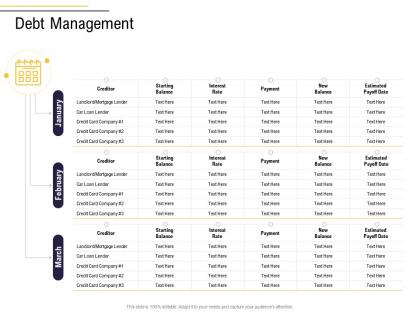
Debt management business process analysis




Try Before you Buy Download Free Sample Product
 Impress Your
 Audience
 100%
100% Editable
 Save Hours
 of Time


Our Debt Management Business Process Analysis are topically designed to provide an attractive backdrop to any subject. Use them to look like a presentation pro.
People who downloaded this PowerPoint presentation also viewed the following :
Debt management business process analysis with all 2 slides:
Use our Debt Management Business Process Analysis to effectively help you save your valuable time. They are readymade to fit into any presentation structure.

FAQs for Debt management
Creating a personal debt management plan involves listing all debts with balances and interest rates, prioritizing high-interest debts, establishing a realistic monthly budget, and choosing a repayment strategy like debt snowball or avalanche methods. These approaches streamline financial obligations by consolidating payments, reducing interest costs, and creating clear timelines, with many individuals finding that systematic debt reduction ultimately delivers improved credit scores and enhanced financial stability.
A debt management plan can initially lower your credit score due to account closures and reduced credit limits, but typically improves it over time through consistent payments and debt reduction. Many participants find their scores recover within 12-24 months as payment history strengthens and credit utilization decreases, ultimately delivering better borrowing opportunities and financial stability.
Debt consolidation combines multiple debts into a single loan with potentially lower interest rates, maintaining credit relationships, while debt settlement involves negotiating reduced payment amounts with creditors, often impacting credit scores negatively. Consolidation streamlines payments and preserves creditworthiness, whereas settlement reduces total debt owed but carries greater financial risks and credit implications.
Signs that indicate you need professional debt management assistance include consistently making only minimum payments, using credit cards for basic necessities, missing payment deadlines, maxing out credit limits, and feeling overwhelmed by multiple creditors. These warning signals often compound quickly, with many individuals finding that early intervention through professional guidance prevents further financial deterioration and enables strategic debt consolidation, ultimately delivering structured repayment plans and restored financial stability.
Budgeting enables effective debt management by tracking income and expenses, identifying areas for cost reduction, and allocating specific amounts toward debt repayment. Through strategic budget planning, individuals and organizations can prioritize high-interest debts, negotiate payment schedules, and build emergency reserves, ultimately accelerating debt elimination while maintaining operational stability and improving long-term financial health.
High-interest debt like credit cards, payday loans, and personal loans should be prioritized first, followed by tax debt, secured loans, and student loans. This strategic approach enables organizations and individuals to minimize interest costs, preserve credit ratings, and allocate resources more efficiently, with many finding that tackling high-cost debt first delivers significant long-term savings.
Interest rate variations significantly impact debt repayment strategies by altering monthly payment amounts, total interest costs, and payoff timelines across different loan types. When rates fluctuate, borrowers with variable-rate debts like credit cards or adjustable mortgages experience immediate payment changes, while fixed-rate obligations remain stable, ultimately requiring strategic rebalancing of repayment priorities and budget allocations.
Debt management tools include budgeting apps like Mint and YNAB, debt tracking spreadsheets, credit monitoring services, debt consolidation calculators, and financial planning software. These resources streamline debt oversight by automating payment reminders, analyzing spending patterns, and providing payoff strategies, with many individuals and small businesses finding that systematic tracking ultimately delivers faster debt reduction and improved financial control.
Negotiating with creditors involves demonstrating financial hardship through documentation, proposing realistic payment plans based on current income, and requesting reduced interest rates or extended payment periods. Many individuals find success by contacting creditors early before defaults occur, presenting hardship letters with supporting financial statements, and negotiating settlements that reduce principal balances while establishing manageable monthly payments.
Financial advisors provide strategic debt consolidation planning, personalized repayment strategies, credit score optimization, and comprehensive financial restructuring guidance. They prove especially valuable when managing multiple high-interest debts, facing potential bankruptcy, or navigating complex situations like business debt, with many individuals finding that professional guidance accelerates debt elimination while preserving long-term financial stability.
Behavioral finance principles aid debt management by addressing psychological biases like present bias and loss aversion through automated payments, debt visualization tools, and strategic account consolidation. These approaches leverage mental accounting and commitment devices to help individuals overcome emotional spending patterns, reduce high-interest obligations systematically, and maintain consistent payment behaviors that accelerate debt elimination while building stronger financial discipline.
Common debt pitfalls include making only minimum payments, ignoring high-interest debts, accumulating new debt while paying off existing obligations, lacking a structured repayment strategy, and failing to budget effectively. These mistakes significantly extend repayment periods and increase total interest costs, with many individuals and businesses finding that strategic debt consolidation and priority-based payment systems deliver faster financial recovery.
Establishing an emergency fund helps with debt management by preventing new debt accumulation during unexpected expenses, maintaining consistent debt payment schedules, and reducing financial stress that can derail repayment plans. With adequate reserves, individuals can continue their debt reduction strategies without borrowing additional funds, ultimately accelerating their path to financial freedom while building sustainable money management habits.
Financial literacy directly enables effective debt management by providing essential knowledge of interest rates, repayment strategies, budgeting techniques, and credit implications. With stronger financial education, individuals and businesses make informed borrowing decisions, prioritize high-interest debts, and develop sustainable repayment plans, ultimately reducing financial stress while building long-term wealth and creditworthiness.
Lifestyle changes significantly enhance debt management by reducing unnecessary expenses, increasing available income for debt payments, and establishing sustainable financial habits. Through strategic adjustments like downsizing housing costs, eliminating subscription services, and adopting cost-conscious spending patterns, individuals streamline their budgets, accelerate debt repayment timelines, and ultimately build stronger financial foundations for long-term stability.
-
It saves your time and decrease your efforts in half.
-
Easily Understandable slides.
-
Top Quality presentations that are easily editable.