


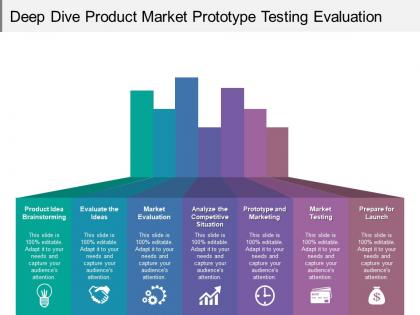
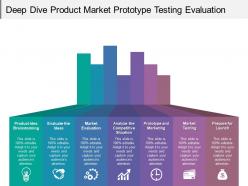
Deep dive product market prototype testing evaluation




Try Before you Buy Download Free Sample Product
 Impress Your
 Audience
 100%
100% Editable
 Save Hours
 of Time


Acknowledge the desire for change with our Deep Dive Product Market Prototype Testing Evaluation. Convince them of your adaptable approach.
People who downloaded this PowerPoint presentation also viewed the following :
Deep dive product market prototype testing evaluation with all 5 slides:
Examine jaded concepts with our Deep Dive Product Market Prototype Testing Evaluation. Convert boredom into excitement.
FAQs for Deep dive product market
Key objectives of prototype testing evaluation include validating functionality, assessing user experience, identifying design flaws, measuring performance benchmarks, and gathering stakeholder feedback. These evaluations enable development teams to minimize costly revisions, accelerate time-to-market, and enhance product quality, with many organizations finding that early prototype testing ultimately delivers significant cost savings and competitive advantage.
User feedback during prototype testing significantly influences final product design by identifying usability issues, revealing user preferences, highlighting missing features, and validating design assumptions through real-world interactions. This iterative process enables designers to refine interfaces, adjust functionality, and optimize user experiences before launch, with many technology companies finding that incorporating early feedback reduces development costs and accelerates market acceptance.
Effective prototype testing methods include usability testing, A/B testing, focus groups, user interviews, and performance benchmarking. These approaches streamline product development by identifying design flaws, validating user experience assumptions, and gathering actionable feedback, with many organizations finding that combining multiple methods ultimately delivers more refined products and faster market readiness.
Low-fidelity prototypes excel at gathering broad conceptual feedback and identifying major usability issues early, while high-fidelity prototypes deliver detailed interaction insights and realistic user behavior data. Through strategic prototype selection, organizations streamline development cycles, minimize costly revisions, and enhance user experiences, with many tech companies and startups finding that matching prototype fidelity to testing objectives ultimately accelerates product success.
Prototype testing success metrics include user task completion rates, error frequency, time-to-completion, user satisfaction scores, and system performance benchmarks. These measurements enable organizations to identify usability bottlenecks, optimize user workflows, and validate design decisions, with many development teams finding that comprehensive metric analysis accelerates product refinement and ultimately delivers stronger market readiness.
Balancing qualitative and quantitative data in prototype testing involves combining user feedback, behavioral observations, and usability insights with performance metrics, conversion rates, and statistical measurements. This strategic approach enables organizations to capture both emotional user responses and measurable outcomes, with many product teams finding that integrated evaluation delivers comprehensive insights, reduces development risks, and ultimately accelerates market-ready innovations.
Common pitfalls during prototype testing evaluation include testing with insufficient user diversity, focusing solely on technical functionality rather than user experience, conducting tests too late in development, ignoring negative feedback, and failing to establish clear success metrics. These oversights significantly compromise product development outcomes, with many organizations finding that early, comprehensive testing with diverse user groups ultimately delivers more robust products, reduced development costs, and enhanced market readiness.
Early-stage prototypes focus on concept validation and basic functionality testing, while later stages emphasize performance optimization, user experience refinement, and integration testing. Through iterative testing approaches, development teams can identify critical design flaws during conceptual phases and fine-tune operational efficiency in advanced stages, ultimately reducing development costs and accelerating time-to-market.
Stakeholder involvement in prototype testing evaluation ensures diverse perspectives from users, clients, and team members are captured, providing comprehensive feedback on functionality, usability, and business alignment. This collaborative approach streamlines the development process by identifying potential issues early, reducing costly revisions, and ultimately delivering products that meet market needs and stakeholder expectations more effectively.
Remote prototype testing can be effectively conducted through digital collaboration platforms, video conferencing tools, screen sharing software, cloud-based prototyping applications, and real-time feedback systems. These technologies streamline evaluation by enabling distributed teams to gather user insights, track interaction patterns, and collect performance data simultaneously, with many organizations finding that remote testing accelerates iteration cycles while reducing costs.
Techniques include blind testing protocols, diverse user groups, structured interview guides, anonymous feedback collection, and randomized testing sequences. These methods streamline evaluation processes by eliminating researcher bias, ensuring representative responses, and maintaining objectivity throughout testing phases, with many organizations finding that standardized protocols deliver more accurate insights and ultimately enhance product development decisions.
Usability testing and prototype testing evaluation complement each other by providing comprehensive insights at different development stages, with usability testing focusing on user interactions and prototype evaluation assessing technical feasibility, design coherence, and stakeholder alignment. This strategic combination enables product teams to identify user experience issues early while validating functionality, ultimately streamlining development cycles and delivering more market-ready solutions with enhanced user satisfaction.
Prototype testing insights improve user experience by identifying usability issues, validating design assumptions, revealing user pain points, and uncovering unmet needs before full development. These findings enable designers to streamline navigation flows, enhance interface clarity, and optimize feature functionality, with many digital product teams finding that early testing reduces post-launch revisions while delivering more intuitive, user-centered experiences.
Teams effectively communicate prototype testing results through comprehensive reports that combine quantitative metrics, user feedback analysis, visual documentation, and actionable recommendations tailored to each stakeholder group's priorities. These communications streamline decision-making by presenting findings through dashboards, executive summaries, and detailed technical appendices, with many organizations finding that structured presentation formats enhance stakeholder buy-in and accelerate product development timelines.
Ethical considerations include informed consent from participants, data privacy protection, transparency about testing purposes, minimizing psychological stress, and ensuring equitable representation across demographics. These guidelines enhance credibility by building stakeholder trust, reducing legal risks, and delivering more inclusive products, with many organizations finding that ethical testing practices ultimately strengthen market acceptance and competitive positioning.
-
Excellent Designs.
-
Enough space for editing and adding your own content.