

Defining Buyer Personas In Sales Training Ppt




Try Before you Buy Download Free Sample Product
 Impress Your
 Audience
 100%
100% Editable
 Save Hours
 of Time


These slides introduce the concept of buyer persona. A buyer persona is a fictional profile based on research representing a target customer. Buyer personas describe your ideal customers, their days, their challenges, and how they make decisions. Its a detailed description of who is researching, purchasing, and sharing your product and services. These slide also mention the importance of creating buyer persona.
People who downloaded this PowerPoint presentation also viewed the following :
Content of this Powerpoint Presentation
Slide 1
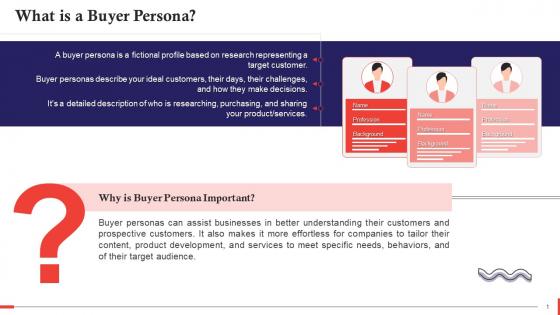
This slide depicts information regarding buyer persona. It highlights that a buyer persona is a fictional profile based on research representing a target customer. Buyer personas describe your ideal customers, their days, their challenges, and how they make decisions. It's a detailed description of who is researching, purchasing, and sharing your product/services. It also mentions the importance of creating buyer persona.
Slide 2
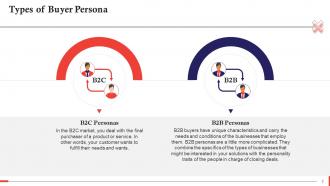
This slide depicts types of buyer persona such as business-to-consumer and business-to-business buyer persona. It highlights that in the B2C market, you deal with the final purchaser of a product or service. In other words, your customer wants to fulfill their needs and wants. Business-to-business buyer personas have unique characteristics and combine the needs and conditions of the businesses that employ them with the personality traits of the people in charge of closing deals.
Slide 3
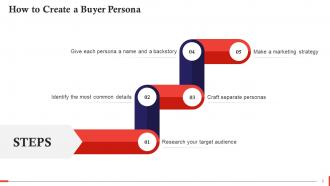
This slide explains the steps to create a buyer persona. The steps are: Research your target audience, identify the most common details, craft separate personas, give each persona a name and a backstory, and craft a marketing strategy.
Slide 4
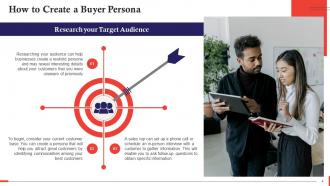
This slide depicts how a sales representative must research their target audience to create a buyer persona. It highlights that researching your audience can assist businesses in developing a realistic persona and may reveal interesting details about your customers that you were previously unaware of. It also suggests that you start by thinking about your current customer base. By identifying commonalities among your best customers, you can create a persona that will help you attract great customers.
Slide 5
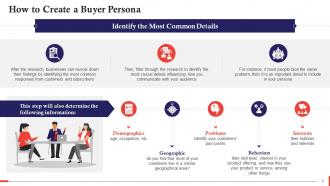
This slide shows how to identify the most common details while creating a buyer persona. It emphasizes that after conducting the research, businesses can narrow their findings by identifying the most common responses from customers and subscribers. Then, filter through the research to find the essential details influencing how you communicate with your target audience. This step will also include demographics, geographic location, behaviors, problems, and interests.
Slide 6
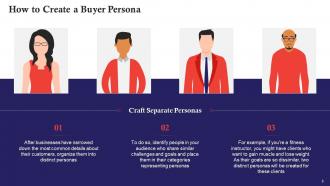
This slide explains how businesses can create distinct buyer personas. It highlights the importance of organizing the most common details about customers into distinct personas after businesses have narrowed them down. It also mentions that to do so, identify people in your audience who share similar challenges and goals and categorize them to represent such personas.
Slide 7
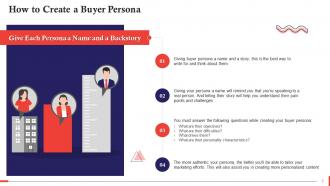
This slide explains how companies can give each persona a name and a backstory. It highlights the importance of giving your buyer persona a name and story to write for and think about them. It also says that giving your persona a name will help you remember talking to a real person, and hearing their story will help you understand their problems and difficulties.
Slide 8
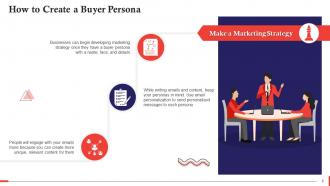
This slide explains about making a marketing strategy to create a buyer persona. It highlights that businesses can begin developing marketing strategy once they have a buyer persona with a name, face, and details. It also mentions that while writing emails and content, keep your personas in mind. Use email personalization to send personalized messages to each persona.
Slide 9
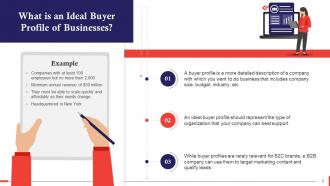
This slide contains information about an ideal buyer profile of businesses. It highlights that a buyer profile is a more detailed description of a company with whom you want to do business, including company size, industry, budget, etc. It also states that an ideal buyer profile should represent the type of organization that your business can best support.
Slide 10
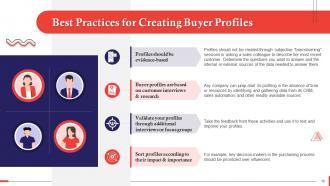
This slide contains information about best practices for creating buyer profiles. The best practices are: Profiles should be evidence-based, based on customer interviews and research, validated through additional interviews or focus groups, and should be sorted according to their impact and importance.
Slide 11
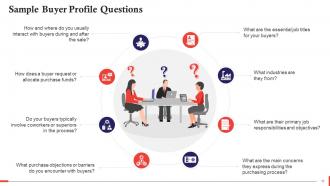
This slide contains a list of sample questions businesses should consider when developing their buyer profile.
Defining Buyer Personas In Sales Training Ppt with all 27 slides:
Use our Defining Buyer Personas In Sales Training Ppt to effectively help you save your valuable time. They are readymade to fit into any presentation structure.









FAQs for Defining Buyer Personas In
Effective buyer personas include demographic details, behavioral patterns, pain points, goals and motivations, preferred communication channels, and decision-making processes. These components work together by enabling targeted marketing strategies, personalized content creation, and improved customer experiences, with many organizations finding that detailed personas significantly enhance conversion rates and customer engagement across sales and marketing initiatives.
Understanding buyer personas improves marketing strategies by enabling targeted messaging, personalized content creation, optimized channel selection, and strategic resource allocation based on specific customer needs and behaviors. Through detailed persona insights, companies streamline campaign development, enhance customer engagement rates, and deliver more relevant experiences across touchpoints, ultimately reducing acquisition costs while increasing conversion rates and customer lifetime value.
Research methods for developing accurate buyer personas include customer surveys, one-on-one interviews, focus groups, website analytics, social media insights, and sales team feedback. These approaches combine quantitative data with qualitative insights, enabling businesses to understand customer motivations, pain points, and purchasing behaviors across different segments, ultimately delivering more targeted marketing strategies and enhanced customer experiences.
Identifying buyer persona pain points involves conducting customer surveys, analyzing support tickets, monitoring social media discussions, reviewing competitor feedback, and interviewing existing clients directly. Through these research methods, businesses uncover specific challenges like lengthy decision processes in B2B sales or complex onboarding experiences in software adoption, ultimately enabling more targeted solutions and improved customer experiences.
Demographic information provides the foundational framework for buyer personas, including age, income, location, education, and job title, which directly influence purchasing behaviors and preferences. These data points enable marketers to tailor messaging, product positioning, and channel strategies effectively, with companies like Netflix and Amazon leveraging demographic insights to deliver personalized experiences that drive engagement and conversion rates.
Buyer personas influence product development by guiding feature prioritization, user experience design, functionality requirements, and market positioning strategies based on specific customer needs and pain points. Through persona-driven development, companies like software firms and e-commerce platforms create more targeted solutions, reduce development costs, and accelerate time-to-market, ultimately delivering products that resonate with their core audiences.
Tools for creating detailed buyer personas include Google Analytics, HubSpot's persona generator, Xtensio, Facebook Audience Insights, and survey platforms like SurveyMonkey or Typeform. These technologies streamline persona development by analyzing customer data, tracking behavioral patterns, and gathering direct feedback, with many marketing teams finding that combining multiple tools delivers more comprehensive insights and enhances targeted campaign effectiveness.
Buyer personas should be updated every 6-12 months, or when significant market shifts, product changes, or customer behavior patterns emerge through data analysis. Regular reviews ensure personas reflect evolving customer needs, with many organizations finding that quarterly assessments of key metrics, annual comprehensive updates, and immediate adjustments following major market changes ultimately deliver more targeted marketing and improved conversion rates.
B2B buyer personas focus on organizational roles, decision-making processes, industry challenges, and business objectives, while B2C personas emphasize personal demographics, lifestyle preferences, emotional drivers, and individual purchasing behaviors. B2B personas typically involve multiple stakeholders in complex buying cycles, whereas B2C personas center on individual consumers making faster, emotion-driven decisions, ultimately requiring different marketing approaches and messaging strategies.
Buyer personas help tailor content by identifying specific demographics, pain points, communication preferences, content consumption habits, and decision-making processes for each segment. Through detailed persona mapping, marketing teams create targeted messaging, select appropriate channels, and develop relevant content formats, with many organizations finding that personalized approaches deliver higher engagement rates and improved conversion outcomes.
Common mistakes include relying solely on assumptions rather than data, creating overly generic personas, focusing only on demographics while ignoring motivations and pain points, and developing too many personas that dilute focus. Businesses often overlook gathering input from sales teams and existing customers, ultimately creating personas that don't reflect real buyer behaviors, leading to misaligned marketing strategies and reduced conversion rates.
Buyer personas enhance customer journey mapping by providing detailed insights into customer motivations, pain points, preferences, and decision-making processes at each stage. Through persona-driven mapping, organizations can identify specific touchpoints, personalize interactions, and optimize experiences for different customer segments, ultimately delivering more targeted marketing campaigns and improved customer satisfaction across retail, healthcare, and financial services.
Ethical buyer persona data collection requires obtaining explicit consent, ensuring data accuracy, protecting customer privacy through secure storage, and using information only for stated purposes. Organizations should implement transparent data policies, provide opt-out options, avoid discriminatory profiling, and regularly audit their practices, with many companies finding that ethical approaches ultimately build stronger customer trust and loyalty.
Visual presentations of buyer personas improve team alignment by providing shared reference points, eliminating subjective interpretations, and ensuring consistent customer understanding across departments. Through compelling infographics and persona cards, marketing, sales, and product teams streamline decision-making processes, reduce miscommunication, and accelerate project timelines, ultimately delivering more cohesive customer experiences and strategic outcomes.
**INPUT**: What metrics can be used to measure the effectiveness of targeting based on buyer personas? **OUTPUT**: Buyer persona targeting effectiveness can be measured through conversion rates, customer acquisition costs, engagement metrics, lifetime value, and retention rates. These metrics enable organizations to assess campaign precision, resource allocation efficiency, and audience resonance, with many companies finding that persona-driven strategies deliver significantly higher ROI and more qualified leads. [Word count: 50 words]
-
Great work on designing the presentation. I just loved it!
-
Great quality slides in rapid time.