


Defining Our Customer Renewal Management Process Timeline Customer Success Best Practices Guide




Try Before you Buy Download Free Sample Product
 Impress Your
 Audience
 100%
100% Editable
 Save Hours
 of Time


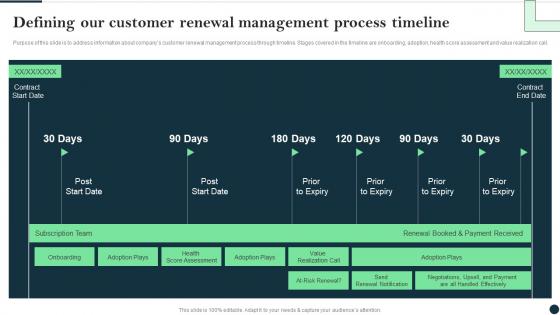
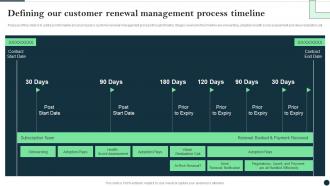
Purpose of this slide is to address information about companys customer renewal management process through timeline. Stages covered in the timeline are onboarding, adoption, health score assessment and value realization call.
People who downloaded this PowerPoint presentation also viewed the following :
Defining Our Customer Renewal Management Process Timeline Customer Success Best Practices Guide with all 6 slides:
Use our Defining Our Customer Renewal Management Process Timeline Customer Success Best Practices Guide to effectively help you save your valuable time. They are readymade to fit into any presentation structure.





FAQs for Defining Our Customer Renewal Management Process Timeline Customer Success
Key renewal metrics include renewal rate, revenue retention, time-to-renewal, customer health scores, and churn prediction indicators. These metrics enable organizations to identify at-risk accounts, optimize renewal processes, and enhance customer relationships through data-driven insights, with many companies finding that proactive monitoring ultimately delivers higher retention rates and increased revenue growth.
Businesses can identify at-risk customers by monitoring engagement metrics, support ticket frequency, product usage patterns, payment delays, and satisfaction scores throughout the renewal cycle. Through predictive analytics and customer health scoring, companies in sectors like SaaS and telecommunications can proactively address concerns, ultimately reducing churn rates and improving retention outcomes.
Customer feedback plays a crucial role in enhancing renewal rates by identifying pain points, revealing unmet needs, and highlighting service gaps that could lead to churn. Through systematic feedback collection and analysis, organizations can proactively address concerns, customize renewal offers, and improve overall customer experiences, with many companies finding that responsive feedback loops significantly boost retention and long-term loyalty.
Technology and automation streamline renewal management by tracking contract dates, sending automated notifications, and analyzing customer usage patterns to predict renewal likelihood. Through CRM integrations and AI-powered analytics, organizations accelerate renewal cycles, reduce manual oversight, and deliver personalized renewal proposals, while minimizing churn rates and ultimately enhancing revenue predictability across their customer base.
Personalization strategies include leveraging customer usage data, implementing predictive analytics, creating customized renewal offers, developing segmented communication campaigns, and utilizing AI-driven recommendation engines. These approaches enable organizations to tailor pricing, timing, and service packages based on individual customer behavior and preferences, with many subscription businesses finding that personalized renewal experiences increase retention rates and drive higher-value contract renewals.
Businesses can leverage data analytics to predict renewals by analyzing customer usage patterns, engagement metrics, support ticket frequency, payment histories, and satisfaction scores. Through predictive modeling and machine learning algorithms, organizations in sectors like SaaS, telecommunications, and financial services can identify at-risk accounts early, enabling proactive retention strategies, ultimately reducing churn and increasing revenue predictability.
Common pitfalls in customer renewal management include waiting until contracts near expiration, lacking proactive engagement, ignoring usage analytics, and failing to demonstrate ongoing value. These oversights result in reduced renewal rates and missed expansion opportunities, with many organizations finding that early renewal conversations, data-driven insights, and consistent value communication ultimately deliver higher retention and increased customer lifetime value.
Communication frequency before renewal dates is critically important, as regular touchpoints help identify concerns, demonstrate ongoing value, and build stronger relationships with customers. Strategic communication schedules, including quarterly business reviews, monthly check-ins, and pre-renewal discussions, enable organizations to address issues proactively, showcase ROI achievements, and ultimately secure higher renewal rates while strengthening long-term partnerships.
Effective onboarding practices include establishing clear expectations, providing comprehensive training resources, assigning dedicated success managers, implementing regular check-ins, and creating milestone-based engagement programs. These strategies streamline customer integration by building strong relationships, ensuring product adoption, and demonstrating ongoing value, with many organizations finding that structured onboarding approaches significantly enhance renewal rates and long-term customer satisfaction.
Businesses can effectively handle renewal objections by actively listening to concerns, acknowledging customer perspectives, and presenting data-driven solutions that address specific pain points. Through preparation with usage analytics, competitive comparisons, and flexible terms, companies like SaaS providers and financial services firms transform objections into opportunities, ultimately strengthening relationships while securing renewals.
Renewal incentives include loyalty discounts, upgrade packages at reduced rates, extended service terms, exclusive features, and flexible payment options. These strategic offers enhance customer retention by reducing switching costs, demonstrating value appreciation, and strengthening long-term partnerships, with many organizations finding that personalized renewal packages significantly improve retention rates and customer lifetime value.
Cross-functional teams improve renewal management by combining sales insights, customer success data, product feedback, and financial analytics to create comprehensive renewal strategies. Sales teams identify at-risk accounts, customer success managers provide usage insights, while product and finance teams deliver pricing flexibility and feature recommendations, ultimately enabling organizations to increase retention rates and reduce churn through coordinated, data-driven approaches.
Customer education plays a pivotal role in successful renewals by demonstrating ongoing value, reducing churn risk, and enhancing product adoption through training programs, best practice sharing, and strategic guidance. Well-educated customers typically achieve better outcomes with solutions, recognize expanded capabilities, and view renewals as strategic investments rather than costs, ultimately delivering higher retention rates and stronger long-term partnerships.
Social proof and testimonials significantly influence customer renewal decisions by building trust, demonstrating value, and reducing perceived risk through authentic peer experiences. When customers see testimonials from similar organizations showcasing improved efficiency, cost savings, and positive outcomes, it validates their renewal choice, with many businesses finding that peer success stories create confidence and reinforce the strategic value of continuing partnerships.
Pricing changes significantly impact customer renewals by affecting perceived value, budget considerations, and competitive positioning, with transparent communication being crucial for retention. Strategic organizations communicate increases early through personalized outreach, emphasizing enhanced features or improved service quality, while many find that bundling additional value or offering flexible payment terms helps maintain renewal rates despite price adjustments.
-
Innovative and Colorful designs.
-
Content of slide is easy to understand and edit.