


Deployment Of 5g Wireless Telecommunication System Powerpoint Presentation Slides




Try Before you Buy Download Free Sample Product
 Impress Your
 Audience
 100%
100% Editable
 Save Hours
 of Time


The Deployment of 5G Wireless Telecommunication System PowerPoint template is a valuable tool in presenting 5G technology guidelines for telecom operators considering implementing the latest 5G technology across various geographical locations. It will allow telecom operators to deploy 5G by assessing different parameters such as cost, market, and technology readiness. This template covers slides depicting uniqueness related to 5G in terms of its design specifications, comparative assessment, and unique features such as latency, speed, intelligent connectivity, heterogeneous network, and use cases in the context of 5G. Policy readiness caters slides about 5G regulatory costs and flexibility policies, 5G era spectrum bands, access, and pricing consideration. Market readiness addresses the competitive landscape of 5G, success factors related to 5G handsets, and new skills requirements for 5G deployment. It also shows slides on various 5G value enablers such as resilient networks, horizontal APIs, operator cloud, network slicing, etc. Lastly, It covers slides about cost determination for 5G by assessing cost-impacting factors such as network capacity, network coverage, network flexibility, network energy efficiency, and network equipment sourcing for 5G. Get access to our powerful 5g technology ppt templates now.
People who downloaded this PowerPoint presentation also viewed the following :
Content of this Powerpoint Presentation
Slide 1: This slide introduces Deployment of 5G Wireless Telecommunication System. State your company name and begin.
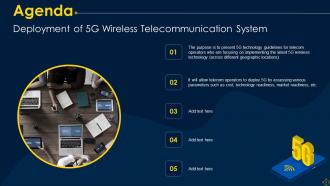
Slide 2: This slide states Agenda of the presentation.
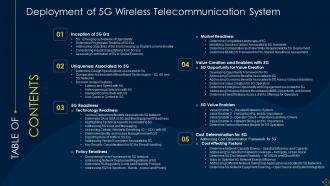
Slide 3: This slide presents Table of Content for the presentation.
Slide 4: This slide highlights title for topics that are to be covered next in the template.
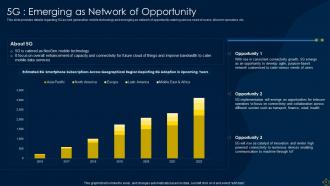
Slide 5: This slide displays 5G as next generation mobile technology and emerging as network of opportunity.
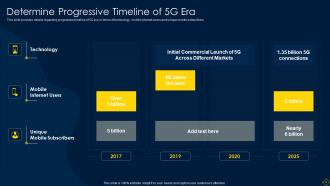
Slide 6: This slide represents details regarding progressive timeline of 5G era.
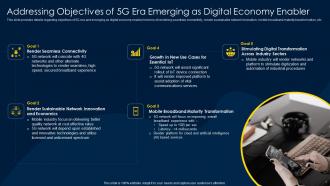
Slide 7: This slide showcases Objectives of 5G Era Emerging as Digital Economy Enabler.
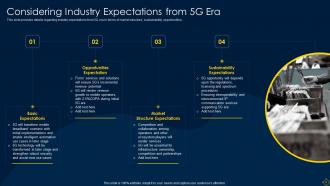
Slide 8: This slide shows Industry Expectations from 5G Era.
Slide 9: This slide presents Contribution of 5G to Global Economy.
Slide 10: This slide highlights title for topics that are to be covered next in the template.
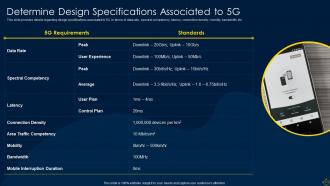
Slide 11: This slide displays Determine Design Specifications Associated to 5G.
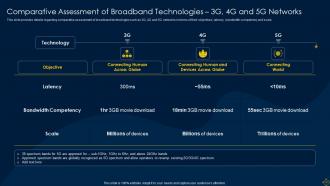
Slide 12: This slide represents details regarding comparative assessment of broadband technologies.
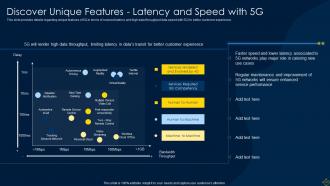
Slide 13: This slide showcases unique features of 5G in terms of reduced latency.
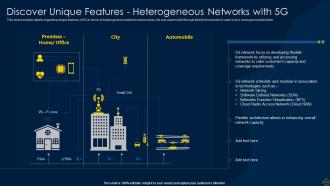
Slide 14: This slide shows unique features of 5G in terms of heterogeneous networks at premises.
Slide 15: This slide presents unique features of AI enabled 5G for intelligent connectivity.
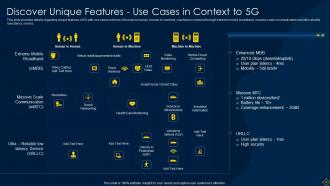
Slide 16: This slide displays unique features of 5G with use cases.
Slide 17: This slide highlights title for topics that are to be covered next in the template.
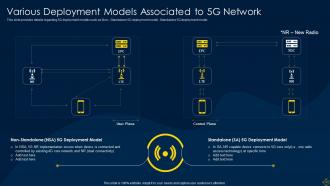
Slide 18: This slide represents Various Deployment Models Associated to 5G Network.
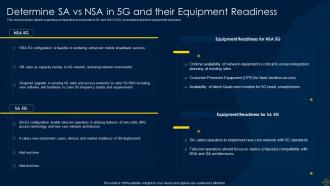
Slide 19: This slide showcases Determine SA vs NSA in 5G and their Equipment Readiness.
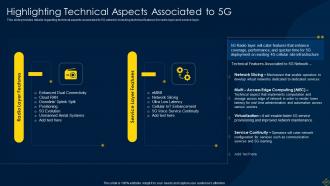
Slide 20: This slide shows Highlighting Technical Aspects Associated to 5G.
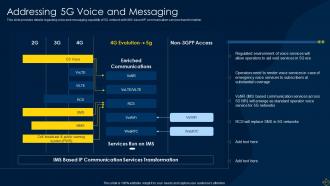
Slide 21: This slide presents details regarding voice and messaging capability of 5G network.
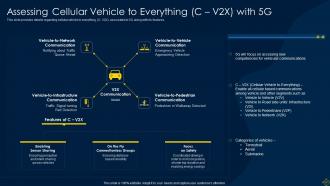
Slide 22: This slide displays Cellular Vehicle to Everything (C – V2X) with 5G.
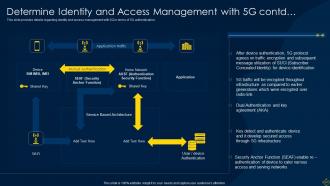
Slide 23: This slide represents Determine Identity and Access Management with 5G.
Slide 24: This is another slide continuing Determine Identity and Access Management with 5G.
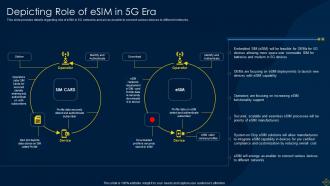
Slide 25: This slide showcases role of eSIM in 5G networks and act as enabler to connect various devices.
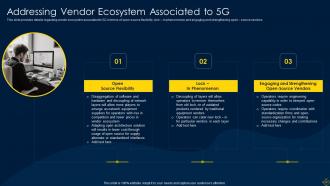
Slide 26: This slide shows Vendor Ecosystem Associated to 5G.
Slide 27: This slide presents Key Security Considerations for 5G for Threat Handling.
Slide 28: This slide highlights title for topics that are to be covered next in the template.
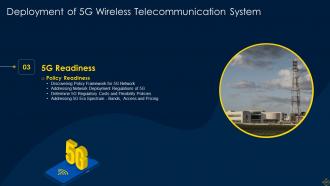
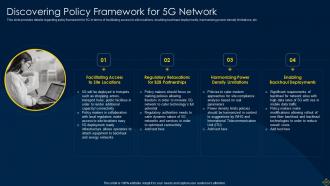
Slide 29: This slide displays Discovering Policy Framework for 5G Network.
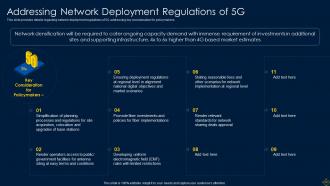
Slide 30: This slide represents Addressing Network Deployment Regulations of 5G.
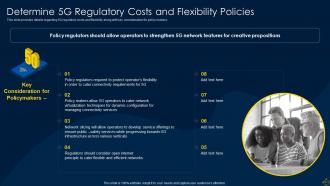
Slide 31: This slide showcases Determine 5G Regulatory Costs and Flexibility Policies.
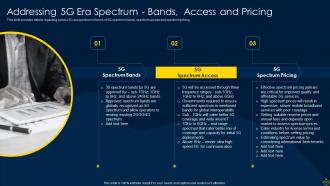
Slide 32: This slide shows Addressing 5G Era Spectrum-Bands, Access and Pricing.
Slide 33: This slide highlights title for topics that are to be covered next in the template.
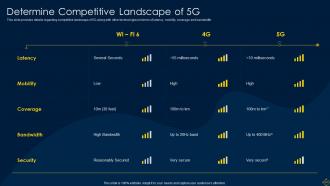
Slide 34: This slide presents Determine Competitive Landscape of 5G.
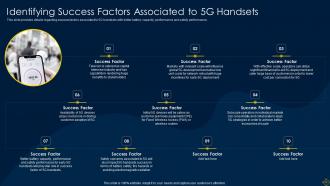
Slide 35: This slide displays Identifying Success Factors Associated to 5G Handsets.
Slide 36: This slide represents Determine Collaboration and New Skills Requirement for 5G Deployment.
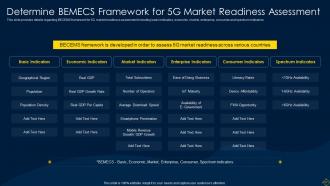
Slide 37: This slide showcases BECEMS framework for 5G market readiness assessment.
Slide 38: This slide highlights title for topics that are to be covered next in the template.
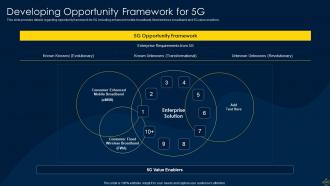
Slide 39: This slide shows details regarding opportunity framework for 5G.
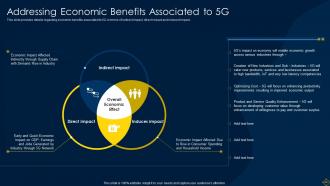
Slide 40: This slide presents economic benefits associated to 5G in terms of indirect impact.
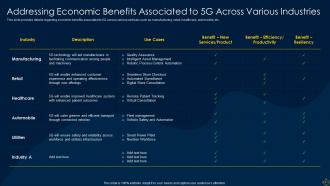
Slide 41: This slide displays Economic Benefits Associated to 5G Across Various Industries.
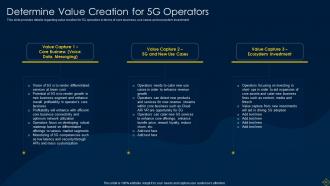
Slide 42: This slide represents value creation for 5G operators in terms of core business.
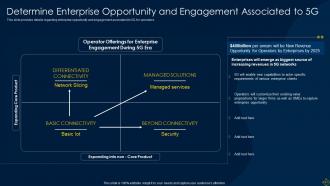
Slide 43: This slide showcases details regarding enterprise opportunity and engagement.
Slide 44: This slide shows Enterprise Opportunity and Engagement Associated to 5G.
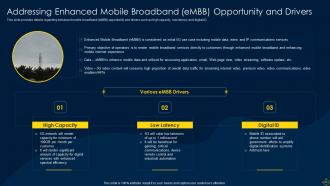
Slide 45: This slide presents enhanced mobile broadband (eMBB) opportunity and drivers.
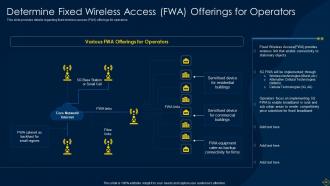
Slide 46: This slide displays fixed wireless access (FWA) offerings for operators.
Slide 47: This slide highlights title for topics that are to be covered next in the template.
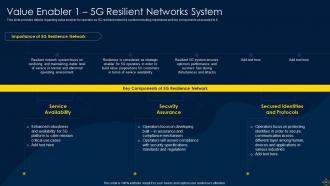
Slide 48: This slide represents value enabler for operator as 5G resilient networks system.
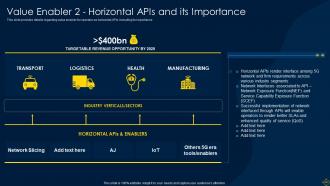
Slide 49: This slide showcases value enabler for operator as horizontal APIs including its importance.
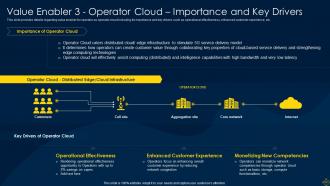
Slide 50: This slide shows value enabler as operator cloud including its importance and key drivers.
Slide 51: This slide presents value enabler for network slicing including its importance.
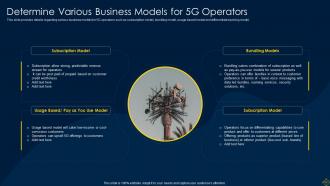
Slide 52: This slide displays various business models for 5G operators.
Slide 53: This slide highlights title for topics that are to be covered next in the template.
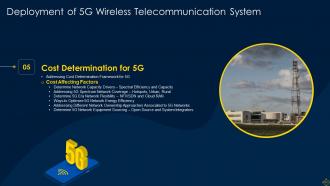
Slide 54: This slide represents Addressing Cost Determination Framework for 5G.
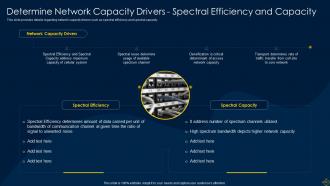
Slide 55: This slide showcases network capacity drivers such as spectral efficiency and spectral capacity.
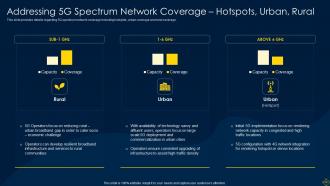
Slide 56: This slide shows 5G spectrum network coverage including hotspots, urban coverage and rural coverage.
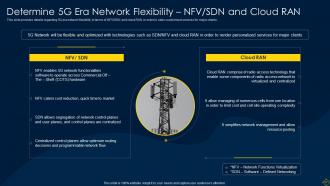
Slide 57: This slide presents 5G era network flexibility in terms of NFV/SDN and cloud RAN in order to cater customized services.
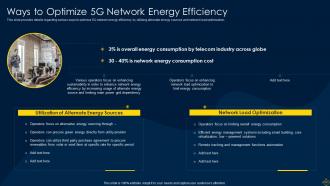
Slide 58: This slide displays Ways to Optimize 5G Network Energy Efficiency.
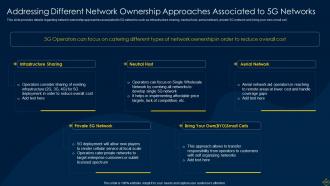
Slide 59: This slide represents network ownership approaches associated to 5G networks.
Slide 60: This slide showcases 5G network equipment sourcing by operators.
Slide 61: This slide is titled as Additional Slides for moving forward.
Slide 62: This slide provides 30 60 90 Days Plan with text boxes.
Slide 63: This slide shows Weekly Timeline with Task Name.
Slide 64: This slide presents Roadmap for Process Flow.
Slide 65: This is an Idea Generation slide to state a new idea or highlight information, specifications etc.
Slide 66: This is Our Target slide. State your targets here.
Slide 67: This slide contains Puzzle with related icons and text.
Slide 68: This slide depicts Venn diagram with text boxes.
Slide 69: This is a Thank You slide with address, contact numbers and email address.
Deployment Of 5g Wireless Telecommunication System Powerpoint Presentation Slides with all 74 slides:
Use our Deployment Of 5g Wireless Telecommunication System Powerpoint Presentation Slides to effectively help you save your valuable time. They are readymade to fit into any presentation structure.




















FAQs for Deployment Of 5g Wireless Telecommunication System
So basically 5G comes down to a few key things. Millimeter wave spectrum gives insane speeds, and massive MIMO antennas can juggle tons more devices at once. Network slicing is where it gets interesting though - your car's emergency braking gets priority over someone's TikTok, which honestly makes sense. Edge computing moves all the processing closer to you instead of bouncing everything off servers halfway across the country. Oh, and if you're thinking about IoT stuff, this changes the game completely. The latency drops are wild.
Dude, 5G is insanely fast compared to 4G - like up to 100x faster downloads. You could grab a whole movie in seconds instead of waiting around forever. But honestly? The latency drop is what blew my mind. Goes from 50ms down to maybe 1-5ms, which feels instant when you're using it. Everything just responds immediately - apps, websites, whatever. My buddy's been using it for some AR stuff and says it's night and day. Perfect timing if you're working on mobile projects since real-time gaming and IoT devices can actually work properly now.
Oh man, the costs are brutal - you need SO many more towers and small cells since 5G range sucks. Coverage gaps everywhere unless you go super dense with infrastructure. Getting permits is honestly the worst part though, every city has different random rules about equipment placement. Spectrum licenses cost a fortune too. Technical stuff gets messy when you're trying to mesh with older networks. If you're shopping vendors, definitely grill them on realistic timelines and whether they actually know the local regulations in your area. That regulatory experience thing can save you months of headaches.
Honestly, governments are running the whole 5G show through spectrum auctions and infrastructure rules. Each country's doing something totally different though - some are fast-tracking permits while others are paranoid about security (especially with the whole Huawei drama). The US and EU have crazy strict cybersecurity stuff that telecom companies hate dealing with. China's obviously going all-in with government backing. Makes the whole global scene pretty competitive and weird. Oh, and if you're planning anything 5G-related, definitely check out the regulations in whatever markets you're targeting first. Trust me, it'll save you so much hassle down the road.
So basically, small cells are like mini towers that fill in all the dead zones regular cell towers miss. 5G signals are weirdly weak and buildings block them constantly, which is honestly annoying. But small cells fix this by creating tons of connection points everywhere - you'll spot them on streetlights, building walls, random utility poles once you know what to look for. Downtown areas and busy spots like stadiums get packed with them. More small cells in your area = way better 5G speeds. Definitely check those coverage maps before you switch carriers though.
So 5G fixes the main headaches with IoT - you can connect millions of devices instead of just thousands, which is pretty wild. Latency drops to almost nothing, so your sensors actually respond instantly. That's critical for stuff like self-driving cars or factory equipment. Oh, and network slicing lets you prioritize important IoT traffic over regular internet usage. Honestly, the reliability boost alone makes it worth considering. Fewer dropped connections = less frustration. If you're thinking about any big IoT projects, definitely plan around 5G infrastructure. It'll make things possible that just weren't doable before.
Honestly, 5G security is kinda messy right now. Way more devices get connected compared to older networks, so hackers have tons more entry points to mess with. Your data's more at risk too - especially with all these IoT gadgets that barely have any protection. Then there's the whole political drama about which companies we should trust for equipment (that's been everywhere in the news). Network complexity goes up, which means more stuff can break. Oh and definitely check what your company's doing about 5G security as they roll it out.
Yeah, so carriers basically go where the money is first - urban areas with tons of people packed together. Makes sense from their perspective, but it sucks for rural folks who are already dealing with crappy internet. Rural deployment is way more expensive too since they need way more towers to cover the same distance. Plus there's just fewer customers out there to actually pay for it all. My cousin lives in the middle of nowhere and she's probably looking at another 3-5 years before she sees decent 5G. If you're planning anything rural-related, I'd definitely build in those delays.
Honestly, Seoul crushed it with their 5G rollout - they've got autonomous buses and smart traffic systems that cut congestion by 30%. Pretty impressive stuff. Barcelona's killing it too with smart parking and waste sensors. Singapore went nuts automating their entire port with 5G, which makes sense given how much shipping they handle. There's this smaller Finnish city, Tampere, that's using it for factory automation. Oh, and here's what I'd do if I were you - pick one thing to focus on first instead of trying to tackle everything. Way easier to manage that way.
Look, China and South Korea jumped on 5G early and now their tech companies are crushing it with IoT and manufacturing stuff. Meanwhile the US and Europe? We've been dragging our feet with all the regulatory nonsense - which honestly makes sense but still sucks timing-wise. Countries with slow 5G are getting left behind on smart city projects, supply chain efficiency, you name it. Your whole digital game suffers when the infrastructure isn't there yet. I'd definitely check where your main markets are in their 5G rollout before planning any major tech upgrades.
So basically 5G's main issue is it's super power-hungry - way more cell towers needed than 4G, which means tons more electricity. Manufacturing all those new phones and towers creates massive emissions too. Electronic waste is gonna be nuts. Though honestly, the IoT stuff could help other industries save energy, which is kinda ironic. Oh and if you're doing deployments, definitely think about renewable power from day one. Equipment lifecycle planning too - that's huge for keeping costs down later.
So 5G basically speeds everything up - data processing, IoT monitoring, remote work stuff. The latency is crazy low, so automated systems respond instantly. Your equipment can finally talk to each other without delays, and video calls don't suck anymore (thank god). Supply chains get real-time visibility too. But honestly, don't just jump in blindly. Figure out where you're actually struggling first - maybe it's slow file transfers or your IoT devices being laggy. Then build around fixing those specific problems. Mobile teams will love the connection though.
Yeah, I know people freak out about 5G and cancer risks, but honestly the science doesn't back that up. It's actually lower power than older networks and stays within safety limits. People hear "radiation" and panic - totally get why - but it's non-ionizing stuff, way weaker than your microwave or even sunlight. WHO and FDA say there's no real health risk based on current research. I mean, you could check SAR ratings on your phone if it makes you feel better, or keep calls shorter. But really, the evidence points to it being safe. Don't stress too much about it.
Dude, 5G is like the backbone that actually makes smart cities work. All those IoT sensors and autonomous vehicles? They need crazy fast responses - can't have a self-driving bus waiting around for directions, right? The bandwidth handles thousands of devices talking at once without everything grinding to a halt. Smart streetlights, traffic systems, emergency stuff - it all runs through that network like a city's nervous system. Honestly, if you're working on any smart city stuff, build around 5G coverage first. Everything else falls apart without it. Way too many projects treat it as an add-on later.
Honestly, self-driving cars are gonna be the biggest winners here - they need to process all that sensor data instantly, like we're talking milliseconds. Remote surgery and factory automation will be huge too since you can control stuff from anywhere with 5G's reliability. AR/VR is finally gonna stop being clunky. Cloud gaming's about to get insane (I'm actually pretty excited about this one). Industrial IoT will explode because everything can talk to everything else without lag. If you're working on projects in any of these spaces, definitely start figuring out how 5G fits in now.
-
Making a presentation has never been this easy for me. Thank you SlideTeam for offering a splendid template library.
-
SlideTeam is the way to go when you are in a time crunch. Their templates have saved me many times in the past three months.