

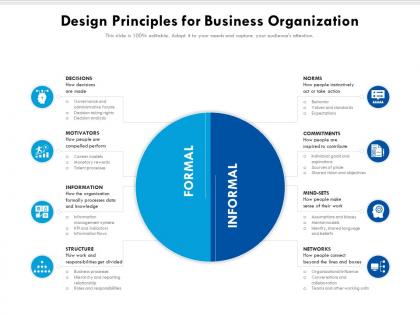
Design principles for business organization




Try Before you Buy Download Free Sample Product
 Impress Your
 Audience
 100%
100% Editable
 Save Hours
 of Time


Our Design Principles For Business Organization are topically designed to provide an attractive backdrop to any subject. Use them to look like a presentation pro.
People who downloaded this PowerPoint presentation also viewed the following :
Design principles for business organization with all 2 slides:
Use our Design Principles For Business Organization to effectively help you save your valuable time. They are readymade to fit into any presentation structure.
FAQs for Design principles
Honestly, it comes down to three big things: put customers first, create real value, and see how everything connects. Design around actual problems people have, not what you assume they need. Most companies totally blow this part - they obsess over cool features instead of whether customers actually get results. Map out your customer journey first and spot where you're genuinely helping vs. just making things complicated. You'll probably need to change direction based on feedback too. Oh, and think about how all your business pieces affect each other. It's like a puzzle where moving one piece shifts everything else.
Honestly, most teams think they know what users want but they're just guessing. Map out how customers actually feel at each step - from finding you to after they buy. Do user interviews, listen to support calls, use your own product like you've never seen it before. I swear this sounds basic but everyone skips it. Build personas around real problems people have, not just "Sarah, 32, marketing manager" stuff. Make this a habit, not something you do once and forget about. Oh and definitely spend some time this week trying to use your product like you're completely lost - you'll probably hate the experience.
Look, data's your best friend when making business design calls. Skip the guessing game - use actual customer behavior, market research, and performance numbers to back up your ideas before you blow cash on something nobody wants. We've all watched "genius" concepts crash and burn, right? Thing is, you gotta collect the RIGHT stuff. User feedback, sales trends, what competitors are doing. Then actually do something with it instead of just hoarding spreadsheets. My old boss used to do that - total data hoarder, never acted on any of it. Focus on metrics that matter for your specific problem and test ideas fast.
Honestly, it's all about speed vs stability. Startups can break stuff and pivot fast - you're basically learning what works while you build it. Corporate? Total opposite. You've got existing systems to work with (which can be a pain tbh), plus you need everything consistent and scalable. At a startup, embrace the messiness and design for quick experiments. Bigger companies require rock-solid processes that won't mess up what's already running. Really depends where you're at - startup chaos means you'll iterate like crazy, but established places focus on systematic growth and not breaking what already works.
Honestly? Start with stakeholder interviews and user research first - don't jump straight into frameworks. Design thinking workshops work great, plus customer journey mapping and business model canvas stuff. Service blueprints are amazing for messy, complex processes. Rapid prototyping lets you test ideas without blowing your budget (learned that one the hard way). But here's the thing - which tool you pick matters way less than just getting everyone together regularly. Pick something that fits your current mess, run a small pilot, then build from there based on what actually works.
Look, sustainability doesn't have to kill your budget - actually three ways to think about it. Operations first: turn your waste into inputs for other processes. Circular stuff, you know? Product-wise, build things that last longer with better materials. Customers are literally paying extra for this right now, which is wild but whatever works. Oh and here's the thing - your whole business model can shift. Instead of selling once, try product-as-a-service deals. Way more recurring revenue. Don't tackle everything though. Pick one area and nail it first, then expand from there.
Cross-functional teams are seriously a lifesaver for design projects. You'll catch so many issues upfront when marketing, engineering, and finance people are all in the room together. Each group sees different problems that others totally miss. It breaks down those department walls that usually create headaches later - and trust me, nobody wants to redesign something because ops said "wait, this won't actually work" at the last minute. The whole thing becomes way more realistic when everyone's input is already built in. My suggestion? Run those cross-team sessions during the design phase, not after you've already committed to an approach.
Oh man, the classic mistake is falling for your first idea - guilty as charged there. Skip user research and you're basically designing blind. Also don't work in complete isolation, but honestly? Trying to make everyone happy usually creates bland garbage. Most failed designs actually solve the wrong problem really well, so nail down what you're actually fixing first. Your users definitely don't think like you do (learned this the hard way). Before getting attached to anything, validate the problem exists. Otherwise you'll build something nobody wants.
Here's the thing - people absorb visuals like 60,000x faster than text, which honestly blows my mind every time I think about it. So when you're pitching business concepts, skip the word walls. Customer journey maps, service blueprints, those value proposition things? They turn your messy ideas into stories people can actually follow. Trust me, explaining user flows with just words is torture for everyone involved. Grab some flowcharts or even doodle it out first. Your stakeholders will get it way quicker and you'll get feedback that's actually useful instead of blank stares.
So business design and innovation management? They're like cousins - related but different jobs. Innovation management is all about coming up with cool new ideas and nurturing them. Business design takes those ideas and actually figures out how to make money from them (or at least not lose your shirt trying). You really can't do one without the other, honestly. Innovation gives you the breakthrough stuff, but business design makes sure it won't flop in real life. I'd start by looking at how your idea-generating processes connect to your actual business model work. That's where things get interesting.
Honestly, just treat your work processes like you're designing an app or something. Talk to people who actually use them daily - what's driving them crazy? Map out where things get stuck. Don't jump straight to solutions though. Really dig into what the root problem is first (this part's harder than it sounds). Then brainstorm fixes with your team and test small changes with like a pilot group before going all-in. The fail-fast thing isn't just startup BS - it actually works for boring office stuff too. Keep tweaking based on feedback. You want workflows that don't make people want to bang their head against their desk.
Track both the hard numbers and the softer stuff to get the real story. User engagement, conversion rates, time-to-market improvements - those are your bread and butter metrics. But honestly? Customer satisfaction scores and NPS often matter more than revenue numbers, even though finance will disagree with me on that one. Don't forget the qualitative side either. How's the user experience actually feeling? Are employees adopting it without being forced? Pick 3-5 metrics that directly connect to your goals. You'll go crazy trying to measure everything at once.
Culture totally changes everything about business design, trust me. User expectations vary wildly between places - what kills it in Silicon Valley might be a disaster in Tokyo or Lagos. Communication styles are different, colors mean different things, people interact with products in completely unique ways. Don't just translate your interface and think you're done (learned that one the hard way). You need real research with actual local users, and honestly? Sometimes you'll end up redesigning core interactions entirely. Get local team members involved from day one, not when you're already halfway done.
Honestly, just connect each design choice back to what your company actually wants to achieve. Can't make that connection? You're probably going down the wrong path. Check with leadership regularly because priorities change fast - like, annoyingly fast sometimes. I'd document how your designs tie to real business results: more revenue, happier customers, whatever matters most. Thing is, you need to translate design thinking for people who don't naturally get it. Build a simple system that links design stuff to metrics they care about. Review it every few months so you don't drift off course.
Honestly, tech is just a way to scale up whatever design principles you already have. Data analytics helps you actually prove your customer decisions work. Automation makes user experiences smoother. Digital platforms let you test stuff fast and iterate. AI's pretty solid for personalizing things at scale - though sometimes it gets weird with edge cases. Collaboration tools keep everyone on the same page about your core principles. But here's the thing: don't let technology make the decisions for you. Your principles should guide what tech you pick up, not the other way around. Map out your current principles first, then find tech solutions that'll strengthen them.
-
Out of the box and creative design.
-
Excellent design and quick turnaround.
-
Very unique and reliable designs.
-
Easily Understandable slides.
-
Great product with effective design. Helped a lot in our corporate presentations. Easy to edit and stunning visuals.
-
Great quality slides in rapid time.
-
Nice and innovative design.