

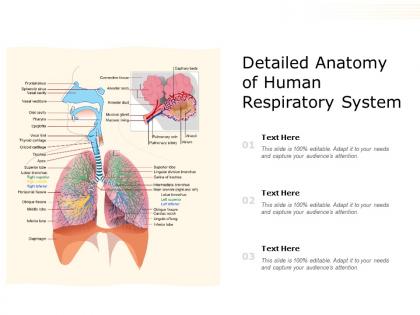
Detailed anatomy of human respiratory system




Try Before you Buy Download Free Sample Product
 Impress Your
 Audience
 100%
100% Editable
 Save Hours
 of Time


Our Detailed Anatomy Of Human Respiratory System are topically designed to provide an attractive backdrop to any subject. Use them to look like a presentation pro.
People who downloaded this PowerPoint presentation also viewed the following :
Detailed anatomy of human respiratory system with all 2 slides:
Use our Detailed Anatomy Of Human Respiratory System to effectively help you save your valuable time. They are readymade to fit into any presentation structure.

FAQs for Detailed anatomy of
So you've got your nose/mouth where air starts, then it goes through your trachea, bronchi, bronchioles, and finally the alveoli - that's where the actual oxygen exchange happens. Your diaphragm and those intercostal muscles between your ribs do all the work to make you breathe. It's honestly crazy how we don't even think about it most of the time. The upper part includes nasal cavity, pharynx, and larynx. Lower part starts at your trachea and goes down to those tiny alveoli. Just trace the whole pathway from start to finish - that's usually what trips people up on tests.
Okay so alveoli are like these tiny air sacs - you've got around 300 million of them which is honestly wild when you think about it. They're super thin, just one cell thick, so oxygen and CO2 can zip back and forth between your lungs and blood really fast. What makes them so good at their job is they maximize surface area while keeping everything super close together. Oh and they're packed with capillaries, so there's tons of blood right there waiting. When you're studying this, the surface area to thickness thing is what you really need to nail down.
So basically your lungs have this whole branching system for moving air around. Air goes from your trachea into the main bronchi - those are the big tubes. Then they split into smaller and smaller bronchioles, kinda like how a tree branches out. The bronchi have cilia and mucus that filter stuff out, which is pretty cool. Bronchioles can actually contract or relax to control how much air flows through. They're like adjustable pipes that keep getting tinier until they hit the alveoli where the real gas exchange magic happens. Oh and the branching pattern massively increases surface area - that's probably worth remembering for your test.
So your diaphragm does like 75% of your breathing work - it's this dome-shaped muscle that flattens when you breathe in. That creates negative pressure in your chest and pulls air into your lungs. Physics is wild. When you exhale, it just bounces back up and pushes the air out. Try putting your hand on your upper belly while taking a deep breath - you'll actually feel it moving. That's why those diaphragmatic breathing exercises work so well for calming down, btw.
So basically your right lung has three lobes, left only has two. Left lung's smaller too because it has to make space for your heart - there's this indent called the cardiac notch. Right lung is broader but not as tall since the liver pushes up from below. Oh, and the right bronchus is wider and more vertical, which is why when people aspirate stuff it usually ends up on the right side (kind of annoying design flaw tbh). Right side has more total lung volume but left side sacrifices space so your heart fits properly.
So basically asthma messes with your airways pretty badly over time. The muscles around your breathing tubes get thicker and way too sensitive - they'll clamp down at the smallest trigger. Plus there's constant inflammation and your lungs start pumping out this gross thick mucus that blocks everything up. It's honestly like your body's having a permanent freak-out over nothing. Without staying on your meds though, this stuff can become permanent damage. My cousin learned this the hard way when she kept skipping her inhaler. Don't mess around with it - those controller meds are there for a reason.
So the pleura is this double-layer membrane that wraps around your lungs. Between those layers there's fluid that works like WD-40 - lets everything slide smoothly when you breathe. The whole setup creates negative pressure that keeps your lungs from collapsing (which would be bad, obviously). Without it, breathing would feel like rubbing sandpaper together every time. You know how sometimes you hear about someone having a "collapsed lung"? That's when this system breaks down and air gets where it shouldn't be. Pretty wild how something so thin does such heavy lifting for us.
So basically your heart has two separate loops going on. The right side pumps all that crappy deoxygenated blood to your lungs through pulmonary arteries. Once it hits those tiny capillaries around the air sacs, oxygen jumps in while CO2 bails out - honestly it's wild how efficient this swap is. Then the good oxygenated blood comes back through pulmonary veins to your left atrium. Your lungs have this insane surface area too, which is why the whole thing actually works. Pretty cool setup when you break it down!
When you're up high, your body does this wild thing where it automatically breathes faster to grab more oxygen. Pretty neat, right? Over a few weeks, you'll actually start making more red blood cells - basically your blood gets better at its job. Your breathing muscles work overtime too, which honestly sounds exhausting but your body just handles it. Those sensors in your neck arteries are constantly checking oxygen levels and making adjustments. If you're heading somewhere high up, don't just rush to the top. Take it slow and let your body catch up - trust me on this one.
So basically your nose, throat, and larynx are like a pre-filter system - they warm up the air, add moisture, and catch all the gross stuff before it goes deeper. Once air hits your trachea and lungs, that's where oxygen actually gets into your blood and CO2 gets kicked out. Your upper tract also does voice stuff obviously. But here's what's cool - when people get sick, infections hit these areas differently because they do totally different jobs. Like a sinus infection vs pneumonia, you know? Makes sense once you think about how they're built for different purposes.
So basically the respiratory epithelium is your airway's built-in cleaning crew. Those tiny cilia beat like crazy to push mucus upward - kinda like a microscopic escalator. Goblet cells make the mucus that traps all the gross stuff you inhale. Honestly, it's pretty impressive how well this system works to keep junk from hitting your alveoli. When you're looking at tissue samples, just watch for that ciliated look. That tells you the epithelium is doing its job properly. My prof always said healthy cilia are like little brooms constantly sweeping.
So your intercostal muscles are basically what make breathing happen - they're tucked between your ribs. External ones contract when you inhale, pulling your ribcage up and out to expand your chest. Internal ones do the opposite for exhaling, compressing everything back down. It's actually pretty cool how it works. Try putting your hands on your ribs while taking deep breaths and you'll feel the whole thing in action. I learned this in my anatomy class and was weirdly fascinated by it. Makes you appreciate how much coordination goes into something we don't even think about.
Okay so basically mammals have way better lung setups than amphibians. We've got these fully internal lungs with all these branching tubes and tiny air sacs that maximize surface area. Plus there's the diaphragm doing all the heavy lifting for breathing. Amphibians? They're still using their skin for some gas exchange - which is actually pretty wild if you ask me. Mammals completely moved past that. The efficiency difference is huge too. Our lungs can pull way more oxygen from each breath, and we've got specialized muscles that let us control breathing rate. It's like comparing a basic engine to a turbo one, honestly.
So basically as we get older, our lungs just start sucking at their job lol. The tissue loses that stretchy quality - like when you've used a hair tie too many times? Your chest wall gets stiffer too, plus all those tiny muscles around your ribs weaken. Oh and the alveoli (those microscopic air sacs) shrink down so there's less area for oxygen to actually get into your blood. The worst part is your cilia get sluggish at sweeping out all the gross stuff, which is exactly why your grandma always seems to catch every cold. Even healthy older people will have lower oxygen levels because of this stuff.
So the big ones you'll see are tracheoesophageal fistula - basically the trachea and esophagus connect when they shouldn't. Choanal atresia blocks the nasal passages. Then there's congenital diaphragmatic hernia where belly organs squish up into the chest. Honestly, bronchopulmonary sequestration is such a pain to explain to worried parents. You might hit laryngeal atresia, missing lung tissue, or tracheal stenosis too. Most of these babies show up with breathing problems right away, so if you've got a newborn struggling to breathe, think about these and order imaging fast. Don't wait around on it.
No Reviews