


Developing product lifecycle management strategies to optimize processes complete deck




Try Before you Buy Download Free Sample Product
 Impress Your
 Audience
 100%
100% Editable
 Save Hours
 of Time


Product lifecycle management incorporates all product aspects from conception to disposal throughout the process. Here is a professionally designed template on Developing Product Lifecycle Management Strategies to Optimize Processes that showcases the challenges faced by product leaders and compares product metrics with key competitors. It also covers the estimated market share of product lifecycle management and talks about the innovative technologies that can increase the same in the future. This deck provides information about the ways to manage the product lifecycle process. It includes steps, product management roles, and essential strategies for comparative assessment of lifecycle management software. The deck presents a strategic timeline to reduce cost, capabilities required for the software development lifecycle process, etc. Moreover, the template shows investment prioritization tools for product evolution and techniques for evaluating product management opportunities. It provides a glimpse of metrics to measure product success and management priorities. It also shows the costs involved in managing product lifecycle stages and the impact of initiatives on overall product performance. At last, this deck incorporates a dashboard and metrics that depict KPIs to measure product performance. Get access now.
People who downloaded this PowerPoint presentation also viewed the following :
Content of this Powerpoint Presentation
Slide 1: This slide displays title i.e. 'Developing Product Lifecycle Management Strategies to Optimize Processes' and your Company Name.
Slide 2: This slide presents agenda.
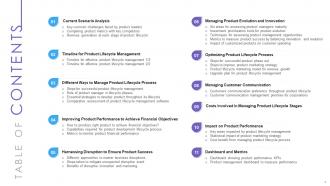
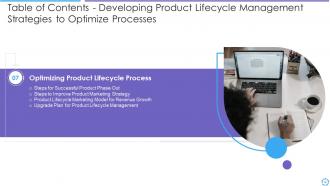
Slide 3: This slide exhibits table of contents.
Slide 4: This slide depicts title for three topics that are to be covered next in the template.
Slide 5: This slide focuses on key common challenges faced by product leaders such as prioritization of product roadmap, etc.
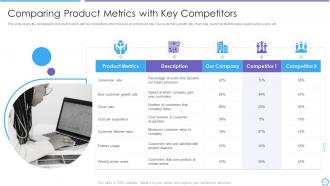
Slide 6: This slide covers the comparison of product metrics with key competitors which focuses on conversion rate, new customers growth rate, etc.
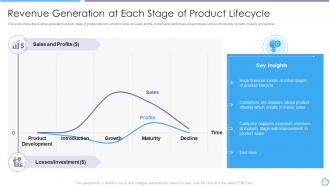
Slide 7: This slide shows the revenue generation at each stage of product lifecycle which focuses on sales, profits, investments, etc.
Slide 8: This slide depicts title for two topics that are to be covered next in the template.
Slide 9: This slide focuses on timeline for effective product lifecycle management that covers product creation, determine quality standards, etc.
Slide 10: This slide covers timeline for effective product lifecycle management which focuses on demand, procedure, technology, organization and business.
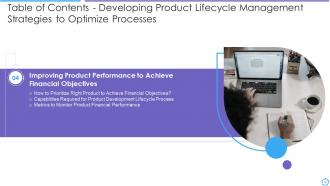
Slide 11: This slide depicts title for four topics that are to be covered next in the template.
Slide 12: This slide shows the steps for successful product lifecycle management such as defining capabilities, link product with framework, etc.
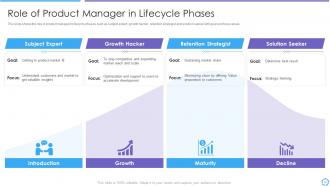
Slide 13: This slide shows the role of product manager in lifecycle phases such as subject expert, growth hacker, retention strategist, etc.
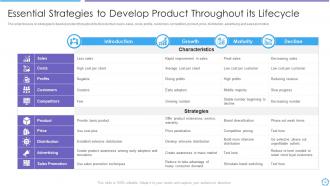
Slide 14: This slide focuses on strategies to develop product throughout its lifecycle that covers sales, costs, profits, customers, competitors, etc.
Slide 15: This slide focuses on comparative assessment of product lifecycle management software which involves features, cost and verdict.
Slide 16: This slide depicts title for three topics that are to be covered next in the template.
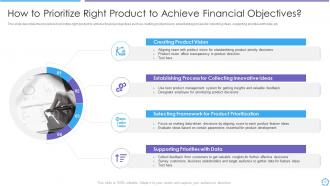
Slide 17: This slide describes the procedure to prioritize right product to achieve financial objectives such as creating product vision.
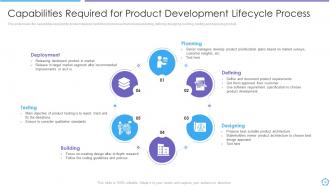
Slide 18: This slide covers the capabilities required for product development lifecycle process that includes planning, defining, designing, etc.
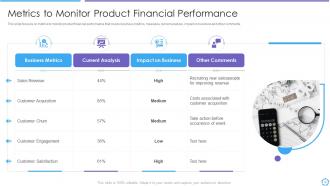
Slide 19: This slide focuses on metrics to monitor product financial performance that covers business metrics, measures, current analysis, etc.
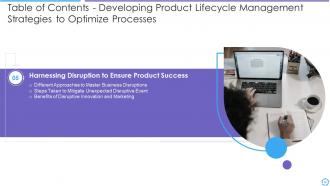
Slide 20: This slide depicts title for three topics that are to be covered next in the template.
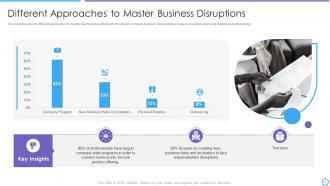
Slide 21: This slide focuses on different approaches to master business disruptions which includes company program, new-business hubs or incubators, etc.
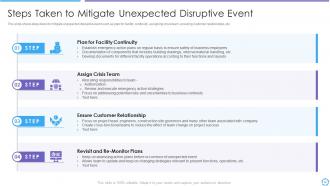
Slide 22: This slide shows steps taken to mitigate unexpected disruptive event such as plan for facility continuity, assigning crisis team, etc.
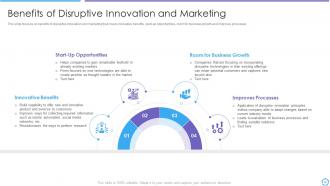
Slide 23: This slide focuses on benefits of disruptive innovation and marketing that covers innovative benefits, start-up opportunities, etc.
Slide 24: This slide depicts title for five topics that are to be covered next in the template.
Slide 25: This slide covers six different areas for assessing product managers maturity such as customer-experience grounding, market orientation, etc.
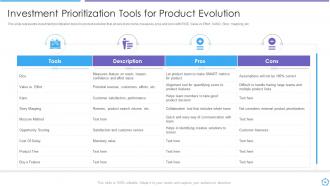
Slide 26: This slide represents investment prioritization tools for product evolution that shows tools name, measures, pros and cons with RICE, etc.
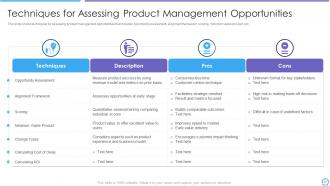
Slide 27: This slide shows techniques for assessing product management opportunities that includes opportunity assessment, alignment framework, etc.
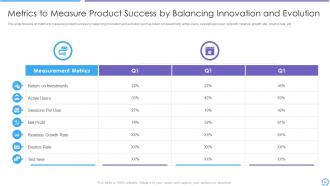
Slide 28: This slide focuses on metrics to measure product success by balancing innovation and evolution such as return on investment, active users, etc.
Slide 29: This slide shows impact of customized products on customer spending which includes number of purchased items, value to average order and net promoter score.
Slide 30: This slide depicts title for four topics that are to be covered next in the template.
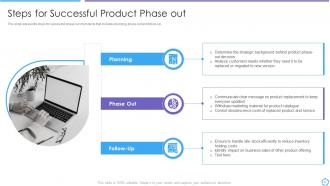
Slide 31: This slide represents steps for successful phase out of products that includes planning, phase out and follow-up.
Slide 32: This slide shows steps to improve product marketing strategy that focuses on data analysis, making adjustments, focusing on top customers, etc.
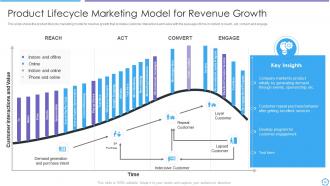
Slide 33: This slide shows the product lifecycle marketing model for revenue growth that includes customer interactions and value.
Slide 34: This slide represents upgrade plan for product lifecycle management that focuses on activities, tasks and output such as product inception, etc.
Slide 35: This slide depicts title for two topics that are to be covered next in the template.
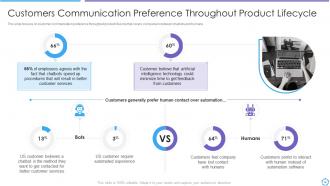
Slide 36: This slide focuses on customer communication preference throughout product lifecycle that covers comparison between chatbots and humans.
Slide 37: This slide shows graphical representation of firm priorities to manage customer communications such as customer experience, etc.
Slide 38: This slide depicts title for one topic that is to be covered next in the template.
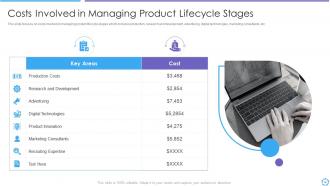
Slide 39: This slide focuses on costs involved in managing product lifecycle stages which includes production, research and development, etc.
Slide 40: This slide depicts title for three topics that are to be covered next in the template.
Slide 41: This slide shows impact of product lifecycle management such as building innovative portfolios, rapid development and product launch, etc.
Slide 42: This slide shows statistical impact of product marketing strategy that covers different parameters such as return on investment, active users, etc.
Slide 43: This slide covers cost benefit analysis from managing product lifecycle process that includes drive, objectives and impact on basis of time, etc.
Slide 44: This slide depicts title for two topics that are to be covered next in the template.
Slide 45: This slide shows dashboard of metrics of product such as revenue, new customers, customer satisfaction, sales comparison, revenue by customer, source , etc.
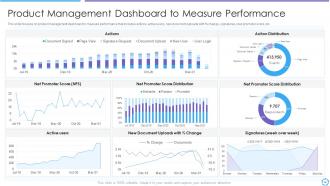
Slide 46: This slide focuses on product management dashboard to measure performance that includes actions, active users, etc.
Slide 47: This is the icons slide.
Slide 48: This slide presents title for additional slides.
Slide 49: This slide exhibits monthly line charts for different products. The charts are linked to Excel.
Slide 50: This slide displays yearly profits stacked column charts for different products. The charts are linked to Excel.
Slide 51: This slide shows about your company, target audience and its client's values.
Slide 52: This slide presents your company's vision, mission and goals.
Slide 53: This slide depicts posts for past experiences of clients.
Slide 54: This slide highlights comparison of products based on selects.
Slide 55: This slide displays puzzle.
Slide 56: This slide displays Venn.
Slide 57: This slide shows details of team members like name, designation, etc.
Slide 58: This slide depicts 30-60-90 days plan for projects.
Slide 59: This is thank you slide & contains contact details of company like office address, phone no., etc.
Developing product lifecycle management strategies to optimize processes complete deck with all 64 slides:
Use our Developing Product Lifecycle Management Strategies To Optimize Processes Complete Deck to effectively help you save your valuable time. They are readymade to fit into any presentation structure.



























FAQs for Developing product lifecycle management strategies to optimize
The key stages include introduction, growth, maturity, decline, and revitalization, each requiring distinct strategic approaches for pricing, marketing, and resource allocation. During introduction, companies focus on market education and penetration, while growth stages emphasize scaling and competitive positioning, with mature products requiring cost optimization and market differentiation strategies, ultimately delivering sustained profitability across lifecycle phases.
Businesses can effectively gather customer feedback through surveys, focus groups, beta testing programs, social media monitoring, and direct interviews with target users. These methods enable companies to identify pain points, validate features, and refine product concepts early, with many organizations finding that systematic feedback collection reduces development costs and accelerates time-to-market significantly.
Technology enhances PLM efficiency by automating workflows, centralizing data management, enabling real-time collaboration, and providing advanced analytics for decision-making. Through cloud-based PLM platforms and AI-driven insights, organizations streamline product development cycles, reduce time-to-market, and improve cross-functional coordination, with manufacturing and automotive companies finding significantly enhanced operational efficiency and competitive advantage.
Companies can align product development with market trends by implementing continuous market research, agile development methodologies, cross-functional collaboration between marketing and R&D teams, and real-time customer feedback integration. Through data analytics and trend forecasting tools, organizations streamline product iterations, accelerate time-to-market, and enhance customer satisfaction, ultimately delivering competitive advantage in increasingly dynamic markets.
Common challenges during product introduction include market acceptance uncertainty, pricing pressures, distribution limitations, competitive responses, and resource allocation constraints. These obstacles can be mitigated through comprehensive market research, strategic pricing models, and phased rollout approaches, with many organizations finding that early customer feedback integration and agile adjustment capabilities ultimately deliver stronger market positioning and sustainable competitive advantage.
Cross-functional collaboration enhances PLM strategies by breaking down silos between engineering, marketing, manufacturing, and supply chain teams, enabling faster product development cycles, improved quality control, and better market alignment. Through integrated communication platforms and shared project management tools, organizations streamline decision-making, reduce costly design revisions, and accelerate time-to-market, ultimately delivering more competitive products.
Sustainability considerations influence product lifecycle management by driving eco-friendly material selection, energy-efficient manufacturing processes, and end-of-life recycling strategies throughout development phases. Companies in automotive, electronics, and consumer goods increasingly integrate carbon footprint assessments, circular economy principles, and waste reduction targets into their PLM frameworks, ultimately delivering cost savings while meeting environmental regulations and consumer expectations.
Companies should track metrics including time-to-market reduction, product development costs, regulatory compliance rates, product quality scores, and cross-functional collaboration efficiency. These KPIs enable organizations to measure innovation velocity, resource optimization, and market responsiveness, with many manufacturing and technology companies finding that integrated PLM dashboards ultimately deliver competitive advantage through faster product launches and enhanced operational transparency.
Businesses leverage data analytics to optimize product lifecycles by analyzing customer behavior patterns, market trends, and operational metrics throughout development, launch, growth, and decline phases. Through predictive analytics and real-time monitoring, companies in sectors like automotive and consumer electronics streamline product development timelines, enhance market positioning strategies, and ultimately deliver more targeted offerings while reducing costs and improving customer satisfaction.
Global supply chain dynamics significantly impact product lifecycle management through increased complexity in sourcing, manufacturing coordination, inventory optimization, regulatory compliance across markets, and demand forecasting variability. These challenges require companies to enhance supply chain visibility, streamline cross-border operations, and implement agile response mechanisms, with many organizations finding that strategic PLM integration ultimately delivers competitive advantage through faster market adaptation.
Organizations achieve better cost control through effective PLM by streamlining development processes, reducing material waste, and optimizing resource allocation across product lifecycles. Through integrated PLM systems, companies minimize design revisions, accelerate time-to-market, and enhance supplier collaboration, with manufacturing firms finding that strategic PLM implementation delivers significant cost reductions and improved operational efficiency.
Successful transition practices include comprehensive market feedback analysis, strategic pricing adjustments, distribution channel expansion, targeted marketing campaigns, and operational scaling preparations. Companies like Tesla and Spotify accelerate growth by continuously refining product features based on early adopter insights, optimizing supply chains, and investing in customer acquisition strategies, ultimately delivering enhanced market penetration and sustainable competitive advantage.
Regulatory requirements fundamentally reshape product lifecycle management by mandating extensive documentation, rigorous testing protocols, and comprehensive compliance tracking throughout development, launch, and post-market phases. In industries like pharmaceuticals, medical devices, and aerospace, companies implement specialized PLM systems that automate regulatory submissions, ensure audit readiness, and maintain version control, ultimately reducing approval timeframes while minimizing compliance risks.
Centralized PLM systems deliver enhanced data consistency, streamlined workflows, reduced redundancy, better regulatory compliance, and unified reporting across all product development teams. While decentralized approaches offer departmental flexibility, centralized systems enable organizations to achieve faster time-to-market, lower operational costs, and improved cross-functional collaboration, with many manufacturing companies finding that centralized control ultimately enhances strategic decision-making and competitive advantage.
Companies ensure continuous innovation while managing established products by implementing portfolio diversification strategies, establishing dedicated innovation teams alongside product maintenance divisions, and creating phased development pipelines that allow simultaneous exploration of emerging technologies. Through strategic resource allocation and cross-functional collaboration, organizations in sectors like technology and pharmaceuticals successfully balance sustaining mature products with breakthrough development initiatives, ultimately delivering both stable revenue streams and competitive market positioning.
-
Awesomely designed templates, Easy to understand.