


Devsecops Powerpoint Template Bundles Ppt Sample





Try Before you Buy Download Free Sample Product
 Impress Your
Audience
 100%
Editable
 Save Hours
of Time


Our Devsecops Powerpoint Template Bundles Ppt Sample are topically designed to provide an attractive backdrop to any subject. Use them to look like a presentation pro.
People who downloaded this PowerPoint presentation also viewed the following :
Content of this Powerpoint Presentation
Slide 1: This is the title slide of the presentation "DevSecOps."
Slide 2: This slide represents CI/CD pipeline that assists companies in integrating DevSecOps to implement security practices in software development and deployment process.
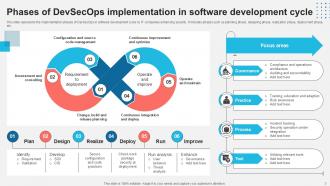
Slide 3: This slide represents the implementation phases of DevSecOps in software development cycle by IT companies enhancing security.
Slide 4: This slide represents maturity model that helps IT companies to track and analyze DevSecOps strategy implementation in company and enhance security.
Slide 5: This slide represents various DevSecOps software categories used by professionals to enhance development and security in IT operations.
Slide 6: This slide represents various DevSecOps tools used by IT professionals to integrate security in software development life cycle phases.
Slide 7: This slide represents roadmap that assist IT organizations to integrate DevSecOps to enhance security practices and resolve vulnerabilities rapidly.
Slide 8: This slide graphically represents the global market of DevSecOps to enhance security and protection in IT driven companies.
Slide 9: This slide represents best practices that help IT and software development organizations to integrate DevSecOps enhancing security.
Slide 10: This slide represents implementation of DevSecOps controls that helps companies to enhance security in cloud adoption journey.
Slide 11: This slide represents pipeline that helps software development companies to integrate artificial intelligence and machine learning components in DevSecOps model.
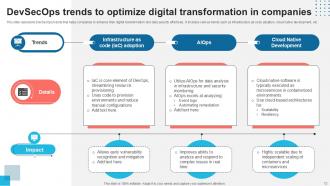
Slide 12: This slide represents DevSecOps trends that helps companies to enhance their digital transformation and data security effectively.
Slide 13: This slide represents various enablers to mitigate the challenges of successful implementation of DevSecOps in IT driven companies.
Slide 14: This is DevSecOps icon slide to optimize security in software development.
Slide 15: This is DevSecOps icon slide to enhance cloud security.
Slide 16: This is Security integration icon slide to enhance DevSecOps process.
Slide 17: This is a Thank You slide with address, contact numbers and email address.
Devsecops Powerpoint Template Bundles Ppt Sample with all 25 slides:
Use our Devsecops Powerpoint Template Bundles Ppt Sample to effectively help you save your valuable time. They are readymade to fit into any presentation structure.















FAQs for Devsecops Powerpoint Template
Dude, you'll catch security problems when they're actually fixable instead of finding them at 2 AM when everything's on fire. That alone makes it worth it. Your releases get way faster too since you're not waiting around for manual security checks to clear. The whole security thing just gets better because you're building it in from the start rather than slapping it on later - which honestly never works that well anyway. Seems like extra work at first but trust me, it saves so much pain down the road. Just throw some basic vulnerability scanning into your CI pipeline and go from there.
So basically DevSecOps builds security right into your dev process from the start, instead of bolting it on later like traditional DevOps does. You're running security scans and compliance checks throughout your whole CI/CD pipeline - not just at the end when finding bugs becomes a nightmare. It's called "shifting left" which sounds weird but makes sense. Way better to catch vulnerabilities early when they're actually fixable without everyone freaking out. Plus your security folks get to be part of the team instead of those people who always say no at the last minute.
SAST tools like SonarQube or Veracode are great for code scanning. For running apps, try OWASP ZAP or Burp Suite - both solid DAST options. Container security's everywhere now, so Twistlock, Aqua, or Snyk will help there. Checkov and Terrascan handle infrastructure-as-code pretty well. Oh, and don't sleep on dependency scanners like OWASP Dependency-Check or WhiteSource - vulnerable libraries will bite you. The tooling changes constantly though, which is honestly exhausting to track. I'd start with maybe two tools that play nice with your current CI/CD setup, then build out from there.
Track both security and delivery stuff to see the whole picture. Mean time to detect/remediate vulnerabilities is huge, plus how many security issues you're catching at different pipeline stages. Also watch your deployment frequency - has it actually improved since adding DevSecOps? The boring metrics matter too though. Compliance audit results, developer satisfaction scores. Happy devs who aren't constantly battling security tools? That's honestly half the battle right there. Set baselines first, then measure consistently. And yeah, automate those dashboards - trust me, you don't want to pull reports manually every month.
Honestly, the hardest part is getting everyone on board. Dev teams think security will slow them down, and security people hate giving up control. Tool integration is a total pain too - especially if you're stuck with older systems that weren't built for this stuff. Plus finding people who actually know both security AND DevOps? Good luck with that. I'd say pick one team and maybe start with something simple like automated vulnerability scanning. Once you show it actually works and doesn't break everything, other teams will want in. Way easier than trying to change everything at once.
So compliance in DevSecOps is just building regulatory stuff right into your dev pipeline instead of dealing with it later. You automate all the compliance checks - from when developers commit code through deployment - constantly checking against SOX, HIPAA, PCI-DSS, whatever applies to you. Way better than those nightmare end-of-cycle audits nobody wanted to deal with. Tools catch violations early when fixes are actually manageable. First figure out which regulations hit your systems, then grab automated tools that can validate everything in your CI/CD pipeline. Trust me, your future self will thank you.
So you'll want your devs to learn secure coding and threat modeling first - that's the foundation. Then get your ops team up to speed on infrastructure as code and building security into those CI/CD pipelines. The tricky part? Getting everyone to actually care about security from day one instead of treating it like an afterthought. I'd honestly start with basic security training for everyone, then do some hands-on workshops with the actual tools like SAST scanners. Don't try to do everything at once though - just pick one security practice this sprint and go from there.
So "shift-left" is just moving your security stuff way earlier in development instead of doing it at the end. Like, you throw security scans and code analysis right into your CI/CD from the start. Way better than scrambling to fix everything before you ship! It's kinda like spell-checking while you type vs waiting until you're done writing - saves so much headache. Finding bugs early means they're actually manageable to fix. I'd start with some basic SAST tools in your build pipeline, then just add more security checks over time. Trust me, future you will thank present you.
So continuous monitoring is like having a security system that actually works around the clock. Instead of doing those old-school security checks once a week or whatever, it's constantly watching your code and apps for sketchy stuff. Way better than crossing your fingers and hoping nothing breaks before your next audit, honestly. You'll get pinged the second something looks weird, and it catches problems while they're still small. The trick is building it right into your deployment process so it just happens automatically. I'd probably start with just one system first though - don't try to monitor everything at once or you'll go crazy.
Honestly, the biggest thing is making security feel like everyone's problem, not just something devs get stuck with at the end. Try doing lunch sessions where your security folks show real bugs they've found in your code - way better than boring theory stuff. Build training into onboarding but keep it going, don't just check a box once and call it done. The real magic happens when you give devs security tools they can use while they're actually coding, like those IDE plugins that catch vulnerabilities. Once it's part of their normal workflow instead of this separate annoying step, that's when you'll actually see things shift.
Dude, get yourself a proper secret manager - HashiCorp Vault, AWS Secrets Manager, whatever works for your setup. I cannot stress this enough: never commit secrets to git. Seriously, I've watched that disaster unfold too many times and it's always a nightmare. Set up automated scanning in your pipeline to catch accidents before they happen. Rotate those credentials regularly and don't give people more access than they actually need. Oh, and make sure your dev environments aren't pointing at prod databases - that's just asking for trouble. Start by figuring out what secrets you've got scattered around, then move everything into one centralized vault.
Honestly, microservices and containers are kind of a double-edged sword for security. Yeah, you've got way more stuff to manage - every service needs scanning, dependency checks, the whole nine yards. Container images can bite you hard if you pick sketchy base images. But the upside? You can automate security checks for each service individually, which is actually pretty sweet. I learned this the hard way last year - scan your images early in the pipeline, not right before you deploy. The distributed setup makes "security as code" way more doable than monolithic apps.
Netflix goes all-in with chaos engineering - they literally break their own stuff on purpose to test how secure everything stays. Crazy but it works. Microsoft changed their whole dev process to bake security in from the start, cut vulnerabilities in half. Capital One runs automated security checks on every single code commit, which honestly seems exhausting but catches problems early. Google built guardrails right into their CI/CD pipelines. The thing is, you don't need to do everything at once. Just pick one security check to automate first, then build from there. Way less overwhelming that way.
So basically you're building incident response right into your CI/CD pipeline. Automated monitoring and alerting tools scan for threats constantly, then trigger response playbooks automatically when something sketchy happens. No more sitting around waiting for someone to manually escalate stuff. Dev and security teams share the same dashboards and see identical real-time data, which honestly makes everything way smoother. Here's the thing though - treat your incident response procedures like code. Version control them, test them regularly. Oh, and definitely start by hooking up your security monitoring to whatever DevOps tools you're already using.
Think of automation as the thing that finally gets your dev, ops, and security teams talking the same language. You can bake security checks right into your CI/CD pipeline instead of doing manual handoffs where stuff inevitably gets dropped. Catches vulnerabilities early when they're actually cheap to fix. It standardizes deployments and monitoring too - goodbye "works on my machine" arguments. Here's the cool part: your security policies become code that runs itself rather than some checklist everyone ignores. Honestly, I'd start with automated security scanning in your build process and just grow it from there.
-
Love the template collection they have! I have prepared for my meetings much faster without worrying about designing a whole presentation from scratch.
-
I am extremely pleased with these PPT slides that we used for our event. They were easy to modify and came out great in all aspects!