


SIEM Cyber Security Powerpoint Ppt Template Bundles





Try Before you Buy Download Free Sample Product
 Impress Your
 Audience
 100%
100% Editable
 Save Hours
 of Time


Introducing our comprehensive SIEM Cyber Security PowerPoint PPT presentation your essential guide to the world of Security Information and Event Management SIEM. Dive into the intricate architecture platform that underpins SIEM cyber security, offering robust solutions to monitor, detect, and respond to security incidents. Explore the dynamic capabilities of SIEM cyber security analytics, providing insights into threat landscapes and empowering organizations to fortify their digital defenses. This presentation unravels the layers of SIEM technology, equipping your team with a deep understanding of its role in proactive cybersecurity. With visually engaging slides and expert insights, our SIEM Cyber Security PPT ensures that youre well versed in the tools and techniques to enhance your organizations cyber resilience. Whether youre a cybersecurity professional, IT specialist, or part of a security operations team, this presentation is your compass for navigating the evolving landscape of SIEM cyber security. Elevate your cyber defenses with our PPT today.
People who downloaded this PowerPoint presentation also viewed the following :
Content of this Powerpoint Presentation
Slide 1: This slide introduces SIEM Cyber Security. State your company name and begin.
Slide 2: This slide showcases the evolution of technology SIEM cyber security. Its aim is to set rule and awareness for threat data management.
Slide 3: This slide presents the machine learning of advanced SIEM cyber security. Its aim is to prioritise and investigate the issues.
Slide 4: This slide showcases the comparative analysis of SIEM cyber security tools. Its objective is to detect threats and log analysis. This slide includes log analysis, LogPoint etc.
Slide 5: This slide displays the SIEM cyber security package. Its aim is to log event management. This slide includes network hardware, firewall, system, operating system etc.
Slide 6: This slide showcases the phases of SIEM cyber security. Its objective is to detect and investigate data logs. This slide includes alerts, respond, data normalisation etc.
Slide 7: This slide presents the benefits of SIEM cyber security. Its aim is to make business capable of security workflow.
Slide 8: This slide showcases the SIEM cyber security architecture. Its aim is to investigate security incidents and detect attacks.
Slide 9: This slide displays the SIEM cyber security analytics solution. Its aim is to use flexible threat monitoring system.
Slide 10: This slide presents the SIEM cyber security kill chai flow chart. Its aim is to show SIEM architecture and alert new messages.
Slide 11: This slide showcases the applicational theory of SIEM cyber security. Its aim is to collect and normalise and prove SIEM capabilities.
Slide 12: This slide displays the co management of SIEM cyber security process. Its aim is to list monitoring activities and manage services.
Slide 13: This slide showcases the use case and application of SIEM cyber security. Its purpose is to protect against threats and conduct internal audits.
Slide 14: This slide displays the steps to curate SIEM cyber security project. Its purpose is to understand the critical threats.
Slide 15: This slide showcases the benefits of incorporation SIEM cyber security. Its objective is to propose a better threat detection system.
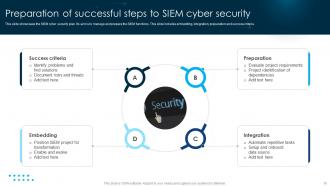
Slide 16: This slide presents the SIEM cyber security plan. Its aim is to manage and prepare the SIEM functions. This slide includes embedding, integration, preparation and success criteria.
Slide 17: This slide showcases SIEM cyber security protection icon.
Slide 18: This slide presents SIEM data cyber security icon.
Slide 19: This slide displays Network SIEM cyber security icon.
Slide 20: This is a Thank You slide with address, contact numbers and email address.
SIEM Cyber Security Powerpoint Ppt Template Bundles with all 28 slides:
Use our SIEM Cyber Security Powerpoint Ppt Template Bundles to effectively help you save your valuable time. They are readymade to fit into any presentation structure.












FAQs for SIEM Cyber Security Powerpoint
So SIEM is Security Information and Event Management - it's like your network's security hub that pulls in logs from everywhere. Picture having a guard who actually pays attention to everything happening at once (unlike Bob from my old job lol). Real-time alerts pop up when sketchy stuff happens, plus it connects dots between events you'd never spot manually. Honestly the best part? It turns all that scattered data into something you can actually use. Oh and compliance reporting becomes way less painful. I'd say start with your most critical systems and build SIEM rules around those first.
So SIEM systems have four key parts you'll want to understand. First are data collection agents - they pull logs from all your network stuff and apps. Then there's centralized storage, usually some database or data lake setup. Correlation engines do the heavy lifting by spotting patterns and threats. Finally you get dashboards for monitoring everything. Think of it like a funnel where data flows into one central brain. Oh, and newer SIEMs throw in threat intelligence feeds plus automated responses too. Honestly though? Start by figuring out what log sources you've got first - that'll tell you how crazy your deployment's gonna be.
Think of SIEM as your security nerve center that's constantly watching log data from everywhere. It uses these correlation rules to catch weird patterns in real-time - like someone bombing login attempts then suddenly hitting sensitive files. When it spots something matching attack signatures or just plain suspicious behavior, boom - instant alerts. Your team can jump on threats right away instead of discovering breaches months later (which honestly happens way too often). Just make sure you tune those rules right or you'll get buried in useless notifications and actually miss the important stuff.
So basically, SIEM pulls everything into one place instead of having your firewall screaming at you while your antivirus is doing its own thing. Traditional tools are all isolated - honestly such a pain to juggle. With SIEM, you get this bird's eye view that can actually connect the dots between random incidents. Like, it might catch that weird login attempt plus suspicious network traffic happening together. Most security tools just react to whatever's right in front of them. SIEM's more like having someone constantly watching for patterns. I'd start by figuring out what security stuff you're probably overlooking right now.
Figure out your use cases and compliance stuff first - don't just start throwing logs at it randomly. Take inventory of your data sources, figure out what's actually valuable. Make sure your team knows how to use the platform (training is way more important than people think). Integration with your current tools matters for keeping workflows smooth. The biggest mistake? Turning on every alert rule at once - that just burns everyone out with false positives. Start small and tune gradually. Oh, and have your incident response plan ready before you flip the switch, otherwise you'll be scrambling when alerts start going off.
Throw everything at it, honestly. Firewalls, routers, IDS stuff first. Then grab endpoint logs from your workstations and servers. Active Directory is obvious but don't sleep on web proxies and email gateways either. Cloud's where it gets interesting though - AWS CloudTrail, Azure logs, O365, all that jazz. More data = better visibility, but here's the thing: start with your crown jewels first. Get comfortable with that volume before you go crazy adding everything else. Your future self will thank you for not drowning in alerts right off the bat.
So ML basically teaches your SIEM what normal behavior looks like, then freaks out when something's off. Way better than those rigid rules that hackers just dance around anyway. False positives drop like crazy once it learns your environment - honestly such a relief after dealing with alert fatigue. The cool part? It catches weird behavioral stuff and zero-days that signature detection totally whiffs on. Just flip on whatever ML your current SIEM has first. You'll probably kick yourself for not doing it sooner when you see how much cleaner your alerts get.
Oh man, you're gonna hate those first few months - alert fatigue is real and it's absolutely miserable. False positives will bury your team alive. Don't try monitoring everything right away, that's a rookie mistake. Focus on your critical stuff first and tune baselines properly. Integration's always messier than vendors admit too. You'll need someone full-time just managing rules because this stuff requires constant babysitting. Budget for professional help during setup - seriously, most places cheap out here and regret it. Start small with high-value use cases. Build up slowly or you'll burn out your whole security team.
SIEM tools are lifesavers for GDPR and HIPAA stuff - they automatically track who's accessing what data and when. Real-time alerts pop up if someone's doing sketchy things with sensitive info. You get those centralized audit trails regulators love, plus automated reports that actually prove you're protecting data (not just saying you are). The retention features handle keeping logs for years too, which is required. Trust me, doing this manually would suck so bad. My old job tried that once... nightmare. Set up alerts for weird data access patterns and automate those compliance reports ASAP.
Your SIEM is pretty much useless without solid incident response planning - I learned this the hard way at my last job. You'll get flooded with alerts but won't know what to actually DO with them. The detection part is easy; stopping the actual attack is where things get messy. Map out your response workflows first, then set up clear playbooks for the common stuff your SIEM flags. Don't forget escalation procedures either - you need to know who calls who when everything hits the fan. Otherwise you're just watching threats waltz right past you.
Start with detection accuracy - how many real threats you're catching vs all those annoying false positives. Speed matters big time, so track MTTD and MTTR. Nobody wants their analysts drowning in useless alerts, so watch those volume trends too. Coverage metrics will tell you if your data sources are actually worth anything. Oh, and don't forget analyst productivity - are they getting through incidents efficiently or just spinning their wheels? Set baselines first, then check progress monthly. Trust me, without good metrics you're basically flying blind.
So SIEM systems are basically your best friend after a breach happens. They collect all your network logs and security events in one spot, which is clutch for figuring out what went wrong. You can trace the whole attack - when it started, how they moved around, what accounts got compromised. The timeline stuff is actually pretty cool to watch unfold. Though honestly, none of this matters if you didn't set up your log retention right from the start. Can't investigate data you never captured in the first place, you know?
Honestly, automation is what keeps SIEM teams sane. It correlates events from tons of data sources and triggers responses when threats pop up - even isolates infected machines automatically. Otherwise you'd be drowning in millions of daily alerts (no thanks). The cool part? It cuts false positives way down and shrinks response times from hours to minutes. I'd start with automating your most boring, repetitive stuff first. That's where you'll actually see the money saved right away.
So SIEM vendors are basically scrambling to keep up with all these new threats constantly popping up. Traditional signature detection? Pretty much useless against zero-days and APTs now. That's why you're seeing AI and ML getting crammed into everything - which honestly gets overhyped sometimes, but it does help with behavioral analysis. Cloud attacks are a whole other nightmare that's forcing these tools to get smarter about automation. The threat landscape moves ridiculously fast. I'd go with a SIEM that actually updates frequently and has solid machine learning - don't get stuck with something that'll be outdated in six months.
Honestly, the biggest thing is tuning those rules constantly - false positives will drive you insane. Keep your data sources running smoothly and archive old logs properly. Weekly rule reviews are a lifesaver, plus monthly performance checks. Document everything too, because debugging at 2 AM with no notes is actual hell. Oh, and update your correlation rules when new threat intel comes in. I learned this the hard way, but staying on top of SIEM health checks really pays off. Start small with the weekly reviews first.
-
Qualitative and comprehensive slides.
-
Eye-catching PPT designs, outstanding team, and best customer service. I’m a super satisfied customer here!