


Cyber Security Tabletop Exercise Powerpoint Ppt Template Bundles




Try Before you Buy Download Free Sample Product
 Impress Your
 Audience
 100%
100% Editable
 Save Hours
 of Time


A tabletop exercise in cybersecurity is a simulated scenario aimed to assess and improve a businesss preparedness for data breaches and events. It entails assembling key stakeholders, including managers, communication staff, security teams and IT professionals to simulate a cyber incident and evaluate the organizations capacity for responses and recovery. This enables organizations to recognize areas for improvement without having to deal with the real life consequences of a cyberattack. Utilize our Cyber Security Tabletop Exercise PowerPoint presentation to Conduct a cyber security training and engage the group in a crisis management drill. Analyse all aspects of the decision making procedures and incident response plan in the course of a real world cyber security scenario. This presentation provides skills to assess the positive and negative aspects of incident response plan, strengthen communication standards, and assure an integrated defense against cyberattacks. This presentation offers an extensive guide for improving the businesss readiness and capacity to prevent cybersecurity events, assuring the protection of data and operations.
People who downloaded this PowerPoint presentation also viewed the following :
Cyber Security Tabletop Exercise Powerpoint Ppt Template Bundles with all 22 slides:
Use our Cyber Security Tabletop Exercise Powerpoint Ppt Template Bundles to effectively help you save your valuable time. They are readymade to fit into any presentation structure.
-
Cyber Security Tabletop Exercise
-
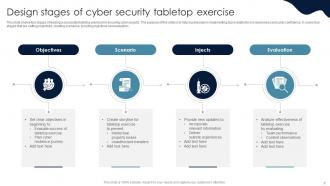
Design stages of cyber security tabletop exercise
-
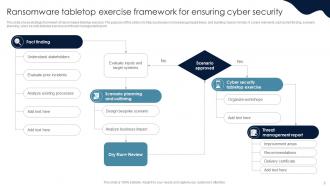
Ransomware tabletop exercise framework for ensuring cyber security
-
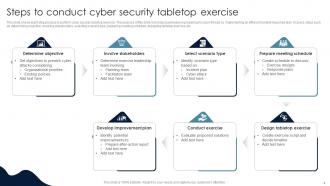
Steps to conduct cyber security tabletop exercise
-
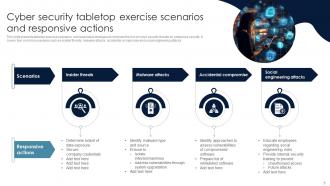
Cyber security tabletop exercise scenarios and responsive actions
-
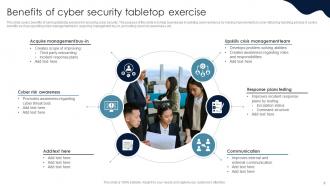
Benefits of cyber security tabletop exercise
-
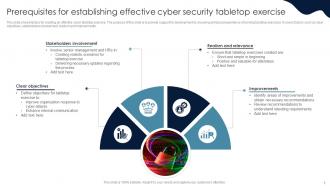
Prerequisites for establishing effective cyber security tabletop exercise
-
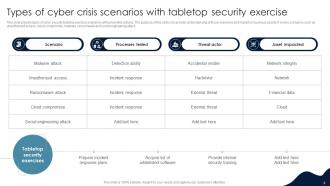
Types of cyber crisis scenarios with tabletop security exercise
-

Cyber security tabletop exercise pyramid
-
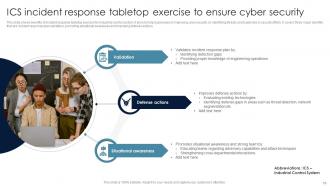
ICS incident response tabletop exercise to ensure cyber security
-
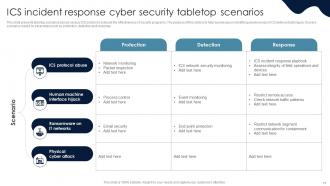
ICS incident response cyber security tabletop scenarios
-
Incident response plan icon for cyber security tabletop exercise
-
Ransomware tabletop exercise icon for ensuring cyber security
-
Thanks for watching
-

-

-

-

-

-

-

-

FAQs for Cyber Security Tabletop Exercise Powerpoint
So you're basically simulating cyberattacks - like ransomware or data breaches - to see how your team actually responds. Tests your incident response plan and shows where communication breaks down. Way better finding that stuff out during practice than when hackers are actually in your network! Plus it helps people figure out who does what when everything's on fire. I honestly think the decision-making under pressure part is huge - you'd be surprised how different things feel when there's fake urgency. Run them quarterly and definitely write down everything that goes wrong so you can patch those gaps.
So you want to run some tabletop exercises? Smart move. First figure out what hackers would actually target at your company - your crown jewels, basically. Then build scenarios around those weak spots. During the exercise, test how your team responds, communicates, and makes decisions when things get chaotic. Honestly, most people think they know what they'd do until pressure hits. The debrief afterward is where you'll find the real gold though - all those gaps in your plan will suddenly become obvious. Write down what broke and fix it before you actually need it.
Start with whoever would actually respond during a real incident - your security team, IT leads, and the executives who'd be making big decisions. Don't forget communications people and legal counsel since they're always involved in breach situations. HR needs to be there too for employee messaging. I'd definitely include reps from your most critical business units - they know their systems best. Third-party vendors can be tricky but if they're part of your response plan, better to have them there than scramble during an actual emergency. Honestly, just think about who you'd panic-call at 2am during a breach and invite those people.
Look at what's actually hitting companies like yours lately. Check CISA alerts and industry reports - seriously, those things are packed with realistic attack scenarios. Your own security logs are gold too. Don't go for the sexy nation-state stuff that makes headlines. Nobody cares if you can simulate APT whatever-the-hell when Karen from accounting is gonna click on a phishing email next Tuesday. Pick 2-3 attack methods that'd actually work against your systems. The whole point is making people think "shit, we're vulnerable to this right now."
Send out quick feedback forms right after - ask about the scenario, how decisions got made, stuff like that. Then compare what your team actually did against your response plan. That's where you'll spot the real problems. Honestly, some of the best feedback comes from just chatting with people a few days later when they've had time to think. Write down what worked and what was a mess. But here's the thing - you gotta assign actual action items with deadlines, or you'll just make the same mistakes again next time.
Give people at least a week to prep - send them the scenario details and background stuff about your incident response plan ahead of time. Don't just throw them into it blind on the day, trust me. I've watched exercises completely fall apart because half the team had no clue what they were supposed to do. Maybe do a quick 15-minute walkthrough right before you start the real thing. Oh, and make it super clear this is for learning - mistakes are totally expected and fine. You want people acting naturally, not trying to impress anyone.
Don't overcomplicate the scenario - stick to one attack vector, maybe two tops. People zone out fast when it gets too realistic or complex. Skip PowerPoints entirely and dive right in. You need the actual IR team lead there, not some random manager (learned that the hard way). Get a good facilitator who won't let everyone argue about some breach from 2019 for an hour. The whole thing becomes pointless theater if you don't write down what you learned and actually make action items afterward. Oh, and when discussions spiral into technical rabbit holes? That's when your facilitator earns their paycheck.
So basically you just match the exercise to what actually scares you most. Healthcare orgs should focus on ransomware taking down patient systems or data breaches. Financial companies? Hit them with payment system attacks. Manufacturing gets the operational tech nightmare scenarios. Don't overthink it if you're small - keep it simple with your core team and straightforward scenarios. Bigger companies can go nuts with multi-day simulations across departments. Honestly, I've seen too many orgs make these way more complicated than needed. Just pick your top 3 real threats and build scenarios your team might face next week.
Look, tabletop exercises are basically stress tests for your incident response plan. You walk through everything - detection, containment, recovery, the whole nine yards. The goal? Finding holes in your process before shit hits the fan for real. Your team gets to practice talking to each other under pressure, which honestly is harder than it sounds. Different departments need to coordinate without stepping on each other's toes. Write down whatever breaks during the exercise - communication hiccups, missing steps, whoever forgot they were supposed to do something. Fix that stuff now, not when you're dealing with an actual breach at 2am on a Friday.
Honestly, twice a year minimum but quarterly is way better if you can manage it. Fresh scenarios keep your team from going through the motions - nobody wants another useless meeting, right? I always tell people to schedule them after big system updates or when you get new people. Threats change so fast these days, your old scenarios get stale quick. Short ones work fine too, doesn't have to be this huge production. Muscle memory matters more than you'd think when stuff actually hits the fan. Start with twice yearly and adjust from there.
Honestly, good tech makes tabletop exercises so much better. Miro or Mural are perfect for mapping incident timelines - everyone can see what's happening visually. Slack or Teams work great for simulating crisis comms too. Half the exercise is just figuring out how your team actually communicates when things go sideways, you know? If you want something fancier, PagerDuty or ServiceNow can mirror your real workflows. Some folks use simple presentation tools or specialized stuff like DECIDE. I'd start with whatever you've already got though - no point buying new tools if PowerPoint does the job.
Start with your post-mortems and incident reports - that's where the gold is. I see teams constantly dreaming up wild scenarios when they've got perfect material sitting right there. Pull out the communication failures, response gaps, all those messy details from real stuff that went sideways. Build your tabletop exercises around those actual breakdowns. Test the same processes that failed (or worked) during real incidents. Honestly, why reinvent the wheel? Document what you learn from both the real disasters and your practice runs. Keep feeding that loop - every incident should teach you something for the next exercise.
Honestly, switching up your scenarios is huge - nobody should feel like they can predict what's coming. I rotate who leads so it's not always the same people jumping in first. Time pressure works great too, just don't make it so crazy that people freeze up. Have them debate opposite sides of decisions - things get intense pretty quick but it's actually productive. The judgment calls are what really get people thinking. Oh, and make sure everyone knows their input genuinely affects the outcome. That's when you see real engagement instead of people just going through the motions.
Honestly, tabletop exercises are amazing for getting people to actually care about cyber stuff. You throw different departments in a room with some "what if a hacker did this" scenario - nothing too scary at first, maybe just phishing emails or whatever. People start talking, sharing war stories, asking questions they were scared to ask before. It's crazy how fast the mindset flips from "that's IT's headache" to "oh shit, I need to know this too." The conversations afterward? That's where the real magic happens. Everyone suddenly gets that security isn't just the tech team's problem. Start simple and you'll be shocked how quickly things change.
Track how engaged people are and whether they actually respond quickly to critical stuff. Communication between teams matters too. Honestly, the knowledge gaps you find are probably the most useful part - that's where the real learning happens. See if your incident response plan actually holds up when tested, and note any process tweaks that come up afterward. Survey people about their confidence levels and if the scenarios felt realistic (some of these exercises can be pretty cheesy). The big thing is comparing performance over multiple exercises - you want faster, more coordinated responses over time.
-
Great quality slides in rapid time.
-
Really like the color and design of the presentation.