


Cyber Security Tabletop Exercise Scenarios And Responsive Actions




Try Before you Buy Download Free Sample Product
 Impress Your
 Audience
 100%
100% Editable
 Save Hours
 of Time


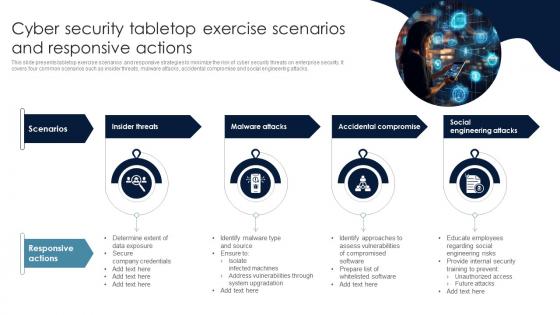
This slide presents tabletop exercise scenarios and responsive strategies to minimize the risk of cyber security threats on enterprise security. It covers four common scenarios such as insider threats, malware attacks, accidental compromise and social engineering attacks.
People who downloaded this PowerPoint presentation also viewed the following :
Cyber Security Tabletop Exercise Scenarios And Responsive Actions with all 9 slides:
Use our Cyber Security Tabletop Exercise Scenarios And Responsive Actions to effectively help you save your valuable time. They are readymade to fit into any presentation structure.








FAQs for Cyber Security Tabletop Exercise Scenarios
Look, you're basically doing fire drills for cyberattacks - testing your incident response plan and seeing where your team falls apart under pressure. Pretty smart actually. These exercises help everyone practice their roles without the actual chaos of a real breach (thank god). You'll spot gaps in your security processes and figure out if your communication protocols actually work or just sound good on paper. Team coordination gets way better too. I'd say run them quarterly and definitely write down what goes wrong - otherwise you'll forget and make the same mistakes when it actually matters.
Okay so tabletop exercises are basically just sitting around talking through "what if this happened" scenarios - no actual systems get touched. Full-scale drills? That's when you actually pull the trigger on everything. Your team gets called in the middle of the night, systems go offline, backup procedures kick in - the real deal. Honestly, tabletops are so much easier to organize and won't piss off your users. I'd definitely start there first to work out the kinks in your plan. Save yourself the headache of discovering major gaps during a full drill when everyone's already stressed.
Look at your actual risk register first - that's where the gold is. Build scenarios around ransomware hitting your most critical systems, supply chain attacks, maybe some insider threat stuff. Whatever your CISO actually worries about, you know? I've sat through way too many boring "nation-state actor" tabletops that helped nobody. You want people walking away thinking "shit, that could happen here next week." Focus on incidents that'd require multiple teams scrambling to fix things. Crown jewel systems going down, processes grinding to a halt - real nightmare fuel that mirrors how you actually operate.
Look at what's actually hitting your industry first - don't waste time on generic scenarios that'll never happen to you. Figure out your most critical systems (the ones that'd really screw you over if they went down) and build exercises around those getting attacked. Your security team probably knows which threats keep them up at night, so start there. Honestly, I'd just grab some recent incidents from similar companies and tweak them to fit your setup. Way more useful than those cookie-cutter templates everyone uses.
Just have everyone play their real roles - your IT security people, incident response team, communications, legal, and leadership. I learned this the hard way when we tried mixing things up once and it was a total mess. Have them respond exactly like they would during an actual breach. Your PR person is super important here since they'll handle all the external messaging. Don't get fancy with fake roles nobody knows how to play. The whole point is testing what would really happen. Keep it simple and focus on realistic decisions based on what everyone actually does day-to-day.
Track your response times and how well people followed procedures during the scenarios. But honestly, the post-exercise debrief is where the magic happens - that's when you hear what actually stuck. Watch how teams communicate and make decisions under pressure. Did they spot the key issues? Follow up with surveys a few weeks out to see what they retained (people forget faster than you'd think). The sweet spot is when your team starts suggesting their own process improvements afterward. Short sentences work too. Communication effectiveness matters, but the real win is seeing participants articulate what they learned.
Don't overcomplicate your first scenario - I've seen people create these elaborate multi-hour disasters that confuse everyone. Skip the trivia approach too; you want real decision-making, not a pop quiz. Always do a solid pre-brief or people will be lost from minute one. Watch out for that one person who takes over while everyone else zones out (there's always one). Document what actually gets learned afterward - honestly, most tabletops turn into expensive time-wasters without follow-up. Keep everyone engaged with clear roles. Simple scenarios work way better than you'd think.
Quarterly is the sweet spot for most companies, but if you're in something risky like finance or healthcare, monthly makes more sense. I've watched teams do them once a year and wonder why their response sucks when shit actually hits the fan. Threats change so fast now - your people need consistent practice or they'll freeze up during real incidents. Mix up the scenarios each time so it doesn't get stale. Actually, start quarterly and see how your team handles it. If they're crushing it, maybe space them out. If not, ramp up. Just don't make it a boring checkbox exercise.
For cyber tabletop exercises, I'd go with 8-12 people max. You need the key players - IT, security, legal, comms, maybe some execs. But honestly? More than that and it gets messy fast. I've watched 20-person sessions turn into total disasters where half the room's on their phones. Keep it smaller so everyone actually talks and contributes. With 8-12, you can hear people think through scenarios without all the chaos. Got a bigger team? Run separate sessions or have extras just observe. Trust me, cramming everyone together never works out well.
Alright, so first thing - actually DO something with what you learned, don't just file it away. Write down every gap you spotted and rank them by how screwed you'd be if they happened for real. Fix your response plans and communication stuff accordingly. Your team probably bombed in a few areas (mine always does), so get them more training on those weak spots. Here's the thing though - you've got to test this again in like 6 months or you're just fooling yourself. I mean, what's the point of finding problems if you're not gonna circle back and see if you actually solved them?
Honestly, most tabletop exercises suck because people use boring generic scenarios. Get something that actually reflects the weird stuff your company might face. You'll want a good facilitator - someone who won't let people ramble but asks tough questions. Drag in folks from different teams, not just the security people. IT, legal, communications, executives - basically anyone who'd be scrambling during a real incident. Oh, and have someone taking notes because you'll forget half the gaps you find. Save decent time for the debrief afterward - that's where you actually figure out what's broken.
Start by making it super clear that screwing up is totally fine - honestly, that's where the real learning happens anyway. I've watched so many of these sessions crash because people freeze up thinking their boss is judging every word. Ask questions that can't be answered with just "yes" or "no," and make sure you're mixing up who talks. Don't let the usual suspects hog all the airtime. When someone admits they don't know something, give them props for it. Oh, and sometimes it helps to kick leadership out of the room entirely if people won't open up otherwise.
Document everything within two weeks while it's all fresh - trust me on this one. Action items from the exercise need actual owners, not just bullet points in some forgotten meeting doc. Schedule training for whatever gaps you found, and honestly? Book your next tabletop right away. Momentum dies fast otherwise. Share the big findings with leadership and other teams too. I learned this the hard way - waiting around just kills all the progress you made.
Honestly, tabletop exercises are clutch for building team trust - you get to see how everyone actually handles pressure without the world ending. Make scenarios super realistic using your actual vendor names and systems, not some generic "Company X got hacked" nonsense. You'll quickly spot who needs more training and where your processes completely fall apart. Communication gaps become obvious fast. The debrief afterward is where the real magic happens though - that's when you update your playbooks with what you learned. Try to run them quarterly if possible. Way better than discovering these issues during an actual breach!
Just don't use real customer data or actual vulnerabilities - that's a lawsuit waiting to happen. Check if your industry requires this stuff anyway (HIPAA, SOX, etc.) because you might knock out compliance requirements too. Document everything since auditors eat that up. Legal should probably review scenarios first, especially around sensitive business stuff. Keep scenarios realistic but scrubbed clean. Oh and think about who might see the results down the road - you don't want anything embarrassing floating around later.
-
Extensive range of templates! Highly impressed with the quality of the designs.
-
Such amazing slides with easy editable options. A perfect time-saver.