

Cyber Security Incident Response Plan Timeline Incident Response Strategies Deployment




Try Before you Buy Download Free Sample Product
 Impress Your
 Audience
 100%
100% Editable
 Save Hours
 of Time


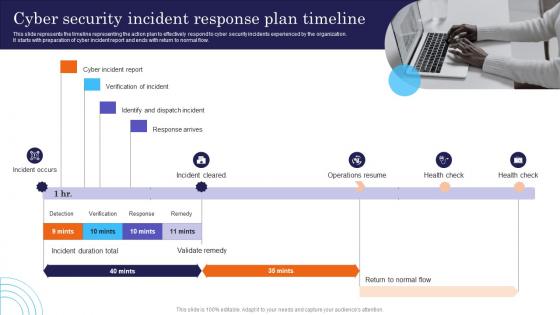
This slide represents the timeline representing the action plan to effectively respond to cyber security incidents experienced by the organization. It starts with preparation of cyber incident report and ends with return to normal flow.
People who downloaded this PowerPoint presentation also viewed the following :
Cyber Security Incident Response Plan Timeline Incident Response Strategies Deployment with all 6 slides:
Use our Cyber Security Incident Response Plan Timeline Incident Response Strategies Deployment to effectively help you save your valuable time. They are readymade to fit into any presentation structure.





FAQs for Cyber Security Incident Response Plan Timeline Incident
Your incident response plan needs six main pieces: preparation (policies, team roles, tools), detection/analysis, containment, eradication, recovery, and post-incident review. Most plans are garbage because nobody actually practices them. Clear communication protocols are crucial - make sure contact info stays updated and escalation paths are obvious. Tabletop exercises are your friend here. Run them regularly or you'll find out your plan is trash when you're scrambling at 2am during an actual breach. Oh, and don't let it become one of those binders that sits on a shelf collecting dust.
Honestly, just do a tabletop exercise first - walk through a fake incident with your team. You'll be shocked at how much stuff breaks down! Run some vulnerability scans too. Does your team even know what they're supposed to do during an actual incident? Check that. Also test if your detection and containment tools actually work. Oh, and don't skip testing communication plans - that's where things usually fall apart in my experience. Review whatever incident response docs you have (assuming they exist lol). Schedule something for next month. You'll spot the problems immediately.
Training your team is honestly make-or-break stuff. I've watched companies with solid plans completely bomb because nobody knew what they were supposed to do during an actual crisis. People freeze up when they don't know their roles or how to escalate things properly. Plus half the time they can't even recognize when something's going wrong in the first place. Run tabletop exercises regularly - way better to mess up during practice than during a real incident. Those fake scenarios help everyone get comfortable with the process. Oh, and don't just do it once and call it good. Skills get rusty fast.
Business impact first, always. Revenue systems down? Customer data compromised? Drop everything. After that, look at how sensitive the data is, which systems are critical, and whether it'll spread. Honestly, I've watched teams create these crazy complicated matrices that just slow them down when shit hits the fan. Keep it simple - maybe 3 priority levels max. The real trick is documenting your criteria beforehand so you're not scrambling to decide what matters when everything's breaking. Trust me, build this framework when things are calm, not during a crisis.
You really need some kind of monitoring system running all the time - SIEM tools, network analysis stuff, whatever fits your budget. Set up alerts for sketchy activity like failed logins or weird data movements. Honestly, attackers are getting pretty sneaky these days, so layered detection is your friend. Train your people to spot red flags too - tech can't catch everything. Start with monitoring your most important assets first, then expand out. Oh, and make sure everyone knows who to call when something looks off. It's really about combining good tools with aware humans.
Your CSIRP needs regular updates - treat it like it's alive. I'd say review it quarterly, plus right after any big security incidents or new threats pop up. Run those tabletop exercises every few months too. They'll always show you blind spots you missed. Keep up with threat intelligence feeds so you're not blindsided by whatever hackers are doing now. Oh, and update your contact lists religiously - trust me, calling a dead number during a real incident is the worst. Honestly, the key is just scheduling these reviews and actually sticking to them.
Track three main things: how fast you catch incidents, how quickly you contain them, and recovery time. Honestly, executives only really care about that last one - getting back to normal operations. False positive rates matter too because nobody wants to deal with constant fake alerts. Do post-incident reviews to see how your team actually performed, not just how they should've performed. Check if people are following your documented procedures or just winging it. Set benchmarks and review quarterly - if your times keep getting worse, something's broken in your process.
Look, you can't just slap communication on top of your incident plan - weave it into every single phase. Have your messaging templates ready beforehand for different audiences (execs, customers, regulators) based on severity levels. Trust me, you don't want to craft your first breach email while servers are literally on fire. Pick dedicated communication people so your tech folks aren't juggling Slack and server logs simultaneously. Oh, and run through these communication flows during tabletop exercises - otherwise it'll be total chaos when something actually happens.
You'll need monitoring tools first - grab a SIEM like Splunk or QRadar for log stuff and threat detection. CrowdStrike or SentinelOne work great for endpoint detection. Wireshark's still the best for packet analysis, honestly can't beat it. For forensics, check out Volatility or SANS SIFT. Oh, and set up Slack or Teams so your team can actually talk during incidents without chaos. The biggest thing though? Train everyone on this stuff beforehand. I've seen teams with amazing tools completely fall apart because nobody knew which button to click when everything's on fire.
Working with outside partners and law enforcement is honestly a game-changer when you're dealing with incidents. They bring specialized skills your team probably doesn't have, plus threat intel from other companies getting hit. Law enforcement can chase attackers internationally too - sounds crazy but it actually works. The trick is building those relationships beforehand through industry meetups, your local FBI office, cybersecurity groups. You don't want to be scrambling for contacts while your systems are getting torched. Trust me on this one.
Start with your data breach laws - GDPR, HIPAA, all that stuff has different deadlines depending where you are. Some places want notification in 72 hours (which is honestly brutal when you're dealing with a crisis). Chain of custody matters too if you need evidence later. Different incident types might require reporting to regulators or even law enforcement. Get your legal team to look over whatever plan you build. Oh, and definitely make a compliance checklist for your playbooks - trust me, you'll forget something important when things go sideways otherwise.
Get everyone together within 72 hours - any longer and people's memories get fuzzy. Break it into three parts: what actually went down (build a timeline), why things broke (dig into root causes), and what you're gonna do differently next time. Don't just invite the incident lead either, get everyone who was in the trenches. Here's the thing though - focus on broken processes, not pointing fingers at people. Nobody wants to be in a blame session. Write down specific action items with actual owners and deadlines. Then actually do the work you said you'd do, because otherwise you're just burning time in conference rooms.
Think of threat intel as your heads-up before the storm hits. It shows you what attackers are planning so you can prep your defenses and update those incident playbooks. Honestly, it's a game changer for response times - you're not scrambling to figure out what's happening because you already recognize the attack patterns. Plus you can focus on threats that actually matter to your industry instead of chasing every shiny vulnerability. Just make sure you're getting feeds that match your environment, otherwise you'll drown in noise that doesn't apply to you.
Okay so three main things you gotta nail down. Automated backups that stay offline - and actually test the damn things because finding out they're broken mid-crisis is brutal. MFA everywhere, obviously, plus keep admin access tight to just the people who absolutely need it. Also build out a solid incident response plan with clear communication chains and who makes what calls when everything's on fire. Honestly though? The game-changer is running practice drills with your team. When people are freaking out, you don't want anyone scrambling to figure out their job.
Dude, make cybersecurity everyone's responsibility, not just IT's headache. Skip those awful PowerPoint trainings - use real attack examples or simulations instead. People need to see what threats actually look like. Create a blame-free culture where reporting weird stuff won't get anyone fired. I've watched too many small issues blow up because someone was scared to admit they clicked something sketchy! Set up easy reporting and actually thank people who spot potential problems. Oh, and run practice drills with your whole team. When real incidents hit, you don't want people freezing up or running around confused.
-
Excellent design and quick turnaround.
-
SlideTeam offers so many variations of designs and topics. It’s unbelievable! Easy to create such stunning presentations now.