

Cyber Security Incident Response Process Flow Chart Incident Response Strategies Deployment




Try Before you Buy Download Free Sample Product
 Impress Your
 Audience
 100%
100% Editable
 Save Hours
 of Time


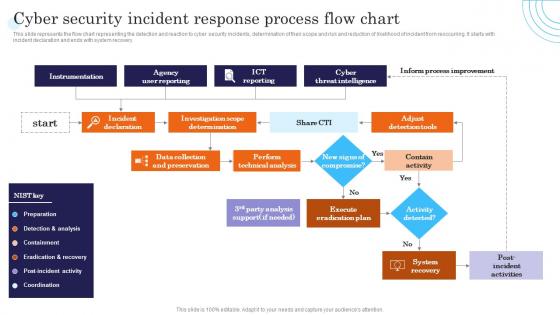
This slide represents the flow chart representing the detection and reaction to cyber security incidents, determination of their scope and risk and reduction of likelihood of incident from reoccurring. It starts with incident declaration and ends with system recovery.
People who downloaded this PowerPoint presentation also viewed the following :
Cyber Security Incident Response Process Flow Chart Incident Response Strategies Deployment with all 6 slides:
Use our Cyber Security Incident Response Process Flow Chart Incident Response Strategies Deployment to effectively help you save your valuable time. They are readymade to fit into any presentation structure.





FAQs for Cyber Security Incident Response Process Flow Chart Incident
You'll need six main pieces: prep work (playbooks, team roles), detection and analysis to figure out what went wrong, containment to stop the damage, eradication to kick out the threat, recovery to get everything running again, and post-incident review. Most companies totally bomb the prep phase - they think they can just improvise when shit hits the fan. Your team should have IT, security, legal, communications, and executives with clear escalation paths. Oh, and test your plan regularly! Trust me, discovering gaps during an actual breach is basically nightmare fuel. Nobody wants that stress.
Honestly, just go with a tiered system - Critical/High/Medium/Low works for most places. Look at what's actually broken first: customer data, money-making stuff, core systems. Then figure out how many people it's hitting. The real pain is that literally everyone thinks their problem is "critical." Set super clear rules beforehand or you'll spend forever arguing during actual fires. Critical = business is dead or we're getting hacked. High = major services down. You get it. Build a quick scoring thing your team can reference. Sounds boring but it'll save your sanity when things go sideways and people start panicking.
Honestly, training your people is huge for incident response. Most companies have solid tech but fall apart when humans panic and don't know what to do. You want folks spotting threats early and knowing exactly who to call - not scrambling around like headless chickens. Monthly tabletop exercises work way better than those boring annual sessions everyone zones out during. Focus on drilling specific roles repeatedly. I mean, what's the point of having great security tools if nobody knows how to actually use them when stuff hits the fan? Make it ongoing and practical.
Honestly, don't wait until you have everything figured out - that's the biggest mistake people make. Talk to your internal team first, then branch out to customers and partners based on how bad it is and what legal stuff you need to handle. People get way more pissed about silence than hearing "we're still investigating." Keep it simple, no corporate BS language. Just the facts. Pick one person to handle all communication so you don't have five different stories floating around - that's a nightmare. Also, tell people when they'll hear from you again and actually do it.
Document everything as it happens - seriously, don't trust your memory on this stuff. Set up a shared timeline with who did what and when. I've watched teams completely blank on crucial details even just days later. Run a blameless post-mortem within a week while it's all fresh. Cover what broke, what worked, and actual fixes you can implement. Here's the thing though - store it somewhere people will actually look at it later. Not some random folder that becomes a digital wasteland. Make it searchable so when the next fire starts, you're not reinventing the wheel.
You'll want to track the obvious stuff first - detection time, how fast you contain things, recovery speed. That shows if your team can actually handle incidents when they hit. But honestly? The real test happens during a live incident when everything's going sideways. I'd also look at your team's technical chops and how they communicate during crisis mode. Do they actually follow the playbooks when stressed? Tabletop exercises are great for finding gaps without the real chaos - much less painful that way. Set up quarterly check-ins to see how you're trending and tweak training as needed.
So I'd definitely get a SIEM like Splunk or QRadar first - that's gonna be your main hub for everything. Network stuff like Wireshark is essential, plus you need endpoint tools like CrowdStrike or SentinelOne. Fair warning though, the learning curve sucks at first but push through it. For deeper analysis, grab Volatility for memory forensics and YARA for malware hunting. Oh and threat intel feeds are clutch for understanding what you're actually looking at. If money's an issue, Security Onion's free and pretty solid to start with.
Honestly, threat intel is a game-changer for incident response. Your team gets actual context about attackers instead of flying blind during an emergency. You'll spot attack patterns way faster and know what the bad guys usually do next. Makes prioritizing so much easier when you're not guessing. The proactive hunting part is clutch too - you can find sketchy stuff before it explodes into a major incident. I'd start by feeding threat intel into your SIEM (assuming it doesn't suck) and actually train people to use it during investigations. Those first few hours are always chaos anyway, so any head start helps.
Honestly, start with the big four: MTTD and MTTR (how fast you detect and respond), plus containment and recovery times. False positive rates matter too - trust me, your team will hate you if alerts are constantly going off for nothing. Track how well you communicated during incidents because that's where things usually fall apart. Cost per incident is boring but leadership always wants those numbers anyway. Oh, and don't try to measure everything at once - you'll just overwhelm yourself. These basics will give you solid data to actually improve your process instead of just collecting random metrics.
Build your compliance stuff right into your incident response plan ahead of time. Figure out what regs hit you - GDPR, HIPAA, SOX, whatever - and know their deadlines. GDPR's that brutal 72-hour thing, but others aren't as tight. Document everything immediately because regulators are obsessed with paper trails. Get your legal team to draft template notifications now, plus map out who escalates to whom. Trust me, you don't want to be googling "how to report data breach" at 2am while everything's on fire. Run tabletop exercises so everyone actually knows the drill.
Oh man, the two big ones that'll bite you: don't jump straight into fixing stuff before you figure out how bad it actually is, and document EVERYTHING as you go. Seriously, you'll hate yourself later if you accidentally wipe evidence or miss how far the breach spread. Communication is huge too - people freak out when they don't know what's happening, plus your team ends up doing the same work twice. Make sure you grab those logs before they disappear, and I know it's tempting but don't just start patching things randomly. Set up a group chat or whatever and keep everyone updated regularly.
Get your business continuity plan running right alongside incident response - don't let them fight over resources. Isolate the compromised systems first, then quickly spin up backups or manual workarounds for critical stuff. Communication's everything here. Your teams need to know what's still working and what temporary procedures they should follow. Honestly, I've watched companies completely botch this part. Put someone in charge of the business side while security handles containment. Oh, and document it all - you'll thank yourself later when this inevitably happens again.
Vet your vendors before shit hits the fan. Map out which ones can access your critical systems - start there. Set up clear communication protocols and spell out their roles in your response plan. Don't assume they know what to do (spoiler: they don't). Get contracts with incident response clauses baked in. Regular security assessments are a must for critical vendors. Have backup plans ready if they flake out during a crisis. This is where companies get absolutely torched because they wing it instead of planning ahead.
Dude, just pick NIST, ISO 27035, or SANS - they're like cheat codes for incident response. Way better than making stuff up as you go. They break everything down: prep, detection, containment, getting rid of the bad stuff, recovery, then figuring out what went wrong. NIST is probably your best bet since it's free and actually makes sense (unlike some frameworks that are total garbage). Most teams grab one as their foundation, then tweak it for whatever weird setup they're dealing with. Trust me, these things exist because people way smarter than us already figured out what works. Don't overthink it.
Honestly, post-incident reviews are a lifesaver - they turn your worst days into actual learning moments. Do it within a week while everyone remembers what happened. Get the whole team together and walk through what broke and what actually worked. Here's the thing though: don't let it become a finger-pointing session or people will just clam up. Focus on rebuilding the timeline, figuring out where communication failed, and whether your tools held up. The real trick? Actually following through on fixes instead of letting your notes disappear into some forgotten Slack thread.
-
Making a presentation has never been this easy for me. Thank you SlideTeam for offering a splendid template library.
-
Professional and unique presentations.