

Cyber Security Incident Response Process Flowchart




Try Before you Buy Download Free Sample Product
 Impress Your
 Audience
 100%
100% Editable
 Save Hours
 of Time


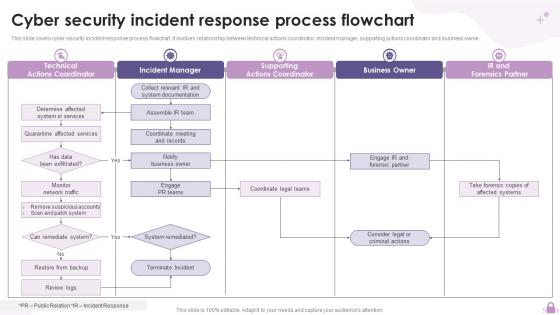
This slide covers cyber security incident response process flowchart. It involves relationship between technical actions coordinator, incident manager, supporting actions coordinator and business owner.
People who downloaded this PowerPoint presentation also viewed the following :
Cyber Security Incident Response Process Flowchart with all 6 slides:
Use our Cyber Security Incident Response Process Flowchart to effectively help you save your valuable time. They are readymade to fit into any presentation structure.






FAQs for Cyber Security Incident
So you'll need the basics: prep work, spotting threats, locking things down, cleaning house, getting back online, and reviewing what went wrong. Have your team roles mapped out ahead of time - plus contact info and message templates ready to go. I know it sounds tedious but trust me, you don't want to be scrambling for phone numbers during a crisis. Figure out how you'll catch incidents early, quarantine infected systems, wipe out the bad stuff completely, then bring everything back safely. Oh, and actually test this plan with mock scenarios because discovering your response is garbage during a real attack? That's a special kind of nightmare you want to avoid.
Keep those playbooks fresh with new threat intel - seriously, outdated procedures are worse than useless. Run tabletop exercises quarterly, but ditch the boring malware scenarios everyone's seen a million times. Cross-train your people so you're not totally screwed when someone's out sick during a major incident (happened to us last year, what a nightmare). Subscribe to decent threat intel services and actually network at conferences. Other IR teams love sharing war stories and real insights. Oh, and debrief after every incident. Sounds obvious but you'd be surprised how many teams skip this step.
So threat intel is basically your cheat sheet for understanding what attackers are actually doing. Random malicious activity suddenly makes sense when you can spot their patterns and tactics. Honestly, it's a game-changer during incidents - you'll respond way faster because you know their playbook. Plus you can hunt proactively for similar stuff in your environment before it becomes a problem. My advice? Start building those threat intel relationships now, even if it feels premature. Trust me, when you're neck-deep in a major incident at 2am, you'll be grateful you did the groundwork.
Business impact trumps everything else - that's my rule. Are customers locked out? Data exposed? Critical stuff broken? Those jump to the front of the line. I've watched teams waste hours debugging some obscure technical glitch while their payment system was literally on fire. Don't be those people. Check how many users you're affecting and if it's spreading. Make a simple high/medium/low grid for impact vs urgency - nothing fancy. Write down your criteria so when chaos hits at 2am, everyone knows what matters most. Trust me, future you will thank present you.
Honestly, the worst thing is when companies freak out and start making random decisions without knowing who's in charge. Communication falls apart fast. Oh, and they wait forever to tell people what's happening - huge mistake. Your IT guys will want to fix everything right away, but hold up - you might wipe out evidence you need later. Document everything too, even when it's crazy busy. You'll thank yourself when lawyers start asking questions. Test your response plan before you actually need it though. Half the time people don't even know what they're supposed to do.
Good communication literally saves your ass during incidents. Set up your Slack channels and contact lists beforehand - seriously, don't wait until everything's on fire. Templates for different scenarios help too, though honestly I always forget we have them until halfway through a crisis. Make sure your tech teams, management, and customers all get regular updates so nobody's duplicating work or missing stuff. Oh, and figure out your escalation paths now. Trust me, you don't want to be googling your boss's phone number at 2am when the servers are down.
Honestly, start with SIEM tools - Splunk and QRadar are solid for catching threats in your logs. EDR solutions are must-haves too. You're gonna need network monitoring and forensics stuff like Volatility or SANS SIFT when things go sideways. Oh, and don't sleep on communication tools because coordinating during an incident is chaos without secure channels. Phantom or Demisto can automate the repetitive stuff, which is huge. Map out what you're missing first, then tackle the biggest risks. Integration is everything - I've seen teams with great tools that couldn't talk to each other.
Set up that review within a week - memories fade fast. Round up everyone who was involved: responders, IT folks, management, the whole crew. Focus on what broke down and timeline issues, but don't turn it into a blame fest (nobody learns anything that way). Write down the actual process gaps, where communication sucked, and what tools failed you. Here's the thing though - most teams do the meeting then forget about it. Actually update your playbooks afterward. Assign someone to own each fix with real deadlines, otherwise you'll just repeat this mess next time.
Oh man, you absolutely have to build breach notification laws right into your incident response plan. GDPR gives you 72 hours, but state laws are all over the place - it's honestly a mess. Make sure you've got legal contacts ready, know what documentation you need, and assign someone to handle regulatory filings. Healthcare and finance have their own nightmare regulations on top of everything else. One thing people forget - figure out the attorney-client privilege stuff for investigations before you need it. Seriously though, get your lawyers writing this plan with you from the start, not scrambling after a breach hits.
So most companies do a combo of mandatory training sessions, fake phishing tests, and those constant awareness campaigns. Train people on the obvious red flags - sketchy emails, weird system stuff, unauthorized logins. Quarterly workshops are pretty standard, plus monthly security reminders (they get old fast but somehow still work). Make reporting dead simple though - hotline, web form, whatever. The biggest thing? Don't make people scared they'll get in trouble for speaking up. I've seen places where everyone's terrified to report anything because they think they'll get blamed. Creates a way better detection rate when people actually want to help.
Don't touch ANYTHING first - seriously, preserve that scene exactly as is. Grab screenshots of whatever's on screens before you move. Creating forensic images beats just copying files (takes forever but trust me on this). Document everything with timestamps - what you saw, when, what you did about it. Your memory gets weird later so detailed logs are clutch. Oh and chain of custody is huge for any evidence you collect. Lock everything down tight, only let essential people access it. The whole process sucks but you'll be glad you did it right.
Honestly, you need an incident response plan mapped out before disaster strikes. Figure out your absolutely critical systems first - what can't go down no matter what. Then document who handles what because trust me, when everyone's freaking out is NOT when you want to be assigning roles. Start by containing the breach, then bring services back based on what the business needs most. Oh, and keep people updated even when you're still figuring things out yourself - silence makes everyone assume the worst. Practice this stuff ahead of time so you're not scrambling to learn while everything's on fire.
Dude, you absolutely need external partners for incident response. Law enforcement handles the criminal stuff, vendors know their own products best, and forensics teams have skills you probably don't. Can't do everything in-house - learned that the hard way at my last job. When customers get affected, coordination becomes a nightmare without the right contacts. Third-party experts also speed things up big time. Build those relationships now, not when you're panicking at 2am. Keep their contact info in your response plan where everyone can find it.
Start with tabletop exercises - walk your team through realistic attack scenarios and see what breaks. Most incident response plans look great on paper but crumble under actual pressure, so test yours regularly. Run drills covering communication, containment, decision-making when everyone's stressed. Check if you've got the right tools and trained people. Don't skip testing your backup and recovery stuff either (learned that one the hard way). Schedule these quarterly and document every failure. Better to find the gaps yourself than let some hacker do it for you.
Honestly, start with the big three: mean time to detection, containment, and recovery. Those tell you if your team's actually fast when things go sideways. False positive rates matter too - nobody wants burned out analysts ignoring real alerts because they're drowning in fake ones. I'd also track how many incidents spiral beyond your first response attempt. Compliance violations and data breaches are obvious ones to measure. Don't sleep on the softer stuff either, like whether stakeholders think you're doing a decent job and if you're actually implementing lessons learned. My advice? Pick 3-4 metrics that hit your worst problems first. Better to nail those than half-ass tracking everything.
-
Exclusive and extensive collection of templates. Really helped me create a professional presentation in just no time.
-
Helpful product design for delivering presentation.