

Workflow For Cyber Security Incident Response Team




Try Before you Buy Download Free Sample Product
 Impress Your
 Audience
 100%
100% Editable
 Save Hours
 of Time


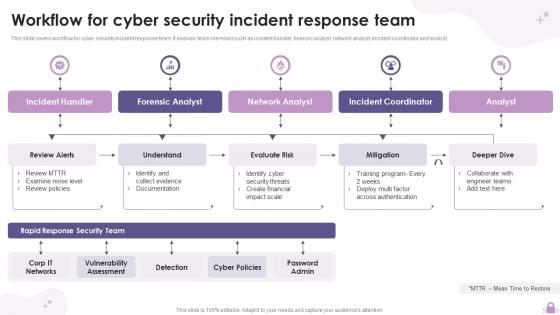
This slide covers workflow for cyber security incident response team. It involves team members such as incident handler, forensic analyst, network analyst, incident coordinator and analyst.
People who downloaded this PowerPoint presentation also viewed the following :
Workflow For Cyber Security Incident Response Team with all 6 slides:
Use our Workflow For Cyber Security Incident Response Team to effectively help you save your valuable time. They are readymade to fit into any presentation structure.





FAQs for Workflow For Cyber Security
Effective cybersecurity incident response workflows include preparation and planning, detection and analysis, containment and eradication, recovery and post-incident activities, and continuous improvement processes. These stages streamline organizational responses by establishing clear protocols, minimizing damage through rapid containment, and enabling faster recovery, with many enterprises finding that structured workflows reduce incident costs by up to 50% while strengthening overall security posture.
Organizations prioritize incidents through severity classification frameworks that assess technical impact, business criticality, affected system importance, data sensitivity levels, and potential regulatory implications. These structured approaches enable security teams to allocate resources strategically, ensuring critical infrastructure threats receive immediate attention while routine issues follow standard protocols, ultimately delivering faster response times and minimized business disruption.
Communication serves as the backbone of incident response, ensuring coordinated internal actions through clear command structures, real-time updates, and cross-team collaboration, while managing external stakeholder expectations through transparent, timely disclosures. Effective communication protocols enable organizations to minimize confusion, maintain regulatory compliance, and preserve customer trust during critical security events, with many enterprises finding that structured communication frameworks significantly reduce response times and operational disruption.
Effective cybersecurity incident response teams include a incident commander for coordination, security analysts for threat assessment, IT specialists for system remediation, communications lead for stakeholder updates, and legal counsel for compliance issues. This structured approach enables organizations to contain threats faster, minimize operational disruption, and maintain customer confidence, with many financial institutions and healthcare providers finding that clearly defined roles reduce response time by 40-60%.
Essential incident response tools include SIEM platforms, endpoint detection and response systems, network monitoring solutions, forensic analysis software, and automated orchestration platforms. These technologies streamline threat detection, accelerate containment procedures, and enhance investigative capabilities, with many organizations finding that integrated toolsets deliver faster response times, improved threat visibility, and significantly reduced breach impact across their security operations.
Organizations ensure effective incident response plans through regular tabletop exercises, simulated breach scenarios, quarterly plan reviews, and post-incident assessments that identify gaps and improvement opportunities. These practices enable security teams to refine detection protocols, streamline communication channels, and update threat intelligence, with many financial institutions and healthcare organizations finding that consistent testing reduces response times and minimizes breach impact significantly.
Common pitfalls include inadequate preparation, unclear role definitions, poor communication protocols, insufficient documentation processes, and lack of regular testing. These workflow weaknesses can significantly delay response times, create confusion during critical incidents, and compromise recovery efforts, with many organizations finding that comprehensive preparation, clear escalation procedures, and routine simulations ultimately deliver faster containment and minimize operational disruption.
Incident response teams integrate threat intelligence by incorporating real-time feeds into detection systems, using contextual data to prioritize alerts, and leveraging indicators of compromise for faster threat identification. This strategic combination enables security teams to proactively hunt threats, reduce false positives, and accelerate containment decisions, with many organizations finding significantly improved response times and threat attribution accuracy.
Organizations should track metrics including mean time to detection, containment duration, recovery time, incident classification accuracy, and stakeholder communication effectiveness. These measurements enhance operational efficiency by identifying response bottlenecks, streamlining resource allocation, and improving team coordination, with many financial services and healthcare institutions finding that comprehensive metrics ultimately deliver faster threat neutralization and reduced business impact.
Legal and regulatory frameworks significantly shape incident response workflows by mandating specific breach notification timelines, data protection protocols, evidence preservation requirements, and stakeholder communication standards. Organizations across sectors like healthcare, financial services, and retail must integrate compliance checkpoints, regulatory reporting mechanisms, and audit trail documentation throughout their response processes, ultimately ensuring legal adherence while maintaining operational efficiency and customer trust.
Incident response team training includes technical skills development, threat intelligence analysis, communication protocols, legal compliance frameworks, and simulated attack exercises. Through hands-on tabletop scenarios and live-fire drills, organizations enhance their teams' decision-making capabilities, reduce response times, and strengthen coordination across departments, with many financial institutions and healthcare providers finding that regular cross-functional training significantly improves breach containment effectiveness.
Organizations leverage automation to enhance incident response through automated threat detection, alert prioritization, containment protocols, evidence collection, and communication workflows. These technologies streamline response times by eliminating manual processes, reducing human error, and enabling 24/7 monitoring, with many financial services and healthcare institutions finding that automated systems deliver faster containment and significantly improved security outcomes.
**INPUT**: What are the best practices for documenting incidents throughout the response process? **OUTPUT**: Best practices include maintaining real-time logs, standardizing incident templates, recording timestamps for all actions, preserving digital evidence, and creating detailed remediation steps. These documentation standards streamline investigations by enabling faster forensic analysis, improving compliance reporting, and facilitating knowledge transfer, with many organizations finding that comprehensive incident records ultimately enhance future response times and regulatory audits. [Word count: 58]
Post-incident analysis informs future cybersecurity strategies by identifying security gaps, attack vectors, and response effectiveness through comprehensive forensic examination and stakeholder feedback. This systematic evaluation enables organizations to strengthen defenses, update protocols, and enhance detection capabilities, with many financial institutions and healthcare providers finding that these insights significantly reduce response times and prevent similar breaches, ultimately delivering more resilient security postures.
Incident recovery involves system restoration from clean backups, vulnerability patching, network re-segmentation, and comprehensive security testing before resuming operations. Organizations should implement gradual service restoration with enhanced monitoring, conduct thorough forensic analysis, and update incident response procedures based on lessons learned, ultimately strengthening their cybersecurity posture and operational resilience.
-
Amazing variety of PowerPoint slides. Really helpful in designing professional presentations.
-
They guys always go the extra mile to meet the expectations of their customers. Almost a year has been associated with them.