


Fintech Cyber Security Powerpoint Ppt Template Bundles





Try Before you Buy Download Free Sample Product
 Impress Your
 Audience
 100%
100% Editable
 Save Hours
 of Time


Our Fintech Cyber Security Powerpoint Ppt Template Bundles are topically designed to provide an attractive backdrop to any subject. Use them to look like a presentation pro.
People who downloaded this PowerPoint presentation also viewed the following :
Content of this Powerpoint Presentation
Slide 1: This slide introduces Fintech Cyber Security. State your company name and begin.
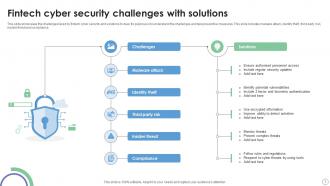
Slide 2: This slide showcases the challenges faced by fintech cyber security and solutions to deal. Its purpose is to understand the challenges and take preventive measures.
Slide 3: This slide presents the best practices for fintech cyber security. Its aim is to follow the practices for maintaining a secure environment in fintech based companies.
Slide 4: This slide showcases the steps to create efficient fintech cyber security application. Its objective is to ensure successful implementation of a bug free fintech application.
Slide 5: This slide displays the areas of fintech cyber security. Its purpose is to secure the various applications against financial attacks. This slide includes payment, insurance, deposit etc.
Slide 6: This slide showcases the threats faced in fintech cyber security. Its use is to face threats in fintech cyber security and help protect against zero day attacks.
Slide 7: This slide presents the essential checklist for fintech cyber security. Its aim is to include the important functions and activities for operational management.
Slide 8: This slide showcases the CIA methodology for fintech cyber security. Its aim is to secure financial transactions across internet based platform.
Slide 9: This slide displays the investment in tools to protect against cyber security. Its aim is to monitor and invest in best tools for securing fintech.
Slide 10: This slide showcases the essential factors for fintech cyber security. Its aim is to manage the business policies and use the right risk management measures.
Slide 11: This slide presents the fintech cyber security KYC process. Its aim is to identify the problems and verify the right customer to protect the data.
Slide 12: This slide showcases privacy security issues in cyber fintech. Its aim is to understand the issues and provide solutions to fix the issues.
Slide 13: This slide graphically represent the best technologies of fintech cyber security industry. Its aim is to manage the best available method for securing the industry.
Slide 14: This slide showcases the fast evolving fintech cyber security technologies. Its aim is to ward off different threats to protect fintech.
Slide 15: This slide presents the best technologies to choose for fintech security management. Its aim is to prioritise the resources and execute the best strategy.
Slide 16: This slide showcases factors influencing fintech cyber security. Its aim is to implement factors for securing fintech cyber security.
Slide 17: This slide presents Fintech encryption cyber security icon.
Slide 18: This slide showcases Fintech business cyber security icon.
Slide 19: This slide presents Online fintech cyber security icon.
Slide 20: This is a Thank You slide with address, contact numbers and email address.
Fintech Cyber Security Powerpoint Ppt Template Bundles with all 28 slides:
Use our Fintech Cyber Security Powerpoint Ppt Template Bundles to effectively help you save your valuable time. They are readymade to fit into any presentation structure.











FAQs for Fintech Cyber Security Powerpoint
Fintech companies face threats including phishing attacks, ransomware, API vulnerabilities, data breaches, and social engineering tactics targeting customer financial information. These cyber risks particularly impact mobile banking platforms, digital payment processors, and cryptocurrency exchanges, with many institutions finding that multi-layered security frameworks significantly reduce exposure while maintaining seamless customer experiences.
Fintech startups can implement cost-effective cybersecurity through cloud-based security solutions, automated threat detection tools, employee training programs, multi-factor authentication, and strategic partnerships with cybersecurity providers. These approaches enable startups to enhance protection by leveraging scalable technologies, minimizing human error risks, and accessing enterprise-grade security expertise, ultimately delivering robust defense while maintaining operational efficiency and customer trust.
Data encryption transforms sensitive financial information into unreadable code, protecting customer data, transaction details, payment credentials, and account information from unauthorized access during transmission and storage. Through advanced encryption protocols, financial institutions safeguard against data breaches, ensure regulatory compliance, and maintain customer trust, while enabling secure digital transactions that deliver faster services and competitive advantage in an increasingly digital banking landscape.
Artificial intelligence enhances fintech cybersecurity by enabling real-time threat detection, automated response systems, behavioral analysis, and predictive risk assessment. Through machine learning algorithms, financial institutions can identify fraudulent transactions, detect anomalies in user behavior, and prevent cyber attacks before they occur, ultimately delivering faster threat resolution and significantly reduced security breaches.
Fintech companies must navigate PCI DSS for payment processing, GDPR for data protection, SOX for financial reporting, and regional banking regulations like PSD2 in Europe. These frameworks enhance operational security through mandatory encryption, incident reporting, and regular audits, with many institutions finding that proactive compliance ultimately delivers competitive advantage and customer trust.
Third-party vendors significantly impact fintech cybersecurity by expanding the attack surface, introducing data access points, and creating potential compliance gaps across interconnected systems. While vendor partnerships enable enhanced services and operational efficiency, they require rigorous security assessments, continuous monitoring, and contractual safeguards, with many financial institutions finding that comprehensive vendor risk management ultimately strengthens their overall security posture.
Mobile fintech application security requires multi-layered authentication, end-to-end encryption, biometric verification, secure API gateways, and real-time fraud monitoring systems. These practices work together by protecting user data, preventing unauthorized access, and detecting suspicious activities instantly, with banks and digital payment providers finding that comprehensive security frameworks ultimately deliver enhanced customer trust and regulatory compliance.
Fintech companies ensure GDPR compliance through robust data encryption, regular security audits, explicit customer consent mechanisms, appointed data protection officers, and comprehensive breach notification systems. These measures streamline regulatory adherence by minimizing data exposure, automating compliance reporting, and maintaining transparent customer communication, with many financial institutions finding that proactive privacy frameworks ultimately deliver enhanced customer trust and competitive advantage.
Effective cybersecurity training programs for fintech employees include phishing simulation exercises, role-based security workshops, incident response drills, regulatory compliance training, and social engineering awareness sessions. These programs enhance security posture by creating security-conscious cultures, reducing human error vulnerabilities, and ensuring compliance adherence, with many financial institutions finding that regular, interactive training significantly minimizes breach risks and strengthens operational resilience.
Blockchain enhances fintech cybersecurity by providing immutable transaction records, decentralized data storage, and cryptographic verification that eliminates single points of failure. Through distributed ledger technology, financial institutions can detect fraud more effectively, secure customer data across multiple nodes, and create transparent audit trails, with many banks finding that blockchain integration significantly reduces cybersecurity vulnerabilities while streamlining compliance processes.
Fintech firms should establish comprehensive incident response strategies including automated threat detection systems, predefined communication protocols, rapid containment procedures, forensic analysis capabilities, and regulatory compliance frameworks. These strategies enable organizations to minimize breach impact through swift identification, coordinated response teams, and transparent stakeholder communication, with many financial institutions finding that proactive planning significantly reduces recovery time and regulatory penalties.
Consumer education navigates fintech cybersecurity by teaching users to recognize phishing attempts, use strong authentication methods, monitor account activity regularly, and understand privacy settings. Through interactive tutorials, financial institutions enhance customer awareness about secure mobile banking practices, password management, and fraud detection, while regulatory compliance programs ultimately strengthen both individual protection and system-wide security resilience.
Fintech companies face challenges including legacy system integration, regulatory compliance across jurisdictions, talent acquisition costs, and balancing security with user experience when scaling cybersecurity measures. These obstacles are particularly acute for rapidly growing platforms handling sensitive financial data, with many institutions finding that strategic partnerships and automated security solutions help streamline protection while maintaining operational efficiency.
Multi-factor authentication is critical for fintech platforms, significantly reducing unauthorized access risks by requiring multiple verification steps beyond passwords, including biometrics, SMS codes, and hardware tokens. This layered security approach helps banks and financial institutions prevent account takeovers and fraud attempts, ultimately delivering enhanced customer trust and regulatory compliance in an increasingly threat-prone digital landscape.
Quantum computing presents both unprecedented cybersecurity challenges and revolutionary opportunities for fintech institutions, potentially rendering current encryption methods obsolete while enabling quantum-resistant security protocols. Financial organizations are increasingly investing in quantum-safe cryptography and post-quantum security frameworks, with many banks and payment processors finding that early preparation delivers competitive advantage in data protection capabilities.
-
I looked at their huge selection of themes and designs. They appeared to be ideal for my profession. I'm sure I'll grab a few of them.
-
SlideTeam is a great place for PPT templates. They have many templates on a single topic. It has made my life a lot easier.