

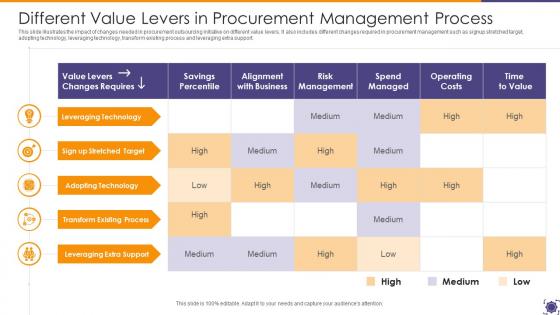
Different Value Levers In Procurement Management Process




Try Before you Buy Download Free Sample Product
 Impress Your
 Audience
 100%
100% Editable
 Save Hours
 of Time


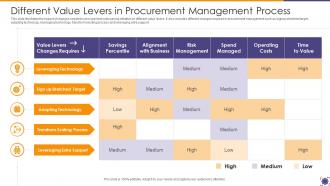
This slide illustrates the impact of changes needed in procurement outsourcing initiative on different value levers. It also includes different changes required in procurement management such as signup stretched target, adopting technology, leveraging technology, transform existing process and leveraging extra support.
People who downloaded this PowerPoint presentation also viewed the following :
Different Value Levers In Procurement Management Process with all 6 slides:
Use our Different Value Levers In Procurement Management Process to effectively help you save your valuable time. They are readymade to fit into any presentation structure.





FAQs for Different Value Levers In
Primary procurement value levers include strategic sourcing, supplier consolidation, contract optimization, spend analytics, and category management. These approaches enhance sourcing strategies by reducing costs through volume negotiations, improving supplier relationships and performance metrics, and leveraging data-driven insights for better decision-making, with many organizations finding that systematic implementation delivers significant operational efficiency and competitive advantage.
Strategic supplier relationships enhance procurement value by fostering collaboration, innovation, risk mitigation, cost optimization, and long-term partnership development. Through these partnerships, organizations streamline supply chain efficiency, accelerate product development cycles, and secure preferential pricing arrangements, while many companies in manufacturing and retail find that trusted supplier networks ultimately deliver competitive advantages and operational resilience.
Technology significantly enhances procurement value levers by automating sourcing processes, enabling real-time spend analytics, streamlining supplier management, and facilitating strategic negotiations through data insights. These digital solutions help organizations achieve cost reductions, improve supplier relationships, and accelerate procurement cycles, with many companies finding that integrated platforms deliver enhanced visibility and competitive advantage.
Organizations measure procurement value lever effectiveness through comprehensive KPIs including cost savings percentages, supplier performance metrics, contract compliance rates, cycle time reductions, and risk mitigation scores. These measurements enable strategic assessment by tracking total cost of ownership improvements, supplier relationship quality, and operational efficiency gains, with many enterprises finding that integrated dashboards ultimately deliver enhanced visibility and competitive procurement advantage.
Implementing procurement value levers in multi-supplier environments presents challenges including coordination complexity, inconsistent data formats, varying supplier capabilities, relationship management difficulties, and standardization issues across different vendors. These obstacles require strategic supplier segmentation, unified communication platforms, and collaborative frameworks, with many organizations finding that phased implementation and dedicated supplier development programs ultimately deliver enhanced operational efficiency and stronger partnership outcomes.
Procurement professionals can identify industry-specific value levers through comprehensive spend analysis, supplier market intelligence, benchmarking against industry peers, and cross-functional collaboration with operations teams. By analyzing procurement data patterns, engaging with specialized suppliers, and understanding unique industry regulations, organizations can prioritize levers delivering maximum cost reduction and operational efficiency, ultimately gaining competitive advantage.
Data analytics drives procurement value levers through spend analysis, supplier performance monitoring, demand forecasting, risk assessment, and contract optimization. These capabilities enable organizations to identify cost-saving opportunities, negotiate better terms, and streamline supplier relationships, with many companies finding that predictive analytics reduces procurement costs by 10-15% while enhancing operational efficiency.
Collaboration between procurement and other departments enhances value creation by aligning sourcing strategies with operational needs, leveraging cross-functional expertise, and enabling integrated decision-making across the organization. Through strategic partnerships with finance, operations, and marketing teams, procurement departments streamline supplier relationships, optimize cost structures, and accelerate innovation cycles, ultimately delivering improved operational efficiency and competitive advantage.
Procurement value strategies present both opportunities and risks, including supplier dependency, quality compromises during cost reduction, supply chain disruptions, and compliance challenges with regulatory requirements. While these strategies enhance operational efficiency and competitive advantage, organizations must balance aggressive cost optimization with supplier relationship management, ultimately ensuring sustainable procurement practices that deliver long-term value without compromising service quality.
Sustainable procurement practices act as value levers by reducing operational costs through energy-efficient suppliers, enhancing brand reputation with environmentally conscious consumers, and mitigating supply chain risks through diversified sourcing strategies. Organizations in manufacturing and retail increasingly find that sustainable procurement delivers competitive advantages, regulatory compliance, and long-term cost savings while strengthening stakeholder relationships.
Supplier diversity enhances procurement value levers by expanding innovation opportunities, reducing supply chain risks, improving market responsiveness, and strengthening competitive positioning through broader vendor networks. Organizations across sectors like healthcare and manufacturing find that diverse supplier bases deliver cost advantages, foster creative problem-solving, and ultimately enhance operational resilience while meeting strategic business objectives.
E-sourcing tools enhance procurement value by automating supplier identification, streamlining bid processes, and enabling data-driven negotiations through comprehensive market analysis. These platforms deliver significant cost reductions, faster sourcing cycles, and improved supplier transparency, with many organizations finding that strategic e-sourcing implementation reduces procurement costs by 10-15% while accelerating sourcing timelines.
Market intelligence enhances procurement decision-making by providing supplier performance data, price benchmarking, market trend analysis, risk assessment insights, and competitive positioning information. Through real-time market data and predictive analytics, procurement teams can negotiate better contracts, identify cost-saving opportunities, and mitigate supply chain disruptions, ultimately delivering strategic sourcing advantages and improved supplier relationships.
Continuous improvement strategies in procurement drive enhanced value realization by streamlining supplier relationships, optimizing contract negotiations, and implementing data-driven decision making processes. These systematic approaches enable organizations to reduce costs, improve quality standards, and accelerate delivery timelines, with many companies finding that regular performance assessments and process refinements ultimately deliver sustained competitive advantage and operational efficiency.
Best practices for training procurement teams include developing comprehensive understanding of spend analytics, supplier relationship management, contract negotiation techniques, market intelligence gathering, and risk assessment methodologies. Through simulation-based learning and cross-functional collaboration, organizations enhance their teams' strategic sourcing capabilities, cost optimization skills, and stakeholder management expertise, ultimately delivering improved procurement outcomes and sustainable competitive advantage.
-
Love how there are no boring templates here! The design is fresh and creative, just the way I like it. Can't wait to edit and use them for my extended projects!
-
My team has been relying on SlideTeam’s professional PPT designs for a while now. It has greatly sped up quality work at my organization. So thanks!