


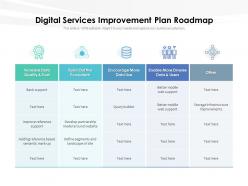
Digital services improvement plan roadmap





Try Before you Buy Download Free Sample Product
 Impress Your
 Audience
 100%
100% Editable
 Save Hours
 of Time


Convince folks you have catered for all contingencies with our Digital Services Improvement Plan Roadmap. It will address ill founded fears.
People who downloaded this PowerPoint presentation also viewed the following :
Digital services improvement plan roadmap with all 2 slides:
Identify ill founded fears with our Digital Services Improvement Plan Roadmap. Clearly indicate how they have cropped up.

FAQs for Digital services
Key components include strategic vision alignment, customer journey mapping, technology infrastructure assessment, resource allocation planning, and performance metrics definition. These elements work together by establishing clear priorities, identifying capability gaps, and creating phased implementation timelines, with many organizations finding that this structured approach delivers faster service delivery, reduced operational costs, and enhanced competitive positioning.
Businesses can identify priority digital services by assessing customer pain points, analyzing competitor offerings, evaluating internal capability gaps, and measuring potential ROI impact. Through strategic audits and stakeholder feedback, organizations streamline decision-making processes, enhance resource allocation, and accelerate implementation timelines, with many finding that customer-centric priorities deliver the strongest competitive advantage and operational efficiency.
Customer feedback serves as a critical foundation for digital services roadmaps by identifying pain points, prioritizing feature development, validating assumptions, and ensuring market alignment. Through systematic collection and analysis, organizations can pivot strategies, enhance user experiences, and allocate resources more effectively, with many companies finding that feedback-driven roadmaps deliver significantly higher adoption rates and customer satisfaction.
Emerging technologies significantly reshape digital services development by enabling enhanced personalization, streamlined automation, and improved user experiences through AI, IoT, blockchain, and cloud computing. These innovations allow organizations to create more responsive, scalable services while reducing operational costs, with sectors like healthcare, finance, and retail leveraging these capabilities to deliver faster, more efficient customer interactions and gain competitive advantage.
Key metrics include user adoption rates, service completion times, customer satisfaction scores, operational cost reductions, and digital channel usage percentages. These measurements enable organizations to track performance improvements, identify optimization opportunities, and demonstrate ROI, with many financial institutions and healthcare providers finding that comprehensive metrics frameworks ultimately deliver enhanced service quality and competitive positioning.
Organizations ensure alignment by establishing clear governance frameworks that connect digital initiatives to strategic business objectives, conducting regular cross-functional reviews between IT and business leadership, and implementing metrics that measure both technical progress and business value delivery. Through quarterly alignment assessments and stakeholder workshops, companies can maintain strategic coherence while adapting to market changes, ultimately ensuring their digital investments directly support revenue growth and competitive positioning.
Common challenges include aligning stakeholder expectations, managing resource constraints, adapting to rapidly changing technology landscapes, integrating legacy systems, and maintaining timeline flexibility while ensuring measurable outcomes. These obstacles often arise from inadequate cross-departmental communication, evolving customer demands, and competing priorities, with many organizations finding that strategic phased implementation and continuous stakeholder engagement ultimately streamline execution and deliver sustainable competitive advantage.
A digital services roadmap facilitates cross-departmental collaboration by establishing shared objectives, standardizing communication protocols, and creating unified project timelines across all teams. This strategic framework enables departments like IT, marketing, and operations to coordinate initiatives seamlessly, reduce resource conflicts, and accelerate project delivery, with many organizations finding significantly improved transparency and operational efficiency.
**INPUT**: What tools and frameworks are beneficial for visualizing a digital services roadmap? **OUTPUT**: Tools for visualizing digital services roadmaps include Roadmunk, ProductPlan, Aha!, Microsoft Visio, and strategic timeline frameworks like NOW-NEXT-LATER models. These platforms streamline roadmap creation by enabling collaborative planning, dependency mapping, and stakeholder alignment, with many organizations finding that visual roadmaps enhance communication and accelerate digital transformation initiatives.
A digital services roadmap should typically be reviewed quarterly and updated bi-annually, though dynamic markets may require more frequent adjustments based on technological developments, customer feedback, and competitive pressures. This regular review cycle enables organizations to adapt to emerging technologies, shifting user expectations, and market opportunities, while maintaining strategic alignment with business objectives, ultimately ensuring sustained digital transformation success.
Securing stakeholder buy-in requires clear communication of ROI projections, phased implementation timelines, and alignment with business objectives through regular workshops and feedback sessions. Organizations achieve success by demonstrating quick wins, establishing cross-functional governance committees, and providing comprehensive training programs, with many finding that transparent progress reporting and addressing specific departmental concerns ultimately delivers sustained engagement and strategic adoption across all organizational levels.
Organizations incorporate agility into digital services roadmap planning by implementing iterative development cycles, continuous feedback loops, flexible resource allocation, and adaptive milestone frameworks. Through agile methodologies, companies can pivot quickly based on market changes, customer insights, and technological advances, with many financial services and retail organizations finding that this approach reduces time-to-market and enhances competitive responsiveness.
Digital service scalability implications include infrastructure requirements, resource allocation strategies, performance optimization needs, cost management considerations, and integration complexity planning. These factors fundamentally shape roadmap prioritization by determining technical architecture decisions, timeline feasibility, and budget allocations, with many organizations finding that early scalability planning ultimately delivers faster market expansion and competitive advantage.
Cybersecurity considerations integrate into digital services roadmaps through threat assessments, compliance frameworks, security-by-design principles, and continuous monitoring protocols. Organizations embed these measures at every development phase, with financial institutions and healthcare providers finding that proactive security integration reduces vulnerabilities by 60% while accelerating service deployment timelines.
User experience serves as a critical prioritization filter for digital services roadmaps, influencing resource allocation, development sequencing, and feature selection based on customer pain points, usability metrics, and engagement data. Organizations increasingly prioritize services that deliver seamless interactions, reduce friction, and enhance satisfaction, with many finding that UX-driven roadmaps accelerate adoption rates and competitive differentiation.
No Reviews