


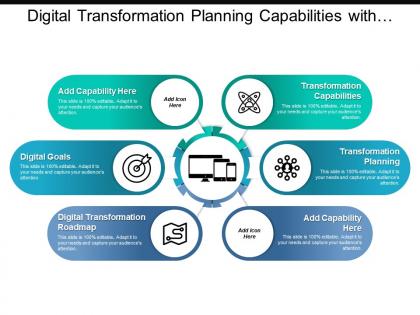
Digital transformation planning capabilities with circles and icons




Try Before you Buy Download Free Sample Product
 Impress Your
 Audience
 100%
100% Editable
 Save Hours
 of Time


Brilliant coverage is certain with our Digital Transformation Planning Capabilities With Circles And Icons. Enlightenment is assured for any audience.
People who downloaded this PowerPoint presentation also viewed the following :
Digital transformation planning capabilities with circles and icons with all 5 slides:
Create a gem of an idea with our Digital Transformation Planning Capabilities With Circles And Icons. Your brainwave will be a fabulous one.



FAQs for Digital transformation planning capabilities with
Key drivers include evolving customer expectations, competitive pressure, operational efficiency needs, data-driven decision requirements, and remote work demands. These forces compel organizations to modernize legacy systems, automate processes, and enhance digital capabilities, with many companies finding that strategic digital investments deliver improved customer experiences, reduced costs, and sustainable competitive advantage.
Organizations can effectively measure digital transformation success through key performance indicators like operational efficiency metrics, customer satisfaction scores, revenue growth from digital channels, employee productivity rates, and cost reduction percentages. These measurements enable companies to track progress across departments, with many enterprises finding that combining quantitative data with qualitative feedback delivers comprehensive insights, ultimately ensuring strategic alignment and competitive advantage.
Leadership drives digital transformation by establishing clear vision, securing necessary resources, fostering change-embracing culture, and ensuring cross-departmental alignment throughout implementation phases. Through strategic communication and commitment, executives enable organizations to navigate technological shifts more effectively, with many companies finding that strong leadership support accelerates adoption timelines, minimizes resistance, and ultimately delivers sustainable competitive advantages.
Companies ensure employee buy-in during digital transformation through comprehensive change management, transparent communication about benefits and timelines, hands-on training programs, and involving staff in solution selection processes. Organizations like banks implementing new customer service platforms and hospitals adopting electronic health records find that early employee involvement, addressing concerns proactively, and celebrating quick wins ultimately delivers smoother transitions and higher adoption rates.
Emerging technologies like AI and IoT fundamentally reshape digital transformation strategies by enabling predictive analytics, automated decision-making, real-time data collection, and enhanced customer personalization. These technologies streamline operations through intelligent automation and seamless connectivity, with organizations in healthcare, manufacturing, and retail finding that strategic integration delivers faster insights, reduced operational costs, and significantly improved competitive advantage.
Businesses maintain customer-centricity during digital transformation by prioritizing user experience design, collecting continuous feedback through digital touchpoints, and ensuring technology implementations directly address customer pain points. Through customer journey mapping and data analytics, organizations can streamline service delivery, personalize interactions, and enhance satisfaction levels, ultimately delivering faster response times and more intuitive experiences.
Common digital transformation challenges include employee resistance to change, legacy system integration complexities, insufficient digital skills, budget constraints, and unclear strategic vision. Organizations overcome these through comprehensive change management programs, phased technology migrations, targeted upskilling initiatives, and executive leadership alignment, with many finding that early wins and transparent communication ultimately deliver sustained adoption and competitive advantage.
Data analytics and insights drive digital transformation by identifying operational inefficiencies, predicting customer behaviors, and revealing market opportunities through comprehensive data examination. Through advanced analytics platforms, organizations streamline decision-making processes, optimize resource allocation, and enhance customer experiences, with many financial services and retail companies finding that data-driven insights ultimately accelerate transformation timelines while reducing implementation costs.
Best practices for integrating legacy systems include API development, middleware implementation, phased migration strategies, data mapping protocols, and cloud-based integration platforms. These approaches streamline operations by maintaining existing functionality while enhancing capabilities, with many financial institutions and healthcare organizations finding that strategic integration delivers improved efficiency, reduced operational costs, and enhanced customer experiences without disrupting critical business processes.
SMEs can approach digital transformation with greater agility and focus by prioritizing quick wins, leveraging cloud-based solutions, and implementing changes incrementally rather than enterprise-wide overhauls. While larger corporations require complex integration across multiple departments, smaller businesses can streamline operations more rapidly, often achieving faster ROI and competitive advantages through targeted automation and customer experience enhancements.
Digital transformation ethical considerations include data privacy protection, algorithmic bias prevention, employee displacement management, cybersecurity responsibilities, and transparent automation processes. Organizations must balance technological advancement with stakeholder trust, ensuring fair data usage, inclusive system design, and responsible workforce transitions, with many companies finding that proactive ethical frameworks ultimately enhance customer loyalty and competitive positioning.
Organizations foster innovation culture through leadership commitment, cross-functional collaboration, employee empowerment, continuous learning programs, and dedicated innovation time or resources. This approach enables teams to experiment with emerging technologies, streamline operational processes, and develop customer-centric solutions, with many companies finding that structured innovation initiatives ultimately deliver competitive advantage and accelerated digital adoption.
Collaboration tools serve as the backbone of digital transformation by streamlining communication, centralizing project management, enabling real-time document sharing, and facilitating remote work integration across distributed teams. These platforms enhance productivity by reducing email dependency, accelerating decision-making processes, and creating transparent workflows, with many organizations finding that strategic tool implementation delivers measurable efficiency gains and competitive advantage.
Businesses can ensure cybersecurity alignment by integrating security protocols into every transformation phase, conducting regular risk assessments, implementing zero-trust architectures, and establishing cross-functional security teams. Through strategic planning and continuous monitoring, organizations in sectors like banking, healthcare, and retail streamline security implementation while accelerating digital initiatives, ultimately delivering enhanced protection and operational efficiency.
**INPUT**: What are the future trends in digital transformation that companies should be aware of? **OUTPUT**: Future digital transformation trends include AI-powered automation, edge computing, hyper-personalization, sustainable technology integration, and seamless omnichannel experiences. These technologies streamline operations by enhancing customer interactions, optimizing resource allocation, and accelerating decision-making processes, with many organizations finding that strategic adoption delivers significant competitive advantages and operational efficiency. [Word count: 54 words]
-
Graphics are very appealing to eyes.
-
Designs have enough space to add content.